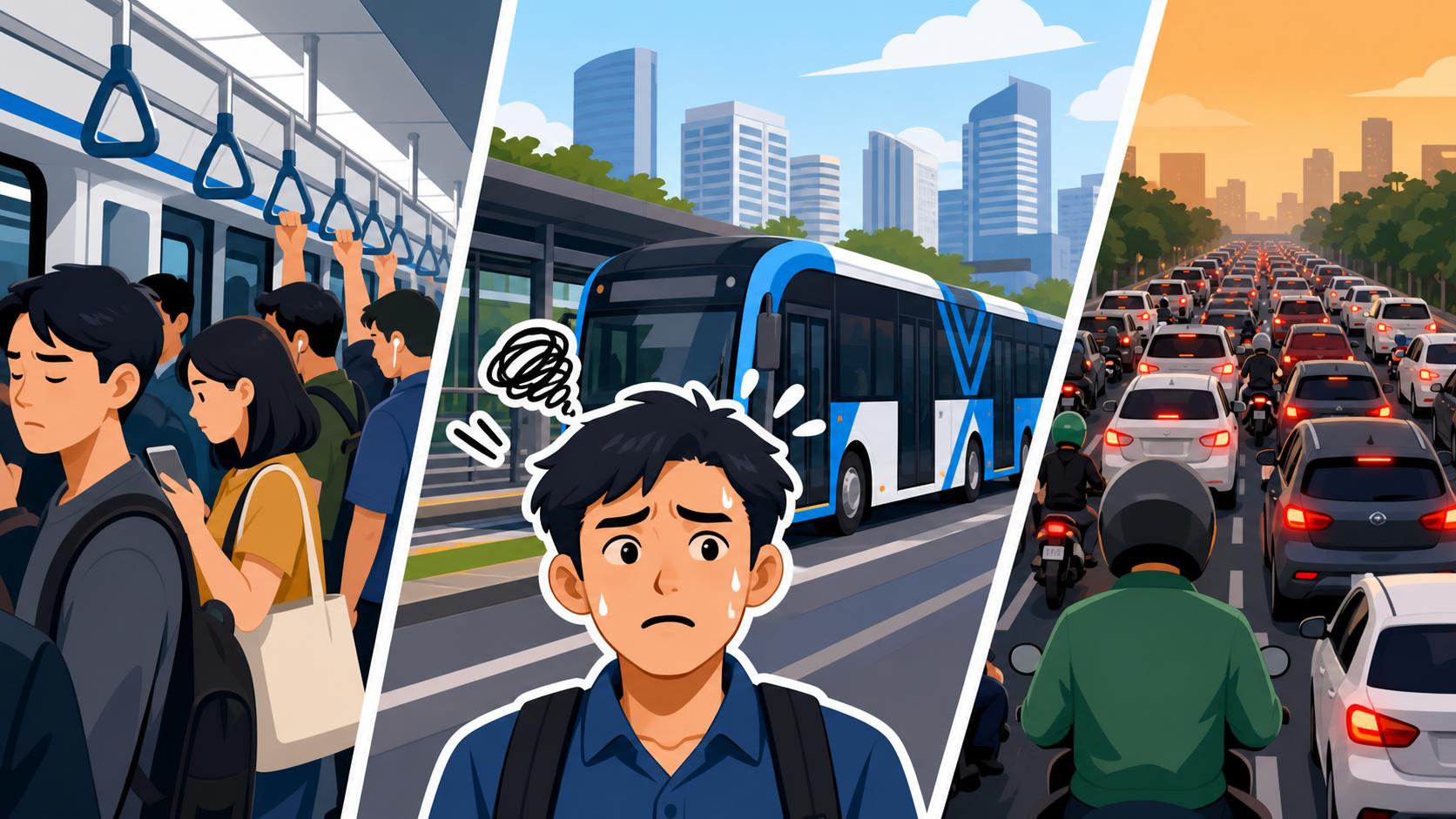
Commuting in Jakarta: Surviving the MRT, TransJakarta, and Macet (Traffic)
Imagine sitting in a stationary taxi on Jalan Sudirman, watching a delivery driver on a motorbike weave through a gap no wider than a toaster while the tropical rain hammers on your roof. I spent three hours in that exact spot during my first week in the city, missing a crucial meeting and questioning every life choice that led me here. This guide solves the riddle of Jakarta’s movement, teaching you how to master the MRT, decode the TransJakarta busway, and survive the legendary "macet" without losing your mind.
The Reality of Macet and the Ganjil Genap Rule
If you are Working in Jakarta: SCBD Salaries, Commuting, and Corporate Lifestyle, your first lesson will be that time is a fluid concept. The word "macet" (traffic jam) is the universal excuse for everything in Indonesia. It is not just a nuisance; it is a structural reality that dictates where you live, where you eat, and how you socialized. When I first arrived, I tried to fight the traffic by leaving earlier or later, but the city always seemed to stay one step ahead.
One of the most confusing aspects for new arrivals is the "Ganjil-Genap" or Odd-Even rule. This policy restricts certain major thoroughfares—like Sudirman, Thamrin, and Gatot Subroto—to cars with license plates ending in either an odd or even digit, depending on the date. It operates during morning and evening rush hours. If you have an even plate on an odd-numbered day, you will be flagged down by the police or caught by the pervasive E-TLE (Electronic Traffic Law Enforcement) cameras. When I was Job Hunting in Indonesia: Market Insights for English-Speaking Professionals, I once forgot this rule and ended up with a hefty fine that wiped out my lunch budget for a week.
To navigate this, most expats rely heavily on navigation apps like Google Maps or Waze, which have "Ganjil-Genap" settings. However, even with technology, you must understand the cultural layer of commuting. High-pressure environments often expect you to be at your desk by 8:00 AM, but "Jam Karet" (rubber time) means that if a massive storm hits, half the office might be an hour late. Understanding these nuances is easier if you are Learning Bahasa Indonesia: BIPA Certification, Tutors, and Workplace Usage, as you can listen to the radio traffic updates. Using a resource like IndonesianPod101 can help you pick up specific commuting vocabulary, such as "jalur alternatif" (alternative route) or "mogok" (broken down), which are essential when communicating with drivers.
The Psychology of the Jakarta Commuter
There is a specific mental state required to survive the Jakarta commute. You will see people sleeping on buses, watching entire movies on their phones in stationary cars, and eating breakfast out of plastic bags on the back of motorbikes. The key is "sabar" (patience). If you fight the traffic mentally, you will burn out within a month.
I learned early on that the commute is actually a great time to be productive if you aren't the one driving. This is when I would use IndonesianPod101 to practice my listening skills, turning a frustrating two-hour crawl into a language lab. Since Indonesian Work Culture: Communication, Hierarchy, and Career Dynamics often involves indirect feedback and "saving face," being able to understand the subtle cues in a conversation is a massive advantage that you can cultivate while sitting in the back of a Bluebird taxi.
Planning Your Life Around Peak Hours
The "peak" in Jakarta isn't just an hour; it is a window. Generally, 7:00 AM to 9:00 AM and 4:30 PM to 8:00 PM are the danger zones. If it rains, all bets are off. Rain in Jakarta doesn't just wet the roads; it causes localized flooding that can turn a 30-minute trip into a four-hour odyssey.
When choosing Where to Live in Jakarta: Neighborhood Guide for Expat Families and Singles, always prioritize proximity to your workplace or a reliable transit line. I once lived in Kemang while working in the SCBD. On paper, it’s a short distance, but the "macet" in the narrow alleys of Kemang meant I was spending 10 hours a week just looking at the bumper of the car in front of me. Moving closer to an MRT station was the single best decision I made for my mental health.
The Modern Savior: Navigating the Jakarta MRT and LRT
The opening of the MRT (Mass Rapid Transit) in 2019 was a literal life-changer for the city. It is clean, incredibly punctual, and air-conditioned to the point of being chilly—a welcome relief from the 33-degree humidity outside. Currently, the North-South line runs from Lebak Bulus in South Jakarta to Bundaran HI (the Hyatt/Kempinski roundabout) in the center.
The MRT is the gold standard for Commuting in Jakarta: Surviving the MRT, TransJakarta, and Macet (Traffic). For example, a trip from Fatmawati to Senayan that would take 90 minutes by car during rush hour takes exactly 20 minutes on the MRT. The stations are modern and well-maintained, with clear English signage. If you are a woman commuting alone, you should know that during peak hours, the first and last carriages are designated for women only. It’s a safer, more comfortable space that many of my female expat friends swear by.
Ticketing and the Multi-Trip Card vs. Apps
You have a few choices for paying your fare. You can buy a "Single Trip" ticket at a kiosk, but that's a rookie move. It involves queuing every single time. Instead, get a "Multi-Trip" card (MTI) at the station or use an electronic money card from a bank (like BCA Flazz, Mandiri e-money, or BNI TapCash). These bank cards are the Swiss Army knives of Indonesia; you use them for the MRT, the LRT, the TransJakarta, and even for paying tolls and parking.
Alternatively, the MRT Jakarta app is quite robust. You can link it to digital wallets like Blue (by BCA) or AstraPay and just scan a QR code at the gate. I personally prefer the physical bank card because if your phone battery dies—which happens often in the heat—you aren't stranded behind the turnstile. If you ever run into trouble at the gates, knowing a few phrases from IndonesianPod101 like "Kartu saya tidak bisa" (My card isn't working) will get the attendant to help you much faster than gesturing wildly.
The LRT and the "Last Mile" Problem
The LRT (Light Rail Transit) is the newer sibling to the MRT, connecting the suburbs like Bekasi and Cibubur to the city center. While the MRT is deep underground or high above the main roads, the LRT feels like a scenic tour of the city's skyscrapers. The main hub is Dukuh Atas, which is a massive interchange where the MRT, LRT, Commuter Line (KRL), and TransJakarta all meet.
The challenge with the MRT and LRT is the "last mile"—the distance from the station to your actual office or home. Jakarta is not a walkable city. The sidewalks are often uneven, blocked by food vendors (kaki lima), or non-existent. This is where you integrate the "Ojek" (motorbike taxi). You step off the train, open your Gojek or Grab app, and a driver will be waiting at the designated "Point" to take you the final kilometer.
TransJakarta: The World's Longest Bus Rapid Transit System
Before the MRT, we had the "Busway." TransJakarta is a massive network of buses that run in dedicated lanes, separated from the main traffic by concrete barriers. It is remarkably cheap (usually around IDR 3,500 per trip) and covers almost every corner of the city. However, it requires a bit more "street smarts" than the MRT.
The beauty of the TransJakarta is that while the cars are stuck in a total standstill, the bus zooms past in its own lane. But there’s a catch: at intersections, the bus has to wait for the same traffic lights as everyone else, and private cars often "leak" into the busway lane, causing delays. During the Cost of Living in Jakarta 2026: Rent, Schooling, and Lifestyle Benchmarks assessment, many expats overlook the TransJakarta because it looks crowded, but it is an essential part of the transit puzzle.
Navigating the Dedicated Lanes and Hubs
To use TransJakarta, you must have an electronic money card (like the ones used for the MRT). You tap in at the station—which is usually a raised platform in the middle of the road accessed via a long pedestrian bridge—and tap out when you leave. Some stations, like the newly renovated ones at Bundaran HI or Sarinah, are beautiful architectural landmarks with viewing decks.
The "corridors" are the main routes. Corridor 1 (Blok M to Kota) is the most popular for expats as it runs right through the heart of the business district. If you are heading to a meeting in Kuningan or Gatot Subroto, the busway is often faster than a private car. Just be prepared for the "desak-desakan" (jostling) during rush hour. It is a very "local" experience, and you will likely be the only foreigner on the bus, which is a great opportunity to observe the city's daily rhythm.
Essential Safety Tips for Bus Commuters
While generally safe, pickpockets do operate on crowded buses. Always wear your backpack on your front. I’ve seen seasoned expats lose their iPhones in the time it took to step from the platform onto the bus. Also, be mindful of the "women-only" section at the front of the bus. If you are a man and you accidentally stand there, the "Petugas" (attendant) will politely but firmly ask you to move to the back.
Language can be a barrier here, as the stops are announced in Indonesian. Using IndonesianPod101 to learn numbers and directions is vital. Knowing that "Kiri" is left and "Kanan" is right helps when you are looking at the maps on the bus walls. If you are feeling unwell and need to take Sick Leave (Cuti Sakit) in Indonesia: How to Get a Surat Keterangan Dokter, the last place you want to be is a crowded TransJakarta bus, so knowing how to call a car instead is just as important.
Micro-Mobility and App-Based Transport: Gojek and Grab
You cannot talk about Commuting in Jakarta: Surviving the MRT, TransJakarta, and Macet (Traffic) without mentioning Gojek and Grab. These are not just "Uber for Indonesia"; they are lifestyle platforms. For the daily commuter, the "Gojek/Grab Point" is the most important landmark in any office building or mall.
When the traffic is "total" (completely stopped), the only thing that moves is the motorbike taxi, or "Ojek." It is the ultimate Jakarta hack. It’s not for the faint of heart—you will be weaving through lanes, breathing in exhaust fumes, and potentially getting caught in a sudden downpour—but it will get you to your destination when nothing else can.
Ojek vs. Car: When to Choose Two Wheels
Choosing between a GoCar/GrabCar and a GoRide/GrabBike is a strategic decision. If you have a formal meeting and need to keep your hair and suit pristine, take the car. If you are GoCar vs GrabCar vs Bluebird: Which is Safest and Most Reliable in Jakarta?, you'll find that Bluebird taxis are often the most professional, but Grab and Gojek offer fixed prices which are great for budgeting.
However, if you are 15 minutes late for a flight and the toll road to Soekarno-Hatta is a parking lot, you get on the back of a bike. I always keep a "masker" (face mask) in my bag to protect against the pollution and a light raincoat. Most drivers provide a helmet, but if you commute this way daily, I highly recommend buying your own helmet for hygiene and safety reasons.
Safety and Etiquette with Online Drivers
Indonesian drivers are generally very friendly, but there is a specific etiquette. When your driver arrives, it's polite to offer a "Siang, Pak" (Good day, Sir). If they have to wait for you, a small tip (IDR 5,000 to 10,000) goes a long way. The app handles the payment via GoPay or OVO, but cash tips are always appreciated.
Safety is a concern, especially with the "Ojek" weaving. Don't be afraid to say "Pelan-pelan, Pak" (Slowly, please) if you feel they are being too aggressive. Using IndonesianPod101 to master these polite commands is a lifesaver. Most accidents happen because of speed and unpredictable lane changes, so being an active passenger is okay.
Comparison of Jakarta Transit Options
| Mode of Transport | Best For | Average Cost (USD) | Pros | Cons |
|---|---|---|---|---|
| MRT | North-South Commutes | $0.30 – $0.90 | Punctual, AC, Modern | Limited Routes |
| TransJakarta | Budget / Long distance | $0.23 (Flat) | Dedicated Lanes, Cheap | Crowded, Intersections |
| Ojek (Bike) | Speed / Short Distance | $1.00 – $3.00 | Beats Traffic, Mobile | Pollution, Rain, Safety |
| Taxi / GrabCar | Comfort / Meetings | $3.00 – $15.00 | Private, AC, Clean | Stuck in Traffic, Tolls |
| KRL (Commuter) | Suburb to Center | $0.20 – $0.50 | Very Fast, Huge Network | Extremely Crowded |
Practical Tips for the Daily Commute
To truly survive, you need a "commuter kit." This should include a power bank (navigation apps drain batteries), a reusable water bottle, a small umbrella, and a "masker." If you are a newcomer, the air quality can be a shock, and wearing a high-quality mask while on an Ojek is not just for COVID—it’s for your lungs.
Another tip is to "bundle" your activities. If you have a meeting in the SCBD, don't try to go back to your office in North Jakarta immediately after. Find a co-working space or a cafe and wait out the 5:00 PM rush. The difference in travel time between 5:30 PM and 8:00 PM can be two hours. I used those "wait out the traffic" sessions to listen to IndonesianPod101 lessons, which turned dead time into productive growth.
Lastly, pay attention to the "Bluebird" phenomenon. While Grab and Gojek are great, Bluebird taxis have a "Silver Bird" tier (usually Mercedes or Toyota Alphards) that can use some of the busway lanes in very specific circumstances or provide a much higher level of comfort if you are stuck for hours. They are more expensive but worth it when you are exhausted and just want to get home safely.
Final Thoughts on Jakarta Mobility
Surviving the commute in Jakarta is a rite of passage. Once you’ve navigated the Dukuh Atas interchange at 6:00 PM on a rainy Friday, you can truly call yourself a Jakartan. It’s a city that rewards those who are flexible. Don't get married to one mode of transport; use the MRT when you can, the Ojek when you must, and the taxi when you need a break.
The infrastructure is improving every year. With the expansion of the MRT Phase 2 and the integration of the LRT, the days of the 3-hour "macet" are slowly—very slowly—being numbered. Until then, keep your GoPay topped up, your noise-canceling headphones charged, and your "sabar" levels high.
Disclaimer
This guide is for informational purposes only. Traffic regulations, fare prices, and transit routes in Jakarta are subject to frequent changes by the provincial government (DKI Jakarta) and relevant transport authorities. While every effort has been made to ensure accuracy for 2026, always verify current "Ganjil-Genap" zones and operational hours via official apps like Jaki or the MRT Jakarta website before traveling. The author is not responsible for any fines, delays, or safety incidents incurred while following these suggestions.