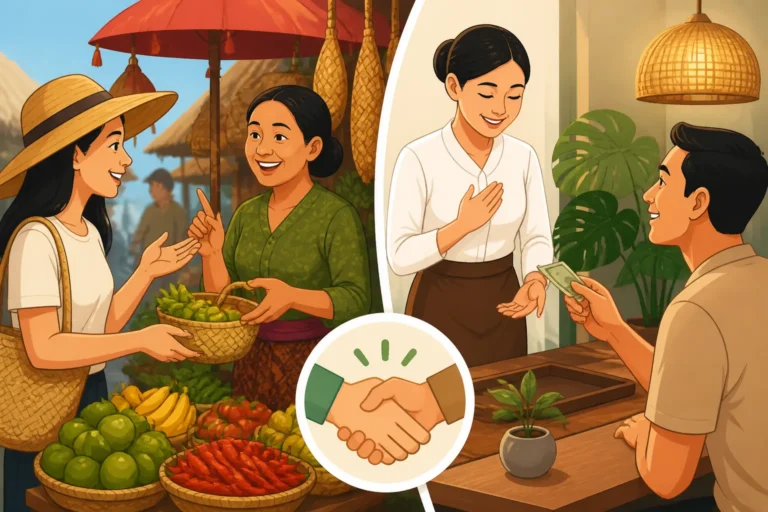
Navigating the Traditional Market (Pasar Tradisional) Early Morning Rush
Navigating an Indonesian traditional market for the first time feels like being dropped into a high-speed game of Tetris where the blocks are sacks of shallots and the soundtrack is a dozen people shouting prices at once. I remember my first dawn visit to Pasar Santa, where I stood paralyzed by the sheer volume of activity while a grandma twice my age nimbly bypassed me with a basket of ginger on her head. This guide breaks down the chaos so you can navigate the early morning rush like a local, save money, and get the freshest ingredients available.
Decoding the Timing and Culture of the Pasar Tradisional
To understand the traditional market, you have to understand the Indonesian clock. Life in the archipelago starts early, often before the first call to prayer at dawn. By the time the sun is fully up, the best produce is already gone. If you show up at 9:00 AM expecting a vibrant scene, you will likely find wilted greens, picked-over fish, and sellers who are already packing up for a nap.
The 4 AM Gold Rush
The real "rush" happens between 4:00 AM and 6:30 AM. This is when the pedagang sayur (mobile vegetable vendors) descend on the market to stock their carts before heading into residential neighborhoods. If you want the absolute best pick of the kangkung (water spinach), the firmest tahu (tofu), or the freshest catch from the coast, this is your window. During these hours, the market is a logistics hub. Huge trucks unload crates of bird’s eye chilies, and the air is thick with the scent of raw spices and diesel.
For an expat, this early start can be a shock to the system. I’ve found that the best way to handle this is to treat it like a mission. Use a service like Agoda to find a stay near a major market if you are just moving in and want to scout neighborhoods. Being within walking distance of a pasar changes your entire relationship with food and community. You begin to recognize the rhythm of the neighborhood, and more importantly, the sellers begin to recognize you.
Why Late Means 8 AM
By 8:00 AM, the market transitions into a different phase. The frantic energy of the wholesale buyers has dissipated, and it becomes a place for casual neighborhood shoppers and those looking for household goods rather than perishables. While it is less stressful, the quality of fresh goods drops significantly. The heat of the Indonesian sun begins to take its toll on leafy greens, and the "wet" section (meat and fish) becomes increasingly fragrant in a way that might challenge a newcomer's stomach.
If you are trying to manage your Monthly Grocery Budgets: Local Markets (Pasar) vs Expat Supermarkets (Grand Lucky), showing up at 8:00 AM might actually get you some "clearance" prices, but at the cost of quality. If you are looking for specific imported items, you won't find them here—traditional markets are for local, seasonal staples. For anything else, you might find yourself browsing Shopee later that afternoon for those hard-to-find kitchen gadgets or specialty oils.
Essential Gear and Logistics for the Dawn Market Visit
You cannot approach a pasar tradisional the same way you approach a gleaming supermarket in a mall. The floors are often damp, the aisles are narrow, and space is at a premium. Preparation is the difference between a successful haul and a miserable, muddy morning.
The Expat Market Uniform
First and foremost: wear closed-toe shoes with good grip. The "wet market" is called that for a reason. Water from fish crates and melting ice often slicks the floor, and you do not want to be navigate these puddles in flip-flops. Beyond footwear, modesty is key. Even in more liberal areas like Bali, the market is a traditional space. Following the guidelines in Dressing Modestly: What 'Sopan' Means Outside of Beach Resort Areas will ensure you receive more respect and potentially better pricing from the vendors.
I always recommend bringing your own reusable bags—specifically the heavy-duty ones. The small plastic bags (kresek) provided by vendors are notoriously thin and prone to breaking at the most inconvenient times. Carrying a sturdy backpack is also a pro-tip, as it keeps your hands free for inspecting produce and handling cash.
Transport and Staying Connected
Parking at a traditional market is almost always a nightmare. If you have your own car, you will likely spend more time navigating the gridlock of delivery trucks than actually shopping. The most efficient way to get there is by using Navigating Gojek and Grab: Food Delivery, Transport, and Package Courier. A motorbike taxi can zip through the narrow entryways and drop you right at the gate.
While you’re in the thick of it, you’ll want your phone ready to check prices or translate the names of exotic fruits. Using a local SIM or an Airalo eSIM ensures you have a stable data connection even in the middle of a crowded, concrete market hall where public Wi-Fi is non-existent. Trust me, being able to quickly Google a picture of "galangal" versus "ginger" while a vendor stares at you is a lifesaver.
Mastering the Art of Negotiation Tawar Menawar
One of the biggest hurdles for foreigners is the lack of fixed prices. In a pasar, the price is often determined by the relationship between the buyer and the seller, the time of day, and yes, your perceived ability to pay.
The Unspoken Rules of Pricing
Negotiation, or tawar-menawar, is expected, but it must be done with a smile. It is a social interaction, not a combat. Start by asking "Berapa harganya?" (How much is this?). If the price feels high, you can counter with a lower offer, but don't go lower than 50-70% of the initial ask. If you go too low, it’s considered insulting.
Remember that for many vendors, a few thousand Rupiah makes a big difference to their daily margin, while for you, it might be the cost of a single coffee. Referencing Tipping and Haggling: Navigating Markets (Pasar) and Service Industries can give you a better sense of when to push for a discount and when to just pay the "expat tax" gracefully. Over time, as you become a langganan (regular), the prices will naturally drop without you having to ask.
Useful Phrases and Etiquette
Language is your best tool for getting a fair price. Even a few words of Bahasa Indonesia go a long way in showing that you aren't just a tourist passing through. Using proper titles like "Ibu" (for women) and "Bapak" (for men) is essential for showing respect. This falls under the broader umbrella of Everyday Etiquette: Religion, Culture, Garbage, and Community Norms, where showing "sopan" (politeness) can actually save you money.
| Common Item | Local Name | Typical Price Unit | Negotiation Potential |
|---|---|---|---|
| Chili (Small/Hot) | Cabai Rawit | per 100g / 1 Ons | Low (Market price fluctuates daily) |
| Eggs | Telur Ayam | per kg | Very Low (Fixed by weight/market) |
| Spinach | Bayam / Kangkung | per bunch (ikat) | Low (Usually IDR 2,000 – 5,000) |
| Chicken | Ayam Potong | per kg or per bird | Moderate |
| Fruit (Mango/Salak) | Buah-buahan | per kg | High (Especially if buying in bulk) |
When you are communicating, keep it simple. If you are there for business-related sourcing, you might need a more formal approach, as detailed in Bahasa Indonesia for Business: Kehormatan, Emails, and Meeting Etiquette, but for the morning market, "friendly and casual" is the winning strategy.
Navigating the Layout and Produce Quality
Most traditional markets follow a loose internal logic. The outer perimeter is usually reserved for dry goods, clothing, and household items. The deeper you go, the "wetter" it gets.
Identifying the Freshest Sections
The produce section is usually the heart of the market. Look for vendors where the vegetables still have soil on them or are being misted with water. One trick I learned early on is to watch where the local restaurant owners are buying. If a particular Ibu has a line of people waiting for her spinach, there is a reason for it.
The meat and fish sections require a bit more scrutiny. Because refrigeration is often minimal or non-existent in smaller markets, you must rely on your senses. Fish should have clear eyes and bright red gills. Meat should be vibrant in color and firm to the touch. If you are worried about food safety, especially in your first few months, it is worth reading up on Bali Belly and Food Safety: Avoiding and Treating Stomach Bugs to understand how to properly clean and prep market-bought meat.
The Community Aspect of the Pasar
The market isn't just a place to buy food; it’s the social heart of the neighborhood. This is where news is traded, and where you, as an expat, will likely be asked many questions about your life. "Sudah makan?" (Have you eaten yet?) and "Dari mana?" (Where are you from?) are standard greetings. Embracing this social side makes the experience far more rewarding.
If you are keeping an eye on your Cost of Living in Jakarta 2026: Rent, Schooling, and Lifestyle Benchmarks, you’ll find that shopping at the pasar can reduce your food expenses by 30-50% compared to high-end supermarkets. It takes more effort and an earlier alarm clock, but the quality of a sun-ripened mango bought for cents is incomparable to the refrigerated versions in the mall.
Health and Safety Considerations for Newcomers
While the traditional market is a wonderful cultural experience, it does come with certain realities that might be jarring. The lack of standardized hygiene can be a concern for those with sensitive health.
I always suggest having a small "market kit" in your bag: hand sanitizer, a small pack of tissues (since market toilets are famously basic), and plenty of small change. Many vendors struggle to break a 100,000 Rupiah note at 5:00 AM. Having a stash of 2,000, 5,000, and 10,000 notes will make your transactions much smoother. If you are still setting up your life here, check the Health Checklist for Your First 30 Days in Jakarta or Bali to ensure you have all your vaccinations and basic medications sorted before diving into the more rustic parts of Indonesian life.
In the end, the early morning rush at the pasar tradisional is a rite of passage. It’s loud, it’s messy, and it’s undeniably beautiful in its raw efficiency. Once you’ve successfully navigated the aisles, haggled for your first kilo of mangosteens, and shared a laugh with a spice vendor, you’ll stop feeling like a visitor and start feeling like a resident.
Disclaimer
The information provided in this guide is based on personal expat experiences and local market conditions as of 2026. Prices, market hours, and regulations in Indonesia can change frequently. Readers are encouraged to verify specific local details and exercise personal judgment regarding food safety and hygiene when shopping at traditional markets.