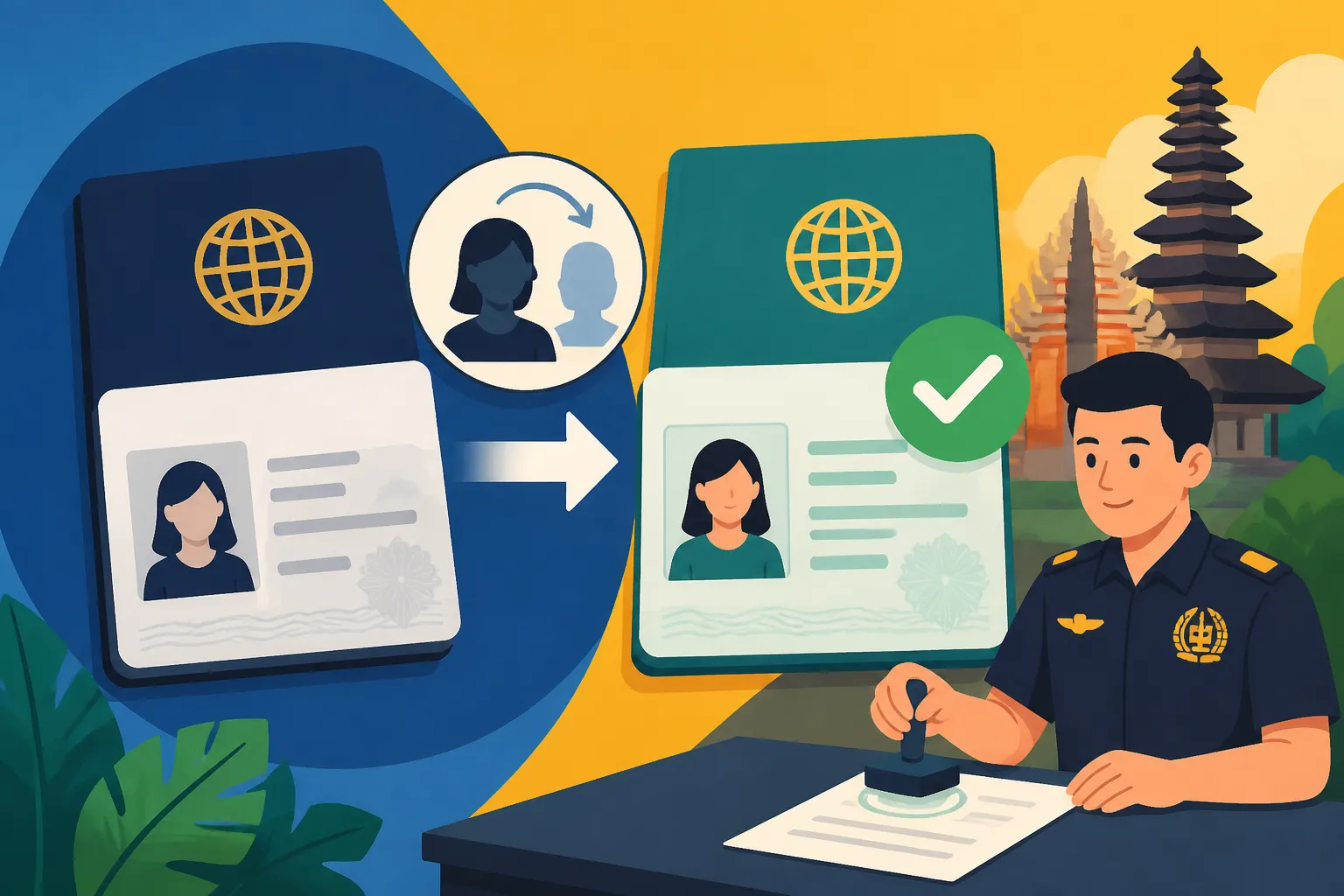
Name Changes on Foreign Passports: Updating Indonesian Immigration Records
Changing your name while living in Indonesia turns a simple passport renewal into a bureaucratic nightmare because Indonesian systems are built on rigid data matching. I once spent three days running between offices because my marriage certificate didn't have the "right" stamp for my new surname. This guide solves exactly how to synchronize your new passport with your Indonesian records.
Why a Name Change Is a High Stakes Administrative Event in Indonesia
In many Western countries, carrying a marriage certificate alongside an old passport is often enough to prove your identity during a transition period. In Indonesia, this logic does not apply. The Indonesian immigration system, known as SIMKIM, relies on a 1:1 match between your passport number, your full name, and your biometric profile. When you show up with a new passport featuring a different name, the system effectively sees a different person.
The trouble usually starts at the most inconvenient times, such as when you are trying to check in for an international flight or when your HR department attempts to process your annual tax filings. If your name on your KITAS Explained: Working, Dependent, and Investor Temporary Stay Permits does not match your current travel document, you are technically in violation of your stay permit conditions. Indonesian officials are generally polite but extremely literal when it comes to documentation. A missing middle name or a hyphenated surname that wasn't there before can trigger a secondary inspection at the airport, leading to missed flights and unnecessary stress.
Furthermore, ignoring this update affects more than just your visa. Your bank accounts, property leases, and health insurance policies are all tied to the name on your initial registration. If you find yourself in a medical emergency, a name mismatch between your passport and your policy with Cigna Global could cause delays in payment guarantees. It is far better to navigate the red tape now than to deal with a frozen bank account or a rejected insurance claim later.
Immediate Steps After Receiving Your New Passport
The moment you have that crisp new passport in your hand, the clock starts ticking. Technically, any change in your civil status or identity documents must be reported to the Indonesian authorities within a specific timeframe—usually 14 to 30 days, depending on the specific immigration office’s local policy. The first thing you must do is ensure you have a "Statement of Name Change" or a similar official document from your embassy.
You cannot simply walk into a Kantor Imigrasi and tell them you’ve changed your name. You need proof that is recognized under Indonesian law. If your name change is due to marriage or divorce, your embassy must provide a letter stating that "Passport Number A (Old Name) and Passport Number B (New Name) belong to the same individual." This letter is the golden key to the entire process. Without it, you will likely be sent back and forth between the embassy and the immigration office.
While you are waiting for embassy appointments, you can use online tools like iVisa to check the current status of your electronic visa records. Having a printout of your current e-visa status can help officers locate your file faster once you arrive at the immigration office. Remember, you aren't just updating a sticker; you are migrating an entire digital history from one identity to another.
Required Documentation for the Update Process
The list of required documents for a name change is extensive and must be organized meticulously. Indonesian immigration offices rarely accept digital copies; they want physical folders (usually a specific color like red or yellow, which you can buy at the "Koperasi" shop inside the office) with original documents and photocopies.
The most critical part of your dossier will be the legal proof of the name change. If this document was issued outside of Indonesia, it must be properly legalized. This often involves an apostille or a stamp from the Indonesian embassy in your home country. You should check the latest rules on Consular Legalization vs Apostille: Indonesia’s New Apostille Rules Explained to see if your home country's documents require the extra step of legalization.
Additionally, any document not in English or Indonesian must be translated. You cannot do this yourself. You must use Certified Translators (Penerjemah Tersumpah) for Immigration Documents to ensure the translation is legally binding in an Indonesian court or government office. Services like RushTranslate are excellent for getting these documents prepared quickly and accurately before you head to your appointment.
Documentation Checklist for Name Change Updates
| Document Type | Specific Requirement | Notes |
|---|---|---|
| New Passport | Original + Photocopy of all pages | Must have at least 18 months validity |
| Old Passport | Original + Photocopy of ID page | Contains the original visa/KITAS entry |
| Embassy Letter | Original with official seal | Must link the old name to the new name |
| Marriage/Divorce Decree | Legalized or Apostilled copy | Proof of the legal basis for the change |
| Certified Translation | Translated into Bahasa Indonesia | Must be from a sworn translator |
| Current KITAS/KITAP | Original and PDF copy | Your current stay permit proof |
| Domicile Letter | Issued by the local Kelurahan | Proof of where you currently live |
The Mutasi Passport and Data Update Procedure
The official term for this process is "Mutasi Data Passport." This is the administrative bridge that moves your legal residency status from your old name to your new one. You will need to visit the specific immigration office that issued your current KITAS or KITAP. You cannot do this at a different branch just because it is closer to your new house.
Once you arrive, you will fill out the Perdim forms (the standard immigration application forms). Be very careful to write your name exactly as it appears in the new passport—every dot and space matters. After submitting your folder, you will be given a receipt and told to return for "Photo and Biometrics." Even though they already have your fingerprints from your previous visa, a name change often requires a fresh set of biometrics to "seal" the new identity in the system.
During this process, be prepared for a brief interview. The officer might ask why you changed your name. If it was a Spouse Sponsored KITAS: Marrying an Indonesian Citizen and Work Rights, they may ask for updated details about your spouse. If the change followed a legal separation, you should be prepared for how Divorcing an Indonesian Citizen: What Happens to Your Spouse KITAS/KITAP might affect your long-term residency. The goal is to prove that the person standing in the office is the same person who was originally granted the right to stay in the country.
Updating Secondary Records at the Civil Registry
Updating your passport and visa is only half the battle. Once your KITAS or KITAP reflects your new name, you must cascade this change down to the local civil records. In Indonesia, this involves a trip to the Disdukcapil (Department of Population and Civil Registration). This is where you update your SKTT (Temporary Resident Card) or your KTP WNA (Foreigner ID Card): Why Banks Will Ask You For It.
The Civil Registry is often more rigid than immigration. They will require the updated KITAS and the embassy letter. This step is vital because your KTP-WNA or SKTT is what you use for "everyday" life—buying a vehicle, getting a local driver’s license, or registering a phone SIM card. If your KTP-WNA has your old name but your passport has the new one, you will find yourself blocked from almost all digital services in Indonesia.
The process at The Civil Registry (Catatan Sipil): SKTT and KTP WNA Explained can take anywhere from a few days to two weeks. I recommend getting multiple "certified true copies" (legalisir) of the new documents once they are issued. You will need them for the next phase: the banks and insurance companies.
Financial and Professional Notifications
With your new passport, updated KITAS, and new KTP-WNA in hand, you must now tackle your financial footprint. Indonesian banks are notoriously strict about Know Your Customer (KYC) regulations. If you try to wire money out of the country and the name on your bank account doesn't match the name on your passport, the transaction will likely be flagged and frozen for security reasons.
Take a day to visit your bank branch in person. Bring all your old and new documents. The bank will need to scan your new KTP-WNA and may require a copy of the "Mutasi" letter from immigration. This is also the time to update your tax ID (NPWP). Since 2024, Indonesia has been integrating the NIK (National Identity Number) with the NPWP, so ensuring your name is correct at the Civil Registry should, in theory, make the tax update easier, but it still requires a manual check at the tax office (Kantor Pajak).
Finally, don't forget your workplace. Your HR department needs to update your Renewing Your KITAS: Timelines, Police Certificates (SKLD), and Paperwork files and your BPJS (Social Security) records. If your BPJS name is incorrect, you might face issues at the hospital during the registration process. It is a domino effect; one incorrect name at the top of the chain can cause the entire system of your life in Indonesia to stall.
Comparison of Handling the Update Solo vs Using an Agent
Many expats wonder if they should handle this themselves or hire a "Biro Jasa" (Immigration Agent). While it is entirely possible to do it yourself, a name change involves more nuance than a standard renewal.
| Factor | Doing It Yourself (DIY) | Using a Professional Agent |
|---|---|---|
| Cost | Minimal (only official fees) | Significant service fees (IDR 2-5 million) |
| Time | Requires 3-4 visits to various offices | Usually only 1 visit for biometrics |
| Complexity | You must handle all translations and queuing | Agent handles all prep and document filing |
| Risk | High chance of rejection due to paperwork errors | Lower risk as they vet documents beforehand |
| Language | Requires basic to intermediate Bahasa Indonesia | Agent acts as your translator and liaison |
If your name change is straightforward (e.g., marriage), DIY is manageable if you have the patience. However, if your name change involves a complex legal decree or if you are in the middle of a job change, an agent can save you weeks of headaches.
Important Disclaimer
The information provided in this guide is for general informational purposes only and is based on personal expat experiences and current administrative practices in Indonesia. Immigration laws, provincial regulations, and documentation requirements in Indonesia are subject to frequent and unannounced changes. We strongly recommend consulting with the official Indonesian Directorate General of Immigration or a qualified legal professional before submitting any applications. We are not a government entity and cannot guarantee the approval of any visa or record update.