The Evolving Role of AI and Automation in Indonesian Corporate Offices
Navigating the rapid shift toward AI in Jakarta’s corporate scene often feels like trying to drive a high-tech electric vehicle through a flooded street in Kemang—it is exciting, yet incredibly prone to unexpected hurdles. I remember sitting in a boardroom in the Sudirman Central Business District (SCBD) just a few years ago, watching a team of interns manually cross-reference paper receipts with Excel spreadsheets while the world outside was already whispering about Generative AI. This guide solves the confusion around how automation is actually landing in Indonesian offices and what you must do to remain indispensable in a 2026 workforce.
From Paper Trails to Processing Power: The Digital Shift
The evolution of the Indonesian office has never been a straight line. For years, the corporate world here was defined by "tumpukan kertas" (piles of paper) and the necessity of physical stamps (stempel). However, Indonesia has a unique habit of "leapfrogging" technology. Just as many Indonesians skipped owning a landline or a desktop computer to go straight to mobile smartphones, local companies are now skipping legacy software and jumping straight into AI-driven cloud solutions. This shift is most visible in the major hubs of Jakarta, Surabaya, and even the growing tech scene in Bali.
The Leapfrog Effect in Jakarta’s Business Districts
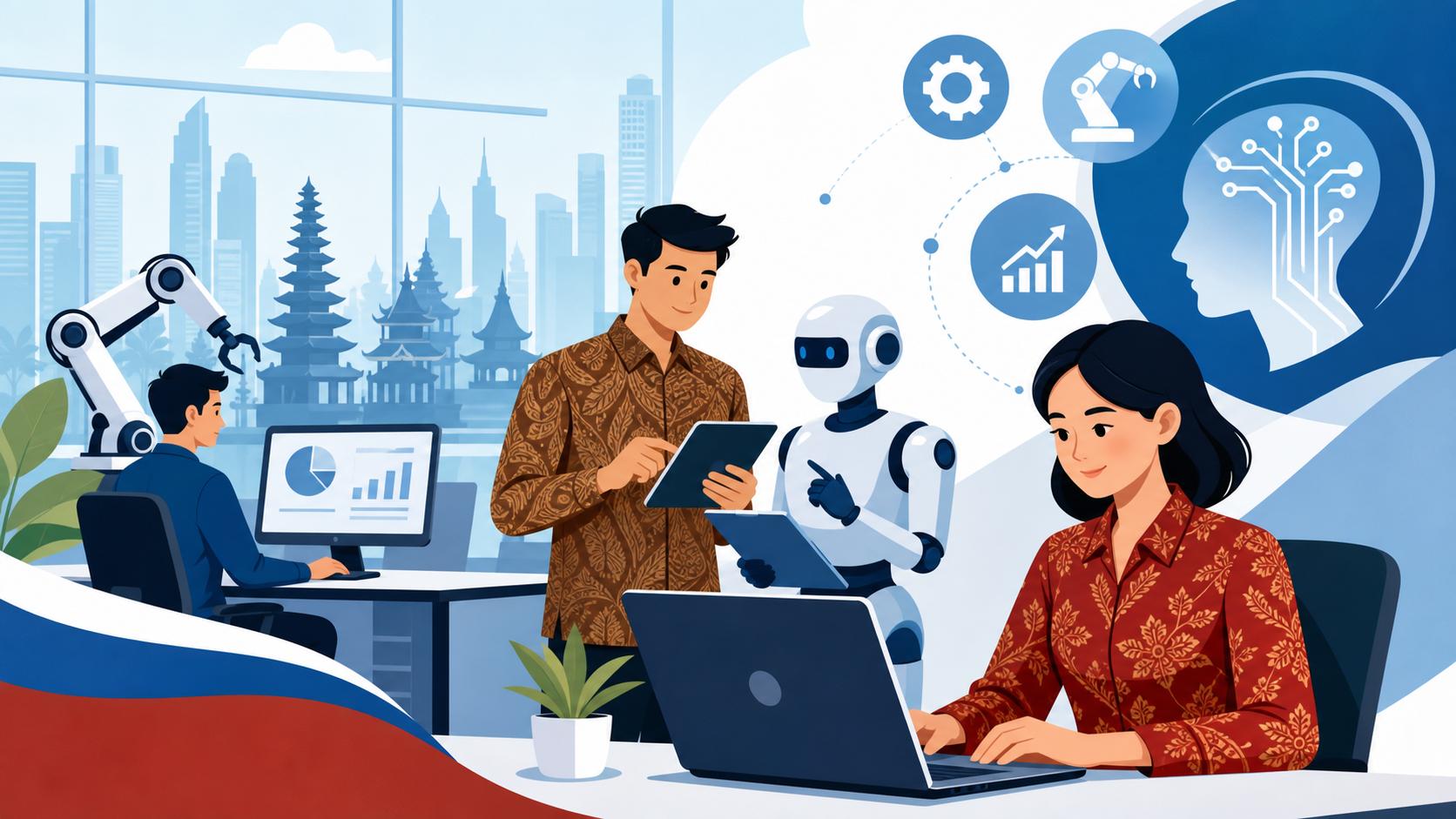
In the high-rises of Mega Kuningan or the SCBD, the transition is palpable. Traditional conglomerates (Perusahaan Bongsor) that once relied on massive administrative departments are now implementing AI for everything from supply chain logistics to predictive maintenance. As an expat, you might find yourself in a role where your primary value is no longer just "technical expertise" but your ability to manage the integration of these tools within a local context. You are essentially the bridge between the high-speed output of an algorithm and the more deliberate, relationship-based pace of Working in Indonesia as a Foreigner: Jobs, Corporate Culture, and Hiring (2027).
I’ve seen several colleagues struggle because they assumed the AI would handle the "Indonesian way" of doing things automatically. It doesn't. While a machine can draft an email in seconds, it often misses the subtle hierarchical cues necessary when addressing a senior director. This is where the human element—specifically the expat who understands both the tech and the culture—becomes a "hero" in the office. You have to be the one to ensure that the automation doesn't strip away the "Sopan Santun" (politeness) that is the bedrock of local business.
AI in Customer Service: The Rise of the Chatbot
If you’ve lived here for any length of time, you know that WhatsApp is the unofficial operating system of Indonesia. From ordering a gallon of water to closing a multi-million dollar real estate deal, it happens on WA. Corporate Indonesia has leaned heavily into this by integrating NLP (Natural Language Processing) chatbots into their customer-facing operations. Banks like BCA and Mandiri, or tech giants like Gojek, have set a standard that smaller PT PMAs (foreign-owned companies) are now scrambling to follow.
For expats in marketing or operations, the challenge is no longer just "managing a team" but managing a "hybrid workforce" of humans and bots. You need to ensure the automated responses don't alienate a customer base that values personal connection. If you are struggling to understand the nuance of these automated interactions, using a resource like IndonesianPod101 can be a lifesaver for picking up the specific formal and informal business registers used in local digital communication.
How Automation is Redefining Expat Management Roles
One of the biggest frustrations for foreign managers in Indonesia is the indirect nature of feedback. We often call it the "Yes" that actually means "Maybe" or "I don't know how to do this." In a pre-AI world, you spent hours in meetings trying to decode these signals. Today, automation is providing a new, albeit complicated, layer of transparency. Data-driven performance metrics are starting to replace "gut feelings" in Performance Reviews in Indonesia: Decoding Indirect Feedback.
Bridging the Gap Between Data and 'Bapak' Culture
Indonesian corporate culture is deeply rooted in the "Bapak/Ibu" system, where respect for seniority often outweighs data. Automation is creating a fascinating friction point here. When an AI suggests a 20% cut in logistics costs by bypassing a traditional vendor—who happens to be a long-time friend of the founder—the expat manager is often the one caught in the middle. You cannot simply point to the screen and say, "The computer says so." That would be a major "Faux Pas."
Instead, you must use the automated data as a tool for Navigating Workplace Hierarchy (Bapak/Ibu Culture) Without Offense. The "I've been there" reality is that you have to present the AI’s findings as a "suggestion for collective benefit" rather than a hard directive. This keeps the "Harmoni" (harmony) of the office intact while still achieving the efficiency gains that your overseas headquarters likely demands.
Managing Remote and Hybrid Teams via Automation
Since the 2020s, the "Work From Anywhere" trend has hit Indonesia hard, particularly with the introduction of the E33G Remote Worker Visa: Eligibility, Tax Status, and Activity Restrictions. For those managing teams across different islands—say, developers in Bandung and sales teams in Medan—automation tools like Slack, Jira, and AI-driven project managers are no longer optional. They are the only way to combat the "Jam Karet" (rubber time) that can easily derail a project.
However, be warned: automation can sometimes be perceived as a lack of trust. In the Indonesian context, physical presence and "Ngopi" (coffee chats) are how trust is built. If you rely 100% on automated tracking, your local staff may feel micromanaged or undervalued. I always recommend a "High Tech, High Touch" approach. Use the automation for the numbers, but never skip the Zoom call just to ask about someone’s family.
Upskilling for the Indonesian AI Economy
The fear that AI will "replace" jobs is just as prevalent in Jakarta as it is in London or New York. However, in Indonesia, the threat is often viewed through the lens of Employment Rights: PT PMA Contracts, Leave, and BPJS Ketenagakerjaan. Companies are becoming more selective, and the bar for hiring foreign talent is rising. To stay relevant, you need to prove that you can do things the AI can’t—specifically, navigating the cultural and linguistic minefields of Southeast Asia's largest economy.
Why Linguistic Nuance Still Trumps Algorithms
Current AI models are getting better at Bahasa Indonesia, but they still struggle with "Bahasa Gaul" (slang) and the incredibly complex world of honorifics. If you are using AI to draft business proposals, you run the risk of sounding like a cold, translated manual. This is why I always emphasize the importance of Bahasa Indonesia for Business: Kehormatan, Emails, and Meeting Etiquette.
To truly master this, you need more than just a translator app. I personally found that supplementing my daily office interactions with lessons from IndonesianPod101 helped me catch the subtle differences between "Formal" and "Office-Informal" that an AI simply wouldn't flag. Understanding these nuances allows you to "audit" the AI's output, ensuring your communication remains culturally appropriate. This skill alone makes you ten times more valuable to an Indonesian employer than a manager who blindly copies and pastes from a chatbot.
| Department | Traditional Manual Task | AI/Automated Evolution | Impact on Expat Staff |
|---|---|---|---|
| HR & Payroll | Manual BPJS reporting and paper payslips | Integrated SaaS with automatic tax (PPh 21) calculation | Shift to strategic talent development |
| Customer Support | Massive call centers with high turnover | NLP Chatbots and AI-driven sentiment analysis | Focus on high-value client escalations |
| Marketing | General billboard and TV spend | Hyper-localized AI social targeting and influencer matching | Demand for cultural nuance and "local feel" |
| Finance | Monthly manual audits and petty cash books | Real-time automated auditing and digital e-wallets | Necessity for higher data literacy and compliance |
Networking in a Tech-First Environment
Even with the rise of AI, who you know still matters more than what you know in Indonesia. However, the way we network is changing. LinkedIn has become a powerhouse in Jakarta, and AI is increasingly being used by recruiters to filter for specific certifications. If you are looking to move up, you need to ensure your profile reflects an "AI-augmented" skill set. But don't forget the human element—use the time saved by automation to engage in Strategies for Effective Cross-Cultural Collaboration in Indonesian Teams. Go to the physical mixers, attend the chambers of commerce events, and use your tech-savviness as a conversation starter, not a shield.
The Future of Your KITAS and Corporate Compliance
Perhaps the most significant (and frustrating) area of automation for expats is the government’s own digital transformation. The days of "knowing a guy" at the immigration office to speed things up are rapidly disappearing, replaced by the "Molina" system and other e-government portals.
The Digitization of Immigration and Labor Reporting
Immigration and the Ministry of Manpower have automated much of the KITAS and RPTKA (Foreign Worker Utilization Plan) process. On one hand, this reduces the "unofficial fees" and the need for dozens of physical photocopies. On the other hand, the systems are rigid. If the AI at the Ministry of Manpower sees a discrepancy in your job title versus your educational background, it will flag it instantly. There is less room for "explanation" than there used to be in the old, manual days.
This automation extends to tax and social security as well. Your BPJS contributions and PPh 21 (income tax) are now tracked through highly integrated systems. As an expat, you must be more diligent than ever about your digital footprint and compliance. Using tools like IndonesianPod101 to understand the terminology in these government portals can save you hours of head-scratching when an "Error 404" or a "Data Inconsistent" message pops up on your screen.
In conclusion, AI and automation aren't coming to take your job in Indonesia; they are coming to change the definition of your job. The successful expat is one who uses the efficiency of the machine to buy more time for the relationships, the cultural deep-dives, and the strategic thinking that no algorithm can yet replicate in the beautiful, complex reality of the Indonesian archipelago.
Disclaimer
The information provided in this guide is for educational and informational purposes only. While every effort has been made to ensure the accuracy of the details regarding Indonesian corporate trends and regulations as of 2026, the digital and legal landscape in Indonesia is subject to frequent and sudden changes. This article does not constitute legal, financial, or professional career advice. Always consult with certified local legal and tax professionals regarding your specific employment or visa situation.