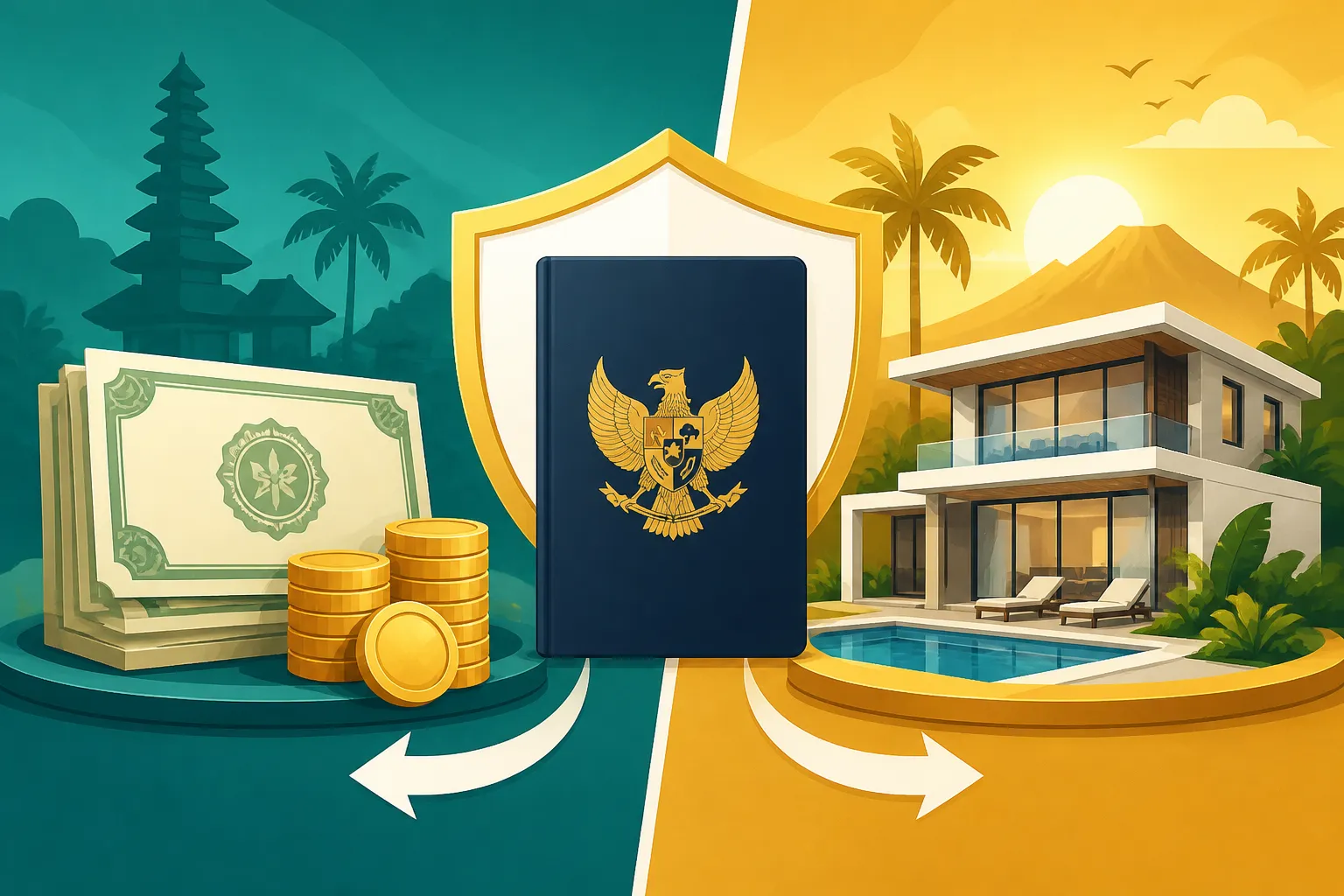
Golden Visa (E28C) for Individuals: $350k Bonds vs $1M Property Route
One of the most exhausting aspects of living in Indonesia has always been the "KITAS dance"—that annual scramble of paperwork, fingerprints, and sponsorship renewals that makes you feel more like a temporary guest than a resident. I spent years navigating those hoops, always wishing for a way to just settle in without the constant administrative anxiety. The Golden Visa (E28C) finally provides that "red carpet" alternative, solving the long-term residency puzzle for those with the capital to invest in Indonesia’s future.
The Evolution of Long Term Residency in Indonesia
For decades, foreigners were limited to year-by-year permits or the elusive KITAP, which often required years of prior residency or marriage to a local. The introduction of the Golden Visa has shifted the landscape entirely. It isn’t just a visa; it is a statement of intent from the Indonesian government to attract high-net-worth individuals who want to skip the line. When you apply for an E28C, you are moving away from the complexities of KITAS Explained: Working, Dependent, and Investor Temporary Stay Permits and into a category that offers five to ten years of stability.
The program was designed to compete with global residency-by-investment schemes in Europe and the Caribbean, but with a uniquely Indonesian flavor. Unlike the Second Home Visa: Navigating the IDR 2 Billion Deposit Requirement, which functions more like a retirement or "proof of funds" permit, the Golden Visa is a proactive investment vehicle. It allows you to choose between highly liquid government bonds or the more tangible—and often more lucrative—route of luxury real estate.
Why the E28C is a Game Changer for Wealthy Expats
The "E" in the visa code signifies that this is an electronic visa, managed through the streamlined Molina system. I remember the days of physical "Blue Books" and manual stamps; the shift to a digital-first approach via services like iVisa has made the initial entry process significantly less painful. The Golden Visa removes the need for a local corporate sponsor, which is perhaps the biggest hurdle for independent investors. You become your own sponsor through your investment, granting you an level of autonomy that was previously impossible.
Beyond the residency itself, the E28C provides a "fast-track" experience at major airports like Soekarno-Hatta and Ngurah Rai. There is a distinct psychological relief in knowing that when you land, you aren't just another tourist in the VOA line. You are a recognized investor with a long-term stake in the country. This autonomy extends to your lifestyle choices as well, allowing you to bypass many of the restrictions that apply to those on a Remote Worker Visa (E33G): Digital Nomad Requirements and Limitations.
5 Years vs 10 Years: Making the Long Term Choice
Choosing between the five-year and ten-year options is more than just a question of "how long do I want to stay." It is a financial commitment strategy. The five-year E28C requires a $350,000 investment in government bonds or a $1,000,000 investment in property. If you want to double that residency to ten years, the bond investment requirement typically jumps to $700,000.
I’ve spoken to many expats who initially lean toward the five-year option as a "trial run," but if you are looking at the property route, the ten-year mark often makes more sense given the transaction costs of Indonesian real estate. You want enough time for the capital appreciation to outweigh the taxes and legal fees. If you are unsure which duration fits your life plan, checking the latest entry requirements on iVisa can help clarify the current fee structures for each timeframe.
The 350000 Dollar Government Bonds Route
The most straightforward path to the Golden Visa is the investment in Indonesian Government Bonds (Surat Berharga Negara or SBN). For many, this is the preferred route because it doesn't involve the headaches of property maintenance, tenant management, or the complexities of Indonesian land law. You essentially park your capital in the state's hands, and in return, you get the right to live in the archipelago. This is a purely financial transaction that appeals to those who want a clean, audited paper trail for their residency.
This route requires you to open a specialized account at a "Mandate Bank"—usually one of the big state-owned institutions like Bank Mandiri or BCA. If you've ever tried opening a standard account here, you know that Opening a Bank Account in Indonesia: Document Checklists (KITAS, NPWP, Passport) can be a multi-day saga. However, Golden Visa applicants are generally assigned dedicated relationship managers who handle the heavy lifting.
How the Investment Works: ORI and SR Bonds
When we talk about government bonds in Indonesia, we are usually looking at instruments like ORI (Obligasi Negara Ritel) or SR (Sukri Ritel). These are retail bonds issued by the government to fund the national budget. The interest rates are often quite competitive compared to Western markets, frequently hovering between 5% and 7% annually. For an investor putting up $350,000, this isn't just "dead money"; it can generate a respectable passive income stream that covers a significant portion of your local living expenses.
The bonds are denominated in Indonesian Rupiah (IDR), which introduces a layer of currency risk. I always advise people to keep a close eye on the exchange rate trends. While the interest rates are high, a sudden devaluation of the Rupiah could eat into your principal when measured in USD. You’ll need to use International Money Transfers: Using Wise, SWIFT, and Local Bank Remittances to move your capital into the country, ensuring you use a service that offers the best mid-market rate to avoid losing thousands of dollars in the conversion process.
Liquidity and Returns: Can You Actually Move Your Money
One of the most common questions I get is, "What happens if I need to leave?" The Golden Visa is designed for those who intend to stay, but life happens. The bonds are generally liquid, meaning they can be sold on the secondary market. However, if you sell your bonds and your investment falls below the $350,000 threshold, your visa status will be jeopardized.
Immigration conducts periodic checks on the status of your investment. If you are using your bond returns to fund your life in Bali or Jakarta, that’s perfectly fine. But the principal must remain intact within the designated Indonesian financial ecosystem. This is where Immigration Compliance: Address Changes, EPOs, Overstays, and Reporting becomes critical; you must ensure your financial status always matches the records held by the Directorate General of Immigration.
The 1000000 Dollar Luxury Property Route
For those who want to see and touch their investment, the property route is the gold standard. Indonesia's luxury real estate market has matured significantly, especially in the high-end pockets of South Jakarta and the coastal stretches of Bali. By investing $1,000,000 in property, you aren't just buying a visa; you are acquiring an asset in one of the world's fastest-growing economies.
However, buying property as a foreigner is fraught with "nominee" scams and "leasehold" traps that have burned many expats in the past. The Golden Visa specifically encourages the "Hak Pakai" (Right to Use) or "Hak Guna Bangunan" (Right to Build) titles for apartments, which are the most secure legal frameworks for non-citizens. Before signing any contracts, you must understand the nuances of Buying Property as a Foreigner: Hak Pakai, Hak Milik Nominees, and Risks to ensure your million-dollar investment is legally sound.
Which Properties Actually Qualify
Not every villa in Canggu or every condo in Menteng qualifies for the E28C. The government has specific price floors to ensure the program targets the "luxury" segment and doesn't inflate the housing market for local citizens. Generally, the property must be a new build or purchased directly from a developer, and it must meet the $1,000,000 valuation per unit.
You cannot simply buy ten small apartments worth $100,000 each; the investment usually needs to be concentrated in a single, high-value asset. I’ve seen many people get excited about a "bargain" villa, only to realize it doesn't meet the E28C threshold. For a deeper dive into the specific buildings that meet these criteria, you should check out our guide on Golden Visa (E28C) Property Purchases: Which Apartments Qualify for $1M?.
Strategic Locations: SCBD Jakarta vs The Bukit in Bali
Where you buy is just as important as what you buy. If you are a business professional who needs to be in the heart of the action, the Sudirman Central Business District (SCBD) in Jakarta is the place to be. Apartments here offer world-class amenities and are steps away from the headquarters of Indonesia’s biggest firms. The rental yields in SCBD are consistently strong, providing a hedge against the cost of the visa itself.
On the other hand, the "Bukit" in Bali (Uluwatu and Bingin) has seen a massive surge in luxury developments. This area is perfect for those who want a "lifestyle" investment. However, remember that Bali property can be more complex due to local zoning laws (the "green zone" vs. "tourist zone"). Dealing with the paperwork for a million-dollar villa often requires professional assistance to ensure that your deeds are correctly registered with the National Land Agency (BPN).
| Investment Type | Minimum Amount | Liquidity | Management Effort | Risk Factor |
|---|---|---|---|---|
| Govt. Bonds | $350,000 | High | Low | Currency Fluctuation |
| Luxury Property | $1,000,000 | Low | High | Market/Legal Risk |
| Bank Deposits | $350,000 | Medium | Low | Inflation/Low Yield |
Navigating the Application Bureaucracy
Even with the "Golden" status, you are still dealing with Indonesian bureaucracy, which means the details matter. The application is handled through the Molina portal, where you will need to upload everything from your passport to proof of investment funds. If you are currently outside the country, using a service like iVisa can help manage the initial e-visa application to ensure you aren't rejected over a technicality.
One of the biggest hurdles is the "Proof of Funds" stage. You need to demonstrate that the $350,000 or $1,000,000 is ready to be moved or has already been moved into an Indonesian account. This requires meticulous bank statements and often "letters of intent." If your documents are not in English or Indonesian, you will need to use a certified service like RushTranslate to ensure the immigration officers can verify every detail of your financial history.
The Role of Certified Translations
I cannot stress this enough: Indonesian Immigration is very particular about document formatting. Whether it’s your marriage certificate (if bringing dependents), your bank statements, or your corporate records, "regular" translations won't cut it. You need a "Penerjemah Tersumpah" (Sworn Translator) or a recognized international service.
Using RushTranslate ensures that your documents meet the legal standards required for the E28C. I’ve seen people delayed for weeks because their birth certificate translation didn't have the right seal or wasn't formatted correctly for the Molina upload. It's a small expense compared to the $350,000 investment, but it’s the one that often causes the most avoidable stress.
Managing Your Transition: From Tourist to Golden Visa
Many investors choose to enter Indonesia on a standard Visa on Arrival (VoA) or a B211A to "scout" for property or meet with bank managers. While you can start the process while on a tourist visa, you will eventually need to convert your status. This transition is much smoother than it used to be, but it still requires a trip to the local "Kantor Imigrasi" (Immigration Office) for your biometrics—fingerprints and a digital photo.
During this transition, you also need to think about your practical life. While you wait for your E28C to be finalized, you might still be navigating the city. Understanding the basics like Commuting in Jakarta: Surviving the MRT, TransJakarta, and Macet (Traffic) will make your "scouting" trips much more bearable. Once your Golden Visa is issued, you’ll receive a physical or digital KITAS/KITAP card, which serves as your primary ID in the country.
Life After Approval: Rights and Reality
Once the E28C is in your hand, life changes. You are no longer looking over your shoulder at your visa expiry date. You are entitled to stay for the duration of your permit (5 or 10 years) and can exit and re-enter the country as many times as you like without needing additional permits. This "Multiple Entry" status is a massive benefit for those who run regional businesses or travel frequently for leisure.
However, with great residency comes great responsibility. You are now a "resident" in the eyes of many government departments. This means you will eventually need to look into a KTP WNA (Foreigner ID Card): Why Banks Will Ask You For It. This card is the key to local life—it makes everything from buying a car to signing up for a phone contract significantly easier. Without it, you are still treated like a tourist in many administrative situations.
Healthcare and Insurance for Long Term Residents
While the Golden Visa offers residency, it doesn't automatically grant you access to free healthcare. In fact, most long-term residents find that the public BPJS system, while useful for emergencies, doesn't meet the standards they are used to. For someone investing $1,000,000 in property, having a high-end international health insurance plan is non-negotiable.
I personally recommend looking into Cigna Global for comprehensive coverage that works both in Indonesia and internationally. While there are many local clinics, for serious issues, you’ll want the peace of mind that comes with being able to access the best private hospitals in Jakarta or even Singapore. You can find more details on local options in our guide on Finding Medical Care in Indonesia: Clinics, Hospitals, and International Facilities. Cigna Global provides that layer of security that protects your lifestyle as much as your health.
Banking and Financial Integration
Holding a Golden Visa makes you a "VIP" at most Indonesian banks. You’ll be able to access premium banking services, including IDR, USD, and EUR accounts. This is essential for managing your bond returns or rental income from your property investment. However, Indonesian banking can still be quirky—online transfers might have low daily limits, and you might find yourself needing to visit a branch for larger transactions.
Having your Golden Visa linked to your bank account also helps with "Know Your Customer" (KYC) requirements. It proves to the bank that you have a legal right to be in the country and that your funds have already been vetted by immigration. This makes using International Money Transfers: Using Wise, SWIFT, and Local Bank Remittances much easier, as the bank is less likely to flag your incoming or outgoing transfers for manual review.
Financial and Tax Implications of the Golden Visa
We need to talk about the "T" word: Taxes. Indonesia operates on a worldwide income tax system for residents. If you spend more than 183 days in the country in a 12-month period, you are technically a tax resident. For many Golden Visa holders, this is the most complex part of the journey. While the visa gives you the right to live here, it also brings you under the umbrella of the Directorate General of Taxes (DJP).
The good news is that Indonesia has Double Taxation Agreements (DTA) with many countries. This means you won't necessarily be taxed twice on the same income. However, you will need to report your global assets and income annually. It’s a bit of a headache, but for the lifestyle and stability the Golden Visa provides, most find it a fair trade-off.
Tax Residency and the 183 Day Rule
The 183-day rule is the trigger for tax residency. If you are a jet-setter who only spends four months a year in your Bali villa, you might remain a non-resident for tax purposes. But if you make Indonesia your primary home, you must register for an NPWP (Tax ID). Your Golden Visa application might even require you to show your NPWP during the renewal or second-stage reporting process.
If you are confused about your tax obligations, especially regarding your bond interest or property rental income, getting a certified translation of your home country’s tax returns via RushTranslate can be helpful when consulting with a local tax professional. They will need to see exactly what you are paying elsewhere to apply the DTA correctly.
Reporting Requirements: Keeping Your Visa Compliant
The Golden Visa is not a "set it and forget it" permit. Every year, or at the mid-way point of your visa (usually year 2 or 3 for a 5-year visa), you may be required to provide proof that your investment is still active. If you bought bonds, you'll need a fresh statement from your Mandate Bank. If you bought property, you might need to show the updated "Hak Pakai" certificate and proof that the property hasn't been sold.
Staying compliant is the only way to ensure your residency remains valid. I’ve seen people get too comfortable and forget these reporting milestones, leading to unnecessary fines or even the cancellation of their visa. Treat your Golden Visa like a business asset—keep a folder with all your iVisa receipts, your RushTranslate certifications, and your bank statements ready for any immigration audit.
Disclaimer
The information provided in this guide is for informational purposes only and does not constitute legal, financial, or tax advice. Regulations regarding the Golden Visa (E28C) and Indonesian immigration laws are subject to frequent changes. Always consult with a qualified immigration lawyer, tax professional, or the official Indonesian Directorate General of Immigration before making significant financial commitments. While we strive to keep this information up-to-date, we cannot guarantee its accuracy at the time of your application.