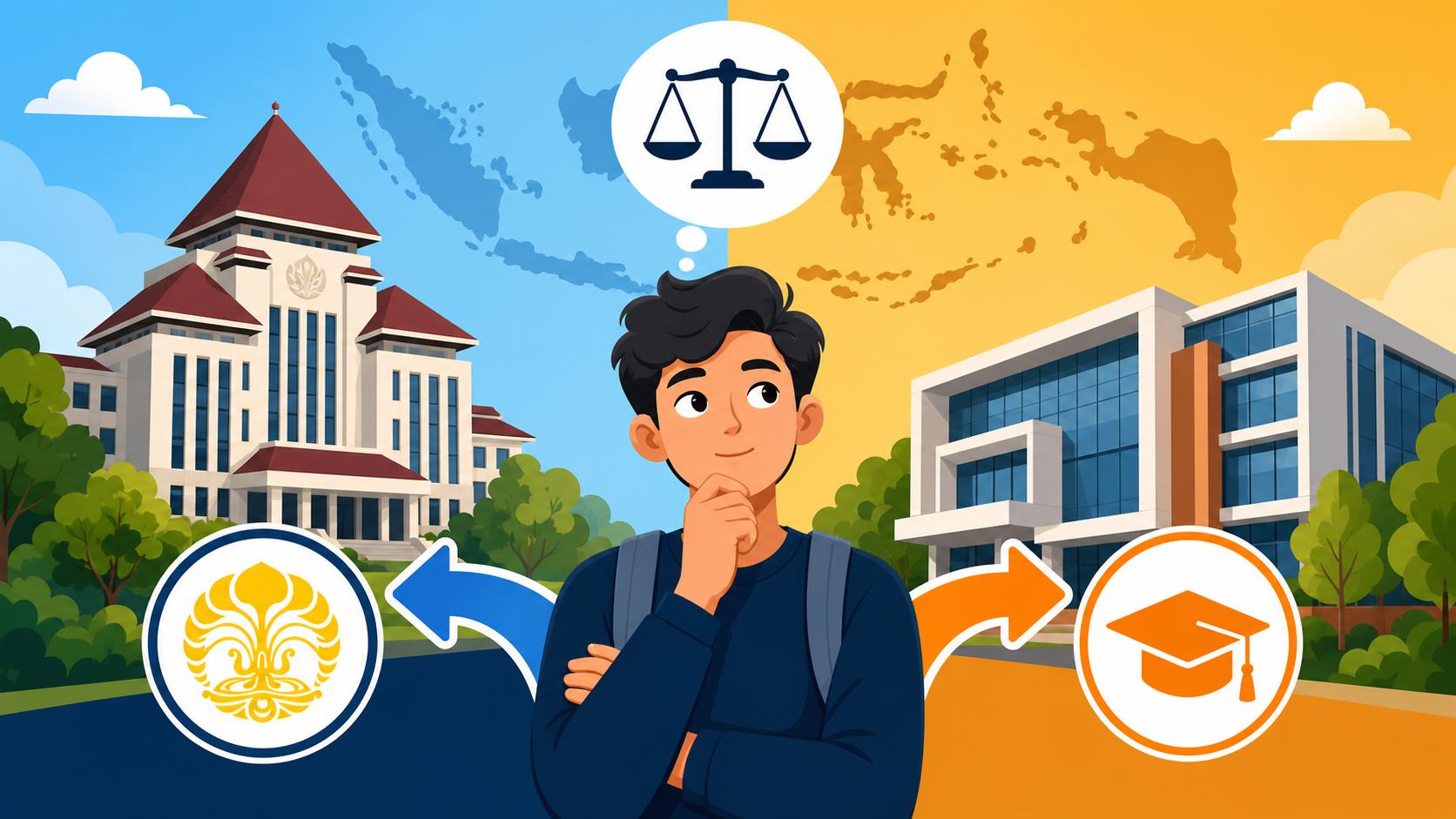
Higher Education in Indonesia: Choosing Between Public (UI/UB) and Private
Landing in the middle of Indonesia’s academic bureaucracy can feel like trying to solve a Rubik’s cube while riding a Gojek through a tropical downpour. I remember the sheer confusion of staring at university websites that only half-loaded, wondering why "social prestige" seemed to matter more than the actual curriculum. This guide untangles the PTN versus PTS debate so you can choose the right campus without losing your mind.
The Cultural Landscape of Indonesian Higher Education
Understanding the divide between public and private institutions is the first step in surviving the Indonesian education system. In most Western countries, private universities often carry the heavy weight of prestige (think Ivy League), but in Indonesia, the script is flipped. Here, the state-run institutions, known as Perguruan Tinggi Negeri (PTN), are the absolute titans of the social and professional hierarchy.
Public Universities and Social Prestige
When you tell an Indonesian colleague or a potential employer that you graduated from a top-tier PTN like Universitas Indonesia (UI), you aren't just sharing your education; you are signaling your status. These institutions are the primary gateways to the civil service and high-level corporate roles in the country. For a foreigner, this prestige can be a double-edged sword. On one hand, the networking opportunities are unparalleled. You will be sitting in classrooms with the future ministers and CEOs of Southeast Asia's largest economy.
However, the "Bapak/Ibu" culture—the deep-seated respect for hierarchy—is felt most strongly in these public halls. As an expat, you might find the administrative pace slower than what you are used to back home. I’ve spent countless hours waiting outside faculty offices just for a single signature on a "KTM" (student ID) application. It is a lesson in patience that no textbook can teach. If you are planning to go this route, you should definitely start Learning Bahasa Indonesia: BIPA Certification, Tutors, and Workplace Usage early, as public campuses are deeply rooted in the local linguistic tradition.
Private Universities and Modern Agility
On the flip side, we have the Perguruan Tinggi Swasta (PTS), or private universities. While they may not always carry the same historical weight as the big state schools, they often win on agility, facilities, and international outlook. Schools like Binus University or Pelita Harapan (UPH) operate much more like businesses. They are responsive, their websites actually work, and they often have better-funded international offices specifically designed to hold your hand through the visa process.
If you are someone who values modern infrastructure—think air-conditioned libraries that actually have reliable Wi-Fi—a private university might be your best bet. Many of these schools focus heavily on "employability" in the private sector, specifically in tech and creative industries. They often have stronger ties with the Tech Careers in Indonesia: Startup Ecosystems and Foreign Engineering Roles world than the older, more traditional public institutions. For many expats who find the PTN bureaucracy too daunting, a top-tier private school offers a much smoother transition into Indonesian life.
Navigating the Admissions Process for International Students
Getting into an Indonesian university as a foreigner isn't just about your grades; it's about your paperwork. The process is a marathon, not a sprint, and it usually begins with something called the "Desk Evaluation."
The Desk Evaluation and Document Requirements
Before you even set foot on campus, the university must submit your documents to the Ministry of Education (Kemdikbud) for a preliminary screening. This is where most students get stuck. You will need your high school or undergraduate transcripts, and they cannot just be photocopies. You will likely need to go through the process of Getting Academic Transcripts Translated and Legalized for Indonesian Visas before they are accepted.
I’ve seen students lose months of progress because their diploma wasn't apostilled or their passport didn't have enough remaining validity. The "Desk Evaluation" checks if your previous education is equivalent to the Indonesian standard. During this waiting period, which can take anywhere from two weeks to two months, I highly recommend using a resource like IndonesianPod101 to familiarize yourself with the academic vocabulary you'll encounter in official emails. Phrases like "Surat Keterangan" (Certificate) and "Legalisir" (Legalized) will become your daily bread and butter.
Language Proficiency and BIPA Certification
A common question I hear is: Do I Need a BIPA Certificate to Study at an Indonesian University? The answer depends entirely on your program. If you are entering an international class (Kelas Internasional) at a school like UI, they may accept TOEFL or IELTS scores. However, if you are joining a regular Indonesian-taught program, BIPA (Bahasa Indonesia bagi Penutur Asing) isn't just a recommendation—it’s a requirement.
Most public universities will require you to complete at least Level 3 or 4 of BIPA before you can attend regular lectures. Even if your program is in English, living in a dorm or a "Kos-kosan" will be significantly harder if you can't communicate with the "Ibu Kos" (landlady) or the campus security. To get a head start, spend some time on IndonesianPod101 focusing on conversational phrases and formal greetings. It will save you from a lot of awkward "lost in translation" moments during your first week of orientation.
Comparing the Giants: Universitas Indonesia vs Universitas Brawijaya
If you’ve decided on a public university, two names will inevitably top your list: UI in Depok (near Jakarta) and UB in Malang. Both are excellent, but they offer vastly different lifestyles for a foreign resident.
Living and Studying in Depok and Jakarta
Universitas Indonesia (UI) is the "Harvard of Indonesia." Its main campus in Depok is sprawling, green, and surprisingly quiet compared to the chaos of central Jakarta. However, make no mistake: if you study at UI, you are part of the Jakarta ecosystem. You will be dealing with the heat, the "macet" (traffic), and the high cost of living. Applying to Universitas Indonesia (UI) as a Foreigner: Required Documents is a rigorous process, as they receive thousands of applications every year.
The advantage of UI is proximity. You are a short MRT or KRL train ride away from the Jakarta Healthcare Guide for Expats: International Clinics and After-Hours Options and the best networking events in the country. For a student, this means access to internships at the headquarters of Gojek, Traveloka, or major multinational banks. The downside? It’s expensive and competitive. You’ll be competing for housing with the country's brightest students, often paying premium prices for a decent apartment near the campus.
The Student Experience in Malang
Universitas Brawijaya (UB), located in Malang, East Java, offers a completely different vibe. Malang is a mountain city, which means the weather is significantly cooler than Jakarta. For many expats, this "eternal spring" climate is a massive selling point. The Universitas Brawijaya (UB) International Admissions: Desk Evaluation Process is generally seen as slightly more accessible for international students than UI’s, though the academic standards remain very high.
In Malang, your money goes much further. You can find a high-end "Kos" with a private bathroom and AC for a fraction of what you’d pay in Depok. The culture in Malang is also "lebih santai" (more relaxed). While Jakarta is about the hustle, Malang is about the community. However, keep in mind that English proficiency among the general population in Malang is lower than in Jakarta. This is where your practice on IndonesianPod101 will really pay off. You’ll need it to navigate the local markets and build friendships with your Indonesian peers who might be shy about speaking English.
The Private Alternative: Why Many Expats Choose PTS
While the prestige of PTNs is undeniable, many of my expat friends have opted for private universities (PTS) for one simple reason: sanity. Private institutions are often better equipped to handle the specific needs of a "WNA" (Warga Negara Asing or Foreign Citizen).
English-Taught Programs and International Partnerships
One of the biggest draws of private universities like Binus International or UPH is their "Dual Degree" programs. They often have partnerships with universities in Australia, the UK, or the US. This means you can study in Indonesia for three years and do your final year abroad, receiving two degrees in the process.
These programs are almost always taught 100% in English. While I still recommend learning the local language, having your core curriculum in English reduces the cognitive load of studying in a foreign country. You can focus on the subject matter—whether it's International Relations or Computer Science—without the added stress of translating complex academic theories from Indonesian in your head. For those worried about their language level, Minimum TOEFL and IELTS Scores for Indonesian Master’s Programs are usually clearly defined on private university websites, making the entry requirements much more transparent.
Infrastructure and Campus Facilities
Let’s be honest: public university infrastructure in Indonesia can be hit or miss. You might find yourself in a state-of-the-art lab one day and a classroom with a broken fan the next. Private universities, funded by tuition and corporate donors, generally offer more consistent quality.
If you are a student who needs a modern gym, a clean cafeteria with international food options, and administrative staff who respond to emails within 24 hours, the private route is for you. They also tend to have more dedicated "International Student Clubs" that help with the social aspect of moving to a new country. They understand that as a foreigner, you might need help with things like Student Housing in Indonesia: Kos-Kosan vs Apartemen for Foreigners or finding a doctor, and they often have staff assigned to assist with these non-academic hurdles.
| Feature | Public University (PTN) | Private University (PTS) |
|---|---|---|
| Social Prestige | Extremely High (National Level) | Moderate to High (Sector Specific) |
| Bureaucracy | Heavy & Traditional | Agile & Business-like |
| Tuition (Foreigners) | Moderate to High (USD 2k-5k/year) | High (USD 5k-15k/year) |
| Language | Primarily Indonesian (BIPA required) | English Options Common |
| Facilities | Varies (Historical to Modern) | Generally High-End/Modern |
| Networking | Government & State-Owned Corps | Private Sector & Startups |
Legal and Administrative Realities for Foreign Students
You cannot just show up in Indonesia on a tourist visa and start attending classes. If you do, you risk deportation and a blacklisting from the country. The legal framework for international students is strict and requires constant attention.
Securing Your Student Visa (ITAS Pelajar)
Your university will act as your sponsor for a Student Visas (ITAS Pelajar): Processing Timelines and Sponsor Responsibilities application. This is not a "set and forget" process. Once you arrive on your e-visa, you have a limited window to visit the local immigration office (Kantor Imigrasi) to provide your fingerprints and photos for your physical ITAS card.
I’ve seen students miss their renewal deadlines because they were too busy traveling during a semester break. In Indonesia, an expired visa results in a fine of 1,000,000 IDR per day. Always keep a digital copy of your ITAS on your phone and set a calendar reminder for three months before it expires. The university's international office will usually help with the paperwork, but the ultimate responsibility for staying legal lies with you.
Post-Graduation Pathways to the PT PMA Market
Many students choose to study in Indonesia because they want to work here afterward. It’s a smart move. Having an Indonesian degree makes you a much more attractive candidate for foreign-owned companies (PT PMA). Employers value the fact that you’ve already navigated the culture and likely speak the language.
If you play your cards right, you can focus on Turning an Indonesian Internship into a Full-Time Job Offer (PT PMA) during your final year. Many private universities have "Career Centers" that specifically host job fairs for international companies looking for bilingual talent. Just remember that your student visa does not allow you to work. You must transition from a student ITAS to a work KITAS once you have a formal job offer, a process that requires your employer to prove why a foreigner is needed for the role.
Costs and Budgeting for an Indonesian Degree
While Indonesia is generally affordable, higher education for foreigners is priced differently than for locals. You need to be prepared for the "International Rate."
Tuition Fees for Foreigners
In public universities, Indonesian students pay a subsidized rate called UKT (Uang Kuliah Tunggal). As a foreigner, you will likely be charged a flat "International Student Fee." For a top-tier program at UI, expect to pay between $2,500 and $5,000 USD per year. Private universities can go much higher, with some elite programs costing upwards of $10,000 to $15,000 USD per year.
Don't forget to factor in the hidden costs. There are often "development fees," laboratory fees, and the cost of the visa process itself, which can add another $500 to $1,000 USD to your first year. Before you commit, make sure you ask for a full breakdown of the "biaya kuliah" (tuition fees) so you aren't surprised by an invoice mid-semester.
Cost of Living: Jakarta vs Regional Hubs
Your biggest monthly expense after tuition will be housing. If you are in Jakarta or Depok, you'll need to choose between a "Kos" and an apartment. For more details on the differences, check out our guide on Student Housing in Indonesia: Kos-Kosan vs Apartemen for Foreigners. Generally, a decent apartment in a safe area of Jakarta will run you $400 to $700 USD a month, while a high-end Kos might be $250 to $400 USD.
In cities like Malang or Yogyakarta, those prices drop by nearly 40%. You can live like royalty on a student budget in regional Java. However, you might spend more on transport if you need to fly back to Jakarta for embassy visits or specialized medical care. Always keep a buffer in your budget for "unexpected adventures"—whether that's a sudden trip to Bali or a repair for your motor-scooter. Using tools like IndonesianPod101 can also help you learn the art of "tawar-menawar" (haggling) at local markets, which can shave a significant amount off your monthly grocery bill.
Disclaimer
The information provided in this guide is based on current regulations as of 2026 and personal experiences within the Indonesian education system. Immigration laws, university tuition rates, and admission requirements in Indonesia are subject to frequent changes. Always verify specific details with your chosen university’s international office and the official Indonesian Ministry of Education website before making financial or legal commitments. This content is for informational purposes only and does not constitute legal or professional advice.