Calculating IMEI Customs Tax: The $500 Exemption and NPWP Discount
Landing at Soekarno-Hatta or Ngurah Rai after a long-haul flight only to realize your smartphone has been "handcuffed" by the network is a rite of passage no expat enjoys. I remember standing by the luggage carousel in Jakarta, desperately trying to call my driver, only to find that my expensive flagship phone was suddenly a paperweight. This guide breaks down the complex math of the Indonesian IMEI tax, the crucial $500 exemption, and how your tax ID can save you a small fortune.
Understanding the Indonesian IMEI Regulation Context
The Indonesian government implemented strict International Mobile Equipment Identity (IMEI) regulations to curb the massive "black market" of smuggled electronic devices. For those of us moving here, this means that any phone brought from abroad must be registered with the Directorate General of Customs and Excise (Bea Cukai) if you plan to use a local SIM card for more than 90 days. If you ignore this, your phone will simply fail to connect to any local Indonesian provider, leaving you stuck with expensive roaming or hunting for Wi-Fi.
Why Indonesia Blocks Foreign Phones
The primary driver is tax revenue and market protection. Before this law, thousands of high-end devices entered the country without paying the requisite import duties. By locking the IMEI to the national database, the government ensures that every permanent resident contributes to the national coffers. For expats, this is often the first "bureaucratic wall" we hit. You might be tempted to just use a temporary tourist SIM, but those are strictly time-limited and require constant renewals that become a headache if you are settling into Jakarta Neighborhoods: Kemang, SCBD, Pondok Indah, and Menteng for the long haul.
The 90-Day Rule vs. Permanent Registration
There is a common misconception that you must register and pay tax the second you land. If you are only visiting for a short stint, you can get a temporary 90-day IMEI block removal at local provider outlets (like Telkomsel). However, if you are a KITAS holder, this is a temporary fix. Eventually, the block returns. To avoid this, permanent registration at the airport upon arrival is the gold standard. It is the only way to claim the generous $500 USD exemption. If you wait and try Registering IMEI at the Customs Office After Leaving the Airport (60 Day Limit) later, you lose that $500 deduction entirely, which can result in a tax bill hundreds of dollars higher than necessary.
Real-World Frustrations: The No Service Moment
I’ve seen dozens of newcomers arrive at their Bali Neighborhoods: Seminyak, Canggu, Sanur, Ubud, and the Bukit villas, only to realize they can’t order a Gojek or authenticate their banking apps because their foreign phone is blocked. This "no service" moment usually happens about 24 to 48 hours after inserting a local SIM if the device isn't registered. To stay connected immediately, many expats use Airalo for a temporary data eSIM while they sort out their permanent registration, but remember that an eSIM doesn't bypass the long-term IMEI requirement for local physical SIM cards.
The $500 Exemption: How the Math Actually Works
The most critical piece of information for any traveler is the $500 USD exemption. Under current Indonesian law, every individual entering the country is allowed to bring in "personal effects" with a total value of up to $500 USD duty-free. For most of us, this means if your phone is worth $600, you are only taxed on the remaining $100. This is a massive benefit that only applies if you declare the phone at the "Red Channel" (Goods to Declare) immediately after clearing immigration and before leaving the airport terminal.
Eligibility for the Duty-Free Allowance
To qualify for this exemption, you must be the one carrying the device. You cannot send a phone via courier and expect the $500 discount; in those cases, the device is treated as an imported commercial good, and you will be taxed on the full value from the first dollar. Furthermore, the allowance is per person. If you are traveling with a spouse or children, each person technically has a $500 allowance, though it is usually applied to the specific device they are carrying. I’ve often advised families to ensure each adult is carrying their own high-end device to maximize these deductions.
The Importance of Registering at the Airport
If you walk through the "Green Channel" (Nothing to Declare) and realize three days later that you need to register your phone, you have made a very expensive mistake. Once you exit the airport, you are no longer considered a "passenger" in the eyes of the immediate customs process. You can still register at a downtown customs office within 60 days, but the $500 exemption vanishes. You will be taxed on the full "fair market value" of the phone as determined by the customs officer’s database. It’s worth the 30-minute wait in the customs queue at the airport to save $150 or more in taxes.
Multiple Devices and Family Allowances
Each passenger is allowed to register a maximum of two devices. If you are a digital nomad carrying an iPhone, an Android testing device, and perhaps a cellular iPad, you need to be strategic. The $500 exemption applies to the total value of the items declared. If you declare two phones worth $400 each (Total $800), you pay tax on $300. If you are staying at a luxury resort you found on Agoda and have a personal assistant or driver meeting you, make sure they know you might be delayed at the customs desk if you have multiple gadgets to process.
The Role of NPWP in Reducing Your Tax Burden
In the world of Indonesian administration, the NPWP (Nomor Pokok Wajib Pajak) is your best friend. This is your personal tax identification number. For expats, having this number significantly reduces the rate of Income Tax (PPh) applied to your imported electronics. Without an NPWP, the government essentially penalizes you with a higher rate, assuming you aren't yet integrated into the local tax system.
Comparing Tax Rates: With vs. Without NPWP
The tax calculation for an IMEI registration involves three main components: Import Duty (Bea Masuk), Value Added Tax (PPN), and Income Tax (PPh 22). While the first two are fixed, the PPh 22 rate changes based on your tax ID status. If you have a valid NPWP, your PPh rate is 10%. If you do not have one, that rate doubles to 20%. On a $1,200 smartphone, this difference can amount to $70 or $80 USD—enough for a very nice dinner in South Jakarta.
Linking NIK to NPWP for Residents
As of 2024 and 2025, Indonesia has been moving toward a unified ID system where your NIK (National ID Number) on your KITAS/KTP-WNA serves as your NPWP. This is a huge relief for those who have already completed their Registering for an NPWP (Tax ID): How Expats Link NIK to Tax Records in 2027 process. When you arrive at the customs desk, showing your digital NPWP or your tax-linked KITAS can immediately trigger the lower tax rate in the officer's system. Always have a screenshot of your NPWP ready on your phone (or a printed copy) because the airport Wi-Fi can be notoriously spotty when you need it most.
What to Do If You Don't Have an NPWP Yet
Most new arrivals don't have an NPWP on day one. If you are moving here for work, your company will eventually process this for you as part of Money in Indonesia for Foreign Residents: Banking, Tax, and Financial Setup (2027). However, if you register your phone at the airport on your first arrival, you likely won't have the ID yet. In this scenario, you must pay the higher 20% PPh rate. Some expats try to argue that they will get an NPWP later and want a refund, but the system doesn't work that way. The tax paid at the airport is final. If your phone is very expensive, it sometimes makes sense to use a roaming SIM for a few weeks, get your NPWP, and then go to a downtown customs office—but remember, you lose the $500 exemption if you do this. You have to weigh the $500 exemption against the 10% tax discount. Usually, the $500 exemption is the bigger saver.
Step-by-Step Guide to Calculating Your Total Payable Tax
Calculating the tax isn't as simple as multiplying the price by a percentage. It is a "layered" calculation where each tax is applied to the new total (the tax base) created by the previous step. In 2026, with the PPN (VAT) at 12%, the math has become slightly more intensive.
Determining the Customs Value (FOB)
The first step is determining the value of your phone in USD. Customs officers use a global database to find the "Fair Market Value." If you bought your phone on sale for $800 but the official launch price was $1,100, they might try to tax you on the higher amount. Always bring your original receipt (digital or physical). If the receipt is in a different currency, they will convert it to USD using the official Ministry of Finance exchange rate for that week. Once they have the value, they subtract the $500 exemption to find the "Taxable Value."
Calculating Import Duty (Bea Masuk)
The Import Duty for mobile phones is currently set at 10% of the Taxable Value.
Example: If your phone is valued at $1,200, the Taxable Value is $700 ($1,200 – $500).
The Import Duty is 10% of $700 = $70.
Value Added Tax (PPN) and Income Tax (PPh)
This is where it gets tricky. The PPN and PPh are calculated based on the "Import Value," which is the Taxable Value plus the Import Duty.
In our example: $700 + $70 = $770.
- PPN (12%): 12% of $770 = $92.40.
- PPh (10% with NPWP): 10% of $770 = $77.00.
Total Tax Due: $70 + $92.40 + $77.00 = $239.40.
| Item Component | Without NPWP (20% PPh) | With NPWP (10% PPh) |
|---|---|---|
| Taxable Value (After $500 Off) | $700 | $700 |
| Import Duty (10%) | $70 | $70 |
| PPN (12% in 2026) | $92.40 | $92.40 |
| Income Tax (PPh 22) | $154.00 | $77.00 |
| Total Payable (Approx) | $316.40 | $239.40 |
Practical Tips for a Smooth Customs Experience
The difference between a 10-minute transaction and a 2-hour ordeal often comes down to preparation. The customs area at the airport is usually the last stop before you reach the arrivals hall where the drivers wait. It can be crowded, especially when multiple flights from Singapore or Australia land simultaneously.
Pre-registering via the Bea Cukai App
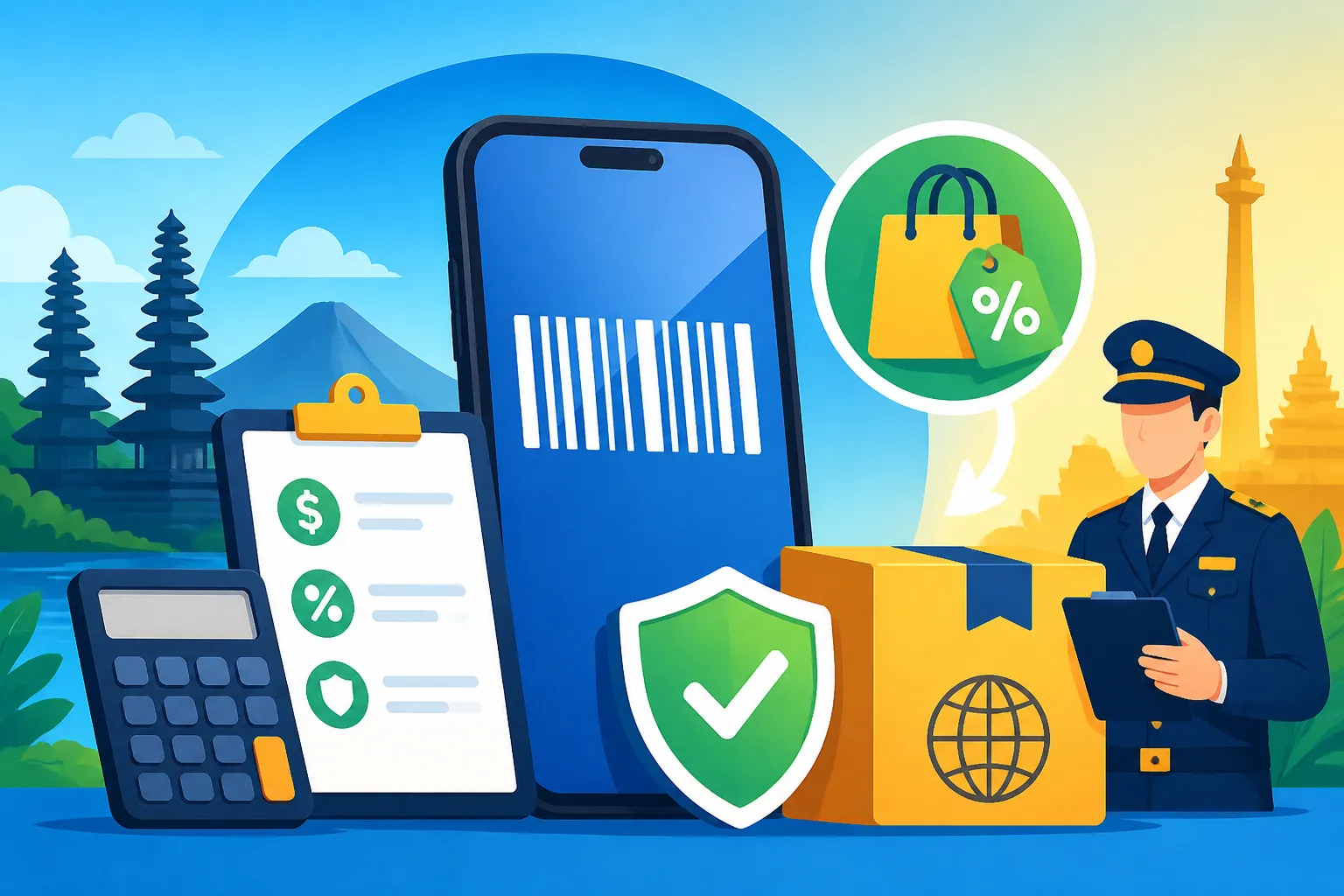
Do not wait until you are at the desk to start the process. Download the "Mobile Beacukai" app or visit the official website before you fly. You can fill in your passport details, device specs, and IMEI numbers in advance. The app will generate a QR code. When you reach the customs officer, you simply show the QR code, they scan it, verify your phone's physical IMEI (by dialing *#06#), and check your receipt. This pre-registration is essential for Mandatory IMEI Registration: The 90-Day Rule and Airport Customs Process to go smoothly.
Managing the Customs Queue at Jakarta and Bali
In Jakarta (CGK), the IMEI registration desk is located just before the final x-ray machines. In Bali (DPS), it’s in a similar position. If the queue looks massive, don't panic. Usually, there are separate lines for "Electronic Customs Declarations" and "IMEI Registration." Ensure you have filled out your general customs declaration form online as well (the one for your luggage). If you are carrying a high-value device and don't declare it, and it's found in the final x-ray, you may face fines or the seizure of the device. It is always better to be upfront.
Validating Your IMEI Status Online
After you pay your tax (usually via credit card or QRIS at the desk), the officer will tell you it's done. However, it can take anywhere from a few hours to 48 hours for the system to sync with the local telecommunication providers. You can verify this yourself by How to Check Your IMEI Registration Status via the Kemenperin Website. If your IMEI doesn't show up as "Registered" after two days, you may need to visit a local customs office with your receipt to have them push the data manually. I always tell friends to keep a photo of the tax payment receipt on their phone forever—it's your only proof of "legality" if the system glitches later.
Long-Term Living: Beyond the Initial Registration
Sometimes, the math just doesn't make sense. If you are carrying an older iPhone 11 or a mid-range Android phone, the tax might be nearly as much as the phone's current value. In these cases, it’s often smarter to leave that phone for use with a home-country SIM (for banking OTPs) and buy a local device once you arrive.
Buying Phones Locally via Shopee
The easiest way to avoid the IMEI headache altogether is to buy a phone that was officially imported into Indonesia. These devices come with "IMEI Terdaftar" (Registered IMEI) out of the box. You can find excellent deals on Shopee or at physical stores like Erafone. When browsing Shopee, look for the "Mall" tag or "Official Store" to ensure the device isn't a "distributor warranty" unit, which is often code for a smuggled device that might have IMEI issues later.
Secondary Market Hazards: The IMEI Registered Myth
If you are looking to save money by buying a used phone in Bali or Jakarta, be extremely cautious. Many sellers on Facebook Marketplace or local "cell shops" will claim a phone is "permanently registered." Often, these are phones that were registered using a temporary 3-month tourist hack or "cloned" IMEIs. If the price for a used Buying an iPhone in Singapore vs Indonesia: Tax Math and IMEI Hassles seems too good to be true, it’s because the IMEI isn't legitimate. If it gets blocked three months later, you have no recourse.
Troubleshooting Connectivity Issues
If you’ve paid your tax and your phone still says "Searching" or "SOS," don't panic. First, try toggling Airplane Mode. If that fails, go into your settings and manually select a network provider (like Telkomsel or XL) instead of leaving it on "Automatic." Occasionally, you may need to reset your Network Settings. If you’ve followed all the steps for Buying and Registering a Car or Scooter in Indonesia on a KITAS and other administrative hurdles, you know that Indonesian systems sometimes just need a "nudge." If all else fails, a quick trip to a "Grapari" (Telkomsel service center) with your customs receipt will usually solve the problem.
Disclaimer
This guide is intended for informational purposes only and reflects regulations as of 2026. Indonesian customs and tax laws are subject to frequent changes without prior notice. While I strive to provide accurate calculations and advice based on my experience as an expat, I am not a legal or tax professional. Always verify the latest rates and procedures on the official Bea Cukai website or via their official social media channels before traveling. The final tax assessment is at the sole discretion of the customs officer on duty.