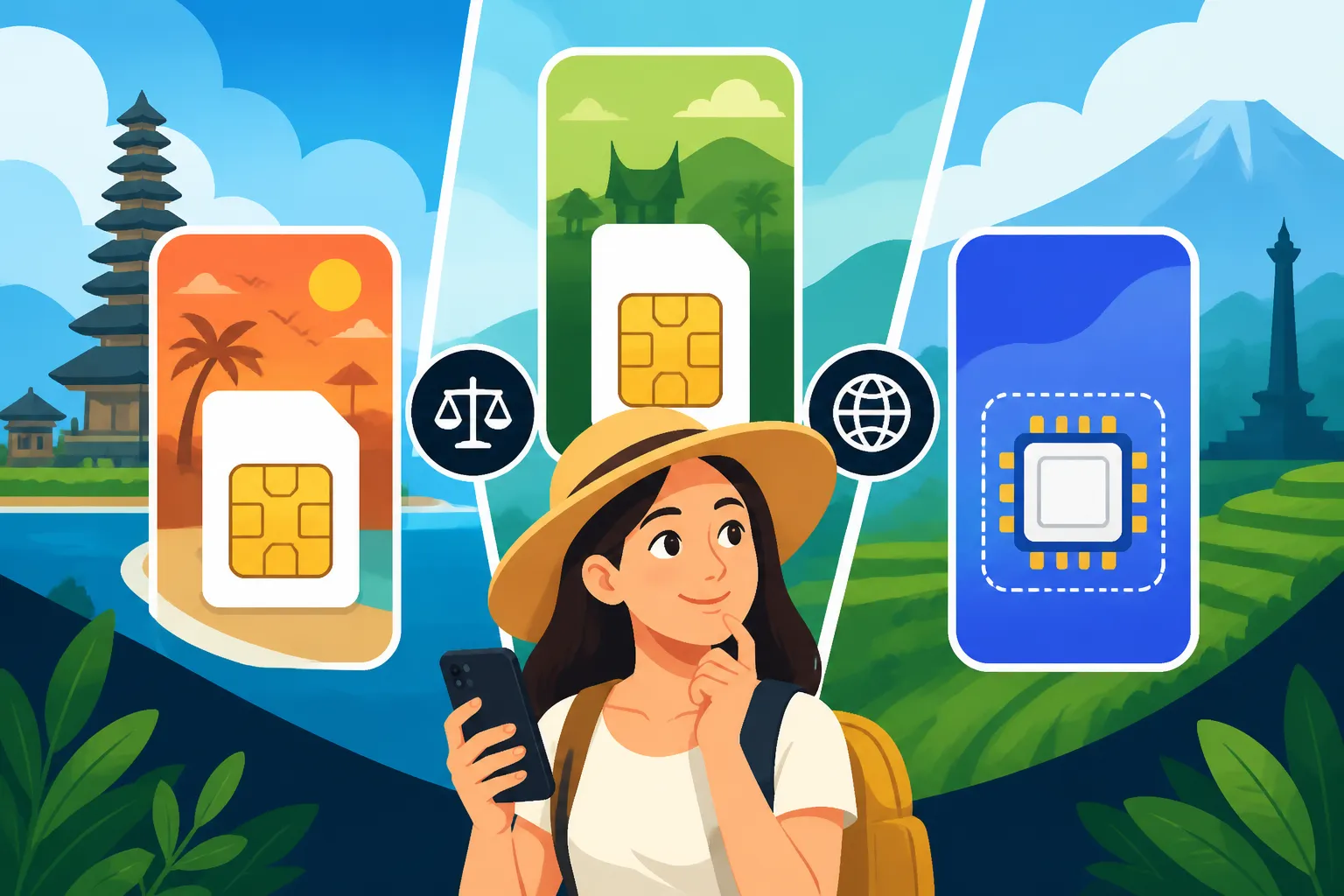
Tourist SIM vs Local SIM: Telkomsel, XL, and eSIM Options for New Arrivals
Stepping off a plane at Soekarno-Hatta or Ngurah Rai only to find your phone is a glorified brick because the roaming didn't kick in is a rite of passage no one wants. I remember my first time in Jakarta, standing in the sweltering heat trying to hail a ride with zero signal while being swarmed by unofficial taxi drivers. This guide settles the debate between Tourist SIMs, Local SIMs, and eSIMs, ensuring you stay connected the moment you clear customs.
The Battle of Connectivity: Tourist SIM vs. Local SIM
When you first land in Indonesia, the sheer number of bright red and blue kiosks can be overwhelming. The primary choice you face is between a designated "Tourist SIM" and a standard "Local SIM" intended for residents. For many, the Tourist SIM is a temporary fix, but if you are planning to stay for more than a month, the nuances of these two options become incredibly important for both your wallet and your sanity.
The Immediate Convenience of Tourist SIMs
Tourist SIMs are specifically designed for the short-term traveler. These are available at almost every international airport arrival hall. The biggest advantage here is the registration process. In Indonesia, all SIM cards must be registered with a National Identity Number (NIK) and a Family Card (KK). Obviously, as a visitor, you don't have these. The Tourist SIM bypasses this by allowing registration using your passport.
Typically, these cards come pre-loaded with a massive amount of data—often 25GB to 100GB—valid for 30 days. The staff at the airport will take a photo of your passport and your phone's IMEI number, and you’ll be out the door in ten minutes. I often tell friends that if they are only here for a two-week holiday in Bali, don't overthink it; just grab the Tourist SIM at the airport. It saves you the headache of finding a provider later who knows how to handle a foreign passport.
The Long-Term Value of Regular Local SIMs
If you are a digital nomad or an expat moving here on a KITAS, the Tourist SIM is a trap. Why? Because most Tourist SIMs cannot be easily extended or topped up with the same high-value data packages once the initial 30 days expire. You might find yourself having to buy a brand-new starter pack every month, which is a massive waste of time and money.
A regular Local SIM, once registered properly at a provider's official office (like a GraPARI for Telkomsel), offers access to "Pulsa" (credit) and monthly data packages that are significantly cheaper. You can manage everything through an app, and your number stays active as long as you keep a minimum balance. This is crucial if you plan on opening a bank account or using local services, as your phone number becomes your primary identity for OTPs and verification. For more on setting up your local life, see our guide on Money in Indonesia for Foreign Residents: Banking, Tax, and Financial Setup (2027).
Understanding the Big Three: Telkomsel, XL Axiata, and IM3
Not all networks are created equal in the Indonesian archipelago. Depending on whether you are sipping a latte in a Jakarta skyscraper or trekking through the jungles of Sumatra, your choice of provider will dictate whether you have 5G or a frustrating "No Service" icon.
Telkomsel: The Coverage King
Telkomsel is the state-owned giant and, quite frankly, the gold standard for coverage. If you plan on traveling outside of major cities like Jakarta, Surabaya, or the main tourist hubs of Bali, Telkomsel is your only real choice. I have been in remote villages in Flores where Telkomsel was the only signal reaching the valley.
They offer a "Tourist Prepaid Card" specifically for foreigners. The catch? It is usually more expensive than its competitors. However, the reliability is worth the premium. Their 5G network is also the most expansive in 2026, covering almost all of South Jakarta and the busier parts of Denpasar and Canggu. If your work involves heavy data usage or video calls, Telkomsel provides the peace of mind that you won't drop out mid-meeting.
XL Axiata: The Balanced Contender
XL Axiata is a favorite among younger travelers and expats living in urban areas. They often have more aggressive pricing than Telkomsel and their data speeds in cities like Jakarta and Bandung are often comparable, if not faster, during off-peak hours. XL is particularly popular in Bali because they have historically offered great roaming deals and "unlimited" social media bundles.
If you are staying in well-developed areas like the Bali Neighborhoods: Seminyak, Canggu, Sanur, Ubud, and the Bukit, XL is a fantastic choice. Their "XL Prioritas" is their postpaid wing, but most expats stick to their "Xtra Combo" prepaid packages. They are also very friendly toward eSIM technology, making them a top choice for users with the latest iPhones or Samsung devices who don't want to fiddle with physical trays.
Indosat IM3: The Budget Choice
Indosat (IM3) has improved significantly since its merger with Three (3), creating a massive network pool. They are often the cheapest of the big three. However, I have personally found their indoor penetration to be a bit weaker. If you are inside a large "Mal" (shopping center) or a basement apartment, you might find your signal dropping to one bar. That said, for a budget-conscious traveler who stays mostly in major cities, the savings can add up. They frequently offer "Freedom Internet" packages that are very straightforward with no "local data" versus "national data" confusing divisions.
The eSIM Revolution: Airalo and Local Digital Options
The days of hunting for a paperclip to pop open your SIM tray are slowly fading. The eSIM has changed the game for arrivals in Indonesia, offering a "land and connect" experience that was previously impossible.
Why Airalo is a Lifesaver for the First 48 Hours
I always recommend that newcomers install an eSIM via Airalo before they even board their flight. While local SIMs are cheaper in the long run, having data the second your plane touches the tarmac is invaluable. You can use it to book your first ride-on Navigating Gojek and Grab: Food Delivery, Transport, and Package Courier, message your Airbnb host, or check your hotel location on Agoda.
Airalo’s Indonesia plans (often under the name "Indocom") run on the local networks but save you the hassle of registration and passport photos at the airport. It’s a "clean" way to get through your first few days while you figure out which local provider has the best signal in your specific neighborhood. Just keep in mind that these international eSIMs usually don't come with a local phone number (+62), which you will eventually need for local apps.
Local eSIMs: Telkomsel and Smartfren
Once you are settled, you can switch to a local eSIM. Telkomsel now offers eSIMs that you can purchase online, though the registration still requires a passport upload and a bit of patience with their web portal. Smartfren is another provider that has leaned heavily into the eSIM market. They are a smaller player but often have the best "Unlimited" data deals. The caveat with Smartfren is that they operate on a different frequency band; you must check if your phone is compatible before buying, or you’ll end up with a digital dead end.
The IMEI Nightmare: What Every Expat and Tourist Must Know
This is where most foreigners get tripped up. Since late 2020, Indonesia has enforced strict IMEI (International Mobile Equipment Identity) registration rules to combat the black market for mobile phones. If you don't understand this, your expensive foreign-bought phone will stop working on local networks after a certain period.
The 90-Day Rule for Foreign Devices
If you are a tourist visiting for less than 90 days, you generally do not need to pay import taxes on your phone. When you buy a Tourist SIM, the provider will "whitelist" your IMEI for 90 days. After that window closes, your phone will be blocked from all Indonesian networks. It won't even work with a different local SIM. This is the government's way of ensuring that people don't bring in phones to sell without paying duty.
For those planning to stay longer, or those arriving on a KITAS, you need to follow the Mandatory IMEI Registration: The 90-Day Rule and Airport Customs Process. If you fail to do this at the airport, you can still do it later at a customs office (Bea Cukai), but it becomes much more bureaucratic.
Registering Your IMEI at the Airport vs. Downtown
The most "pro" tip I can give you is this: Register your IMEI at the customs desk before you leave the airport terminal. There is a specific desk near the baggage claim or just after the X-ray machines. If your phone is valued under $500 USD, the registration is free. If it is over $500, you will have to pay a percentage of the excess value in tax.
Having an NPWP (Indonesian Tax ID) can actually lower this tax rate significantly. For more details on the math, check out the Calculative IMEI Customs Tax: The $500 Exemption and NPWP Discount. If you miss the airport registration and try to do it a month later, you lose that $500 exemption and have to pay tax on the full value of the phone. I have seen expats hit with $200 bills just to keep their three-year-old iPhone working.
Where to Buy and How to Top Up
Once you have your SIM, the next challenge is keeping it alive. Indonesia uses a "Prepaid First" culture, and understanding how to navigate the "Pulsa" system is essential.
Navigating the Airport Stalls
At the airport, you will see stalls for Telkomsel, XL, and others. They will charge a premium. A SIM that costs 50,000 IDR downtown might be 250,000 IDR at the airport. You are paying for the convenience and the fact that the staff there are experts at registering foreign passports. If you are tired and just want to get to your hotel, pay the premium. If you are on a budget, use your Airalo data to get to the city, then find a "Cellular Shop" (locally known as a "Counter" or "Toko Pulsa") in a mall the next day.
Using Shopee and Banking Apps for Refills
The most efficient way to manage your SIM is through the provider's app (MyTelkomsel, myXL, etc.). However, you can also top up your credit through Shopee, which often has discounts or "flash sales" on data packages.
Once you have set up your Digital Banking and E-Wallets: How to Register for GoPay, OVO, and Dana, you can top up your phone in seconds. This is a lifesaver when your data runs out in the middle of a traffic jam while you're trying to navigate the Jakarta Public Transport: MRT, LRT, and Commuter Line Guide for Expats.
| Feature | Tourist SIM | Local SIM (Prepaid) | International eSIM (Airalo) |
|---|---|---|---|
| Registration | Passport (Easy) | NIK/KK or Passport at Office | None Required |
| Validity | Usually 30 Days | Flexible/Extendable | 7 to 30 Days |
| Cost | Premium/High | Very Low | Moderate |
| Phone Number | Included (+62) | Included (+62) | Data Only (Usually) |
| Best For | Short Vacations | Long-term Expats/Nomads | Immediate Arrival/Short Stays |
| Network | Telkomsel/XL | Any | Varies (Indocom) |
Practical Tips for Smooth Data Usage in Indonesia
Even with the best SIM, Indonesia's geography can be a challenge for signals. Here are a few "I've-been-there" tips to keep you from losing your mind.
Signal Dead Zones and Regional Variations
Jakarta is a concrete jungle, and the thick walls of older malls or high-rise apartments are notorious for blocking signals. If you find your phone struggling, try switching your network mode from 5G to 4G/LTE. Sometimes the 5G signal is just "ghosting"—it shows bars but doesn't move data.
In Bali, the "Bukit" (the southern peninsula) has notorious dead zones because of the limestone cliffs. If you are staying in a villa in Uluwatu, check with the host about which provider works best at that specific house. I have lived in villas where Telkomsel was dead, but XL was blazing fast, simply because of the location of the nearest tower.
Managing Local vs. National Data
When you buy a data package in Indonesia, you will often see it split into "Kuota Utama" (National Data) and "Kuota Lokal" (Local Data). Local data can only be used in the city or region where you purchased the package. If you buy a massive data pack in Jakarta and then fly to Bali, you might find you have zero data because you are now outside your "local" zone. Always look for packages that say "Nasional" or "Semua Jaringan" to avoid being stranded when you travel between islands.
Important Disclaimer
The information provided in this guide is for general informational purposes only and is based on conditions in Indonesia. Telecommunications regulations, IMEI laws, and provider pricing are subject to frequent changes by the Indonesian Ministry of Communication and Informatics (Kominfo) and Directorate General of Customs and Excise. While every effort is made to keep this information accurate, we recommend verifying specific requirements with your chosen provider or the official Indonesian Customs website upon arrival. This guide does not constitute legal or professional advice.