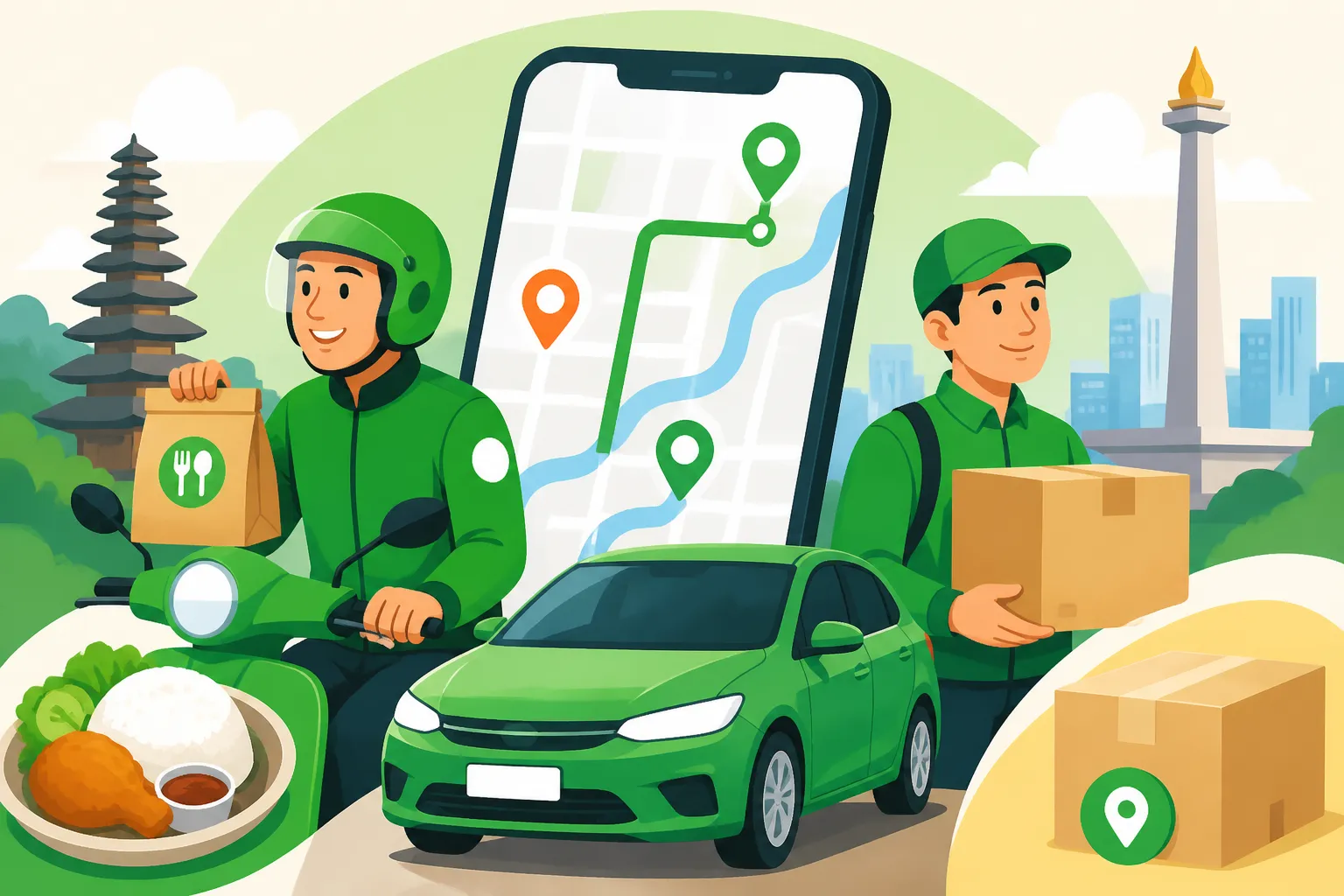
Navigating Gojek and Grab: Food Delivery, Transport, and Package Courier
Stepping out of an air-conditioned airport into the humid, chaotic energy of an Indonesian city can be overwhelming for any newcomer. I remember my first week in Jakarta, paralyzed by the sight of thousands of motorbikes weaving through gridlocked traffic, wondering how I would ever get around or even find a decent meal. This guide solves that navigational dread by teaching you to master the "Super Apps" that essentially run daily life in Indonesia.
The Super App Ecosystem in Indonesia
In many Western countries, you have one app for food, another for rides, and a third for paying bills. In Indonesia, the digital landscape is dominated by two "Super Apps": Gojek and Grab. These platforms are not just luxuries; they are fundamental utilities for survival. Whether you are living in a high-rise in the SCBD or a villa in the hills of Ubud, these apps bridge the gap between your needs and the complex local infrastructure.
To get started, you must have a reliable data connection the moment you touch down. Using a service like Airalo to secure a local eSIM ensures that you can download these apps and register your account while still at the baggage claim. Without a working local number or data, you are essentially "blind" in the Indonesian digital economy. Most drivers will call or message you immediately upon accepting a booking, often using WhatsApp or the in-app chat, making a stable connection non-negotiable.
Choosing Between Gojek and Grab
For most expats, the question isn't which app to choose, but how to use both effectively. Gojek is the homegrown hero, born in Jakarta as a way to formalize the traditional "ojek" (motorbike taxi) system. It has a deeply local feel and often integrates better with smaller, neighborhood-level vendors. Grab, originally from Malaysia but now a regional behemoth, offers a very similar suite of services but often has a slightly different pricing algorithm.
I have found that having both apps is the only way to navigate peak hours. When a tropical downpour hits at 5:00 PM, one app might have no drivers available, while the other might have a "GrabCar" just around the corner. Prices fluctuate based on demand, so "app-switching" is a common habit among veterans. While Gojek’s interface feels a bit more intuitive to some, Grab’s loyalty program (GrabRewards) can offer significant discounts on future rides or meals if you use it consistently.
Setting Up Your Account and Payment Methods
Setting up your account is relatively straightforward, but there is a major hurdle: the phone number. While you can sometimes register with a foreign number, it often leads to communication errors with drivers. I highly recommend linking your account to a local Indonesian SIM card. Once your profile is active, your next step is navigating the payment landscape. While cash is still accepted, it is the least efficient way to use the apps. Drivers often struggle with change, and during a rainy season "macet" (traffic jam), the last thing you want to do is faff about with wet banknotes.
To truly unlock the power of these apps, you need to dive into the world of Digital Banking and E-Wallets: How to Register for GoPay, OVO, and Dana. Gojek uses GoPay, while Grab is integrated with OVO. You can top up these wallets at any Indomaret or Alfamart (the ubiquitous convenience stores) by simply showing your phone number and handing over cash to the cashier. This allows for "seamless" transactions where the fare is deducted automatically, allowing you to simply hop off the back of a bike or exit a car without a word.
The Role of E-Wallets and QRIS
The integration of e-wallets goes beyond just paying for your ride. Both GoPay and OVO are now part of the national QRIS system. This means you can use your Gojek or Grab app to pay for almost anything in the physical world—from a high-end dinner at a restaurant you found on Agoda to a small bowl of bakso from a street cart. When you see the universal QRIS barcode, you simply open your preferred app, scan, and pay.
This financial integration is a lifesaver for expats who haven't yet secured a local bank account. It provides a level of digital transparency that helps you track your spending in a way that cash never could. If you're trying to stick to a Cost of Living in Jakarta 2026: Rent, Schooling, and Lifestyle Benchmarks, reviewing your transaction history in Gojek or Grab is the most accurate way to see where your "leaks" are happening—usually on too many late-night GoFood orders.
Mastering Transport GoRide GoCar and Beyond
Transportation is the backbone of these apps. In a country where public transport is still developing, Gojek and Grab provide the mobility needed to maintain a professional and social life. However, navigating these services requires more than just hitting a button; it requires an understanding of the local geography and the unspoken rules of the road.
Navigating Traffic with Motorbike Taxis
The "GoRide" (Gojek) and "GrabBike" (Grab) services are the ultimate "macet-busters." When the cars in Jakarta are at a total standstill, these motorbikes weave through the gaps with terrifying precision. For a new expat, the first ride can be hair-raising. You will be handed a helmet—usually green—and expected to hop on. Always check that the chin strap is secure. I’ve spent countless hours on the back of these bikes, and they are the only way to ensure you make a meeting on time.
One "I've-been-there" tip: carry a small pack of tissues or a "hair net" (balaclava). The helmets are shared among hundreds of passengers and, despite the drivers' efforts, can get quite "fragrant" in the tropical heat. If it starts to rain, your driver will likely pull over under a flyover to put on a poncho. They usually have a spare one for you, but it’s often better to carry your own high-quality raincoat if you plan on Commuting in Jakarta: Surviving the MRT, TransJakarta, and Macet (Traffic) regularly.
Comfort and Safety in Four Wheeled Transport
When the heat is too much or you’re dressed for a formal event, you’ll want a car. You have several choices here: economy cars, larger 6-seaters, and premium options. In Jakarta, specifically, you can even book a "Bluebird" taxi through the Gojek app. This is a favorite among expats because Bluebird drivers are famously professional and their cars are meticulously maintained. If you’re unsure about the safety of a private car, the Bluebird option provides an extra layer of comfort.
For a deeper comparison of your options, you should check out GoCar vs GrabCar vs Bluebird: Which is Safest and Most Reliable in Jakarta?. Generally, GrabCar and GoCar are cheaper than traditional taxis, but during surge pricing, the gap narrows. Always check the license plate in the app against the car that pulls up. While the system is very safe, it’s a basic security habit that every resident should maintain. If you are traveling with a group, the "XL" versions of these services are a godsend, fitting up to six people comfortably with room for a few shopping bags from Shopee.
Communication and Etiquette with Drivers
The moment you book, you will likely receive a message asking "Sudah sesuai titik?" (Are you at the pin?). Drivers are obsessed with the "titik" (the GPS point) because the apps penalize them for waiting in the wrong spot. If you are in a large mall or a complex office building, use the in-app chat to send a photo of your surroundings. This saves 10 minutes of "Where are you?" frustration.
Etiquette is vital in Indonesian culture. Always greet your driver with a "Pak" (for men) or "Bu" (for women). It goes a long way in establishing rapport. If you are happy with the service, tipping is expected but not mandatory. A tip of IDR 5,000 to 10,000 is standard for short rides, while for a long, traffic-heavy journey, you might go higher. For a full breakdown of the social nuances, refer to Tipping Culture in Indonesia: Gojek Drivers, Waitstaff, and Spa Therapists.
Food Delivery Bringing the Warung to Your Door
If transport is the heart of the super apps, GoFood and GrabFood are the soul. The convenience of having any imaginable dish delivered to your door for a few dollars is a "trap" many expats fall into. It is remarkably efficient, but it requires a bit of strategy to get the best experience.
| Feature | GoFood (Gojek) | GrabFood (Grab) |
|---|---|---|
| Merchant Variety | Excellent for local warungs and "street" finds. | Stronger on international chains and high-end malls. |
| Subscription Plan | Gojek Plus (Flat delivery fees). | GrabUnlimited (Stacked vouchers/discounts). |
| Interface | Visual, easy to browse by "mood." | Data-driven, excellent "re-order" features. |
| Delivery Speed | Generally very fast in urban centers. | Reliable, with "Priority Delivery" options. |
Exploring Culinary Diversity
The sheer variety available is staggering. You can order anything from a $1 "Nasi Gila" from a street cart to a $50 Wagyu steak from a luxury hotel. The apps categorize food by "Near Me," "Best Sellers," and "Promos." One tip for newcomers: the photos in the app are often "representative," meaning they might look a bit different when they arrive in a plastic container. If you have specific dietary needs, use the "notes" section to specify "tidak pedas" (not spicy) or "tanpa daging" (without meat).
Learning a few basic terms in the local language will significantly improve your ordering success. While many drivers in expat hubs speak basic English, the restaurant staff often do not. If you are serious about integrating and making the most of your Living in Indonesia as an Expat: The Complete Starter Guide (2027), spending some time Learning Bahasa Indonesia: BIPA Certification, Tutors, and Workplace Usage will help you navigate the nuances of food customization and address any errors that might occur.
Navigating Promos and Subscriptions
Never pay full price for food delivery if you can avoid it. Both apps are in a constant "subsidy war." Look for the "Promo" tab where you can find "Flash Sales" or "Free Delivery" thresholds. If you find yourself ordering more than three times a week, subscribing to "Gojek Plus" or "GrabUnlimited" is a no-brainer. These programs usually cost a couple of dollars a month and provide significant savings on delivery fees and service charges.
Be aware that the price in the app is often slightly higher than the price at the physical restaurant to cover the merchant's commission. However, when you factor in the cost of fuel, parking, and the value of your time not being stuck in traffic, it’s almost always worth it. During major holidays like Ramadan, delivery times will increase significantly around sunset (Buka Puasa). Plan your orders for 4:00 PM or wait until 8:00 PM to avoid the rush.
Understanding Delivery Fees and Tipping
Delivery fees are calculated based on distance. If you order from a restaurant 10km away, expect to pay a premium. Additionally, there is usually a "Service Fee" and a "Small Order Fee" if you are only buying a single coffee. These fees go toward maintaining the app infrastructure, but the driver only sees a portion of the delivery fee.
Because of this, tipping your food driver is highly encouraged, especially during heavy rain. I always keep a few small bills handy or use the in-app tipping feature. These drivers are the unsung heroes of the city, navigating floods and fumes to bring you your latte. For more on how to handle these interactions, see Tipping and Haggling: Navigating Markets (Pasar) and Service Industries.
Logistics and Couriers Moving Items Across the City
One of the most underutilized features for new expats is the on-demand courier service. GoSend (Gojek) and GrabExpress (Grab) allow you to send or receive items across the city in under an hour. This is how business is done in Indonesia; whether it’s a forgotten set of keys, a signed contract, or a tray of brownies, the "green army" handles it.
On Demand Delivery with GoSend and GrabExpress
The process is simple: you enter the pickup and drop-off locations, describe the item, and a driver is dispatched. For documents or small items, the motorbike service is incredibly fast. I have used this to send my passport to visa agents or to receive documents from Certified Translators (Penerjemah Tersumpah) for Immigration Documents. The app provides real-time tracking, so you can see exactly where your item is on the map.
One crucial detail: always ensure the recipient's phone number is correct. The driver will call them upon arrival. If you are sending something valuable, you can opt for "Instant" (one driver, one delivery) rather than "Same Day" (a driver picks up multiple packages). The "Instant" service is more expensive but significantly more secure and faster.
Moving Larger Items and Furniture
If you've been furniture shopping at IKEA or found a great mid-century piece on a Facebook expat group, you don't need to hire a professional moving company. Gojek offers "GoBox," which allows you to book everything from a small pickup truck to a large "Engkel" truck. This is a game-changer for Using GoSend to Move Furniture or Send Documents Across Town.
When you book a GoBox, you can also "add-on" help for loading and unloading. I’ve moved entire apartments using just GoBox. It’s significantly cheaper than traditional movers, though you do have to be more "hands-on" with the management. Ensure you have plenty of bubble wrap and blankets, as these are essentially cargo trucks, not specialized furniture movers.
Tracking and Security for Important Documents
While the systems are generally reliable, sending original documents (like a KITAS or a property deed) requires caution. Always use the "Instant" service and take a photo of the driver’s ID and his license plate before he leaves. Most apps include basic insurance for your items, but for high-value goods, you may want to increase the insurance coverage within the app for a small fee.
If you are a business owner or a freelancer, these courier services are indispensable for logistics. Instead of maintaining your own delivery fleet, you can simply "outsource" it to the super apps. This flexibility is a core reason why the Indonesia Job Market Overview 2027: Key Industries Hiring Foreign Talent continues to see growth in the e-commerce and small-business sectors.
Beyond the Basics Groceries Bills and Lifestyle Services
The "Super" in Super App comes from the fact that you can manage almost every aspect of your household from your phone. As you settle into your Living in Indonesia as an Expat: The Complete Starter Guide (2027), you’ll find yourself using the utility and grocery features more than the rides.
Grocery Shopping via GoMart and GrabMart
If you’ve run out of milk or need a specific ingredient for dinner, "GoMart" or "GrabMart" can have it to you in 30 minutes. They partner with major supermarkets like Alfamart, Indomaret, and even specialty stores like Grand Lucky or Ranch Market. This is particularly useful for finding imported goods that you might miss from home.
While it’s more expensive than going to the "Pasar" (traditional market), the convenience is unmatched. You can see the inventory in real-time, although sometimes items might be out of stock. In those cases, the "shopper" (the driver) will usually call you to suggest a replacement. It’s a bit of a dance, but it works surprisingly well once you get used to it.
Paying Utilities and Topping Up
In Indonesia, many apartments and houses use a "token" system for electricity. When your meter starts beeping, you need to buy a 20-digit code to top it up. You can do this instantly through the "Bills" section of Gojek or Grab. You can also pay your water (PDAM), your home internet, and even your Mandatory BPJS Enrollment: Who Must Register and Employer Obligations contributions.
Topping up your "Pulsa" (phone credit) is another essential task. Even if you have a post-paid plan, you might need to buy extra data or credit for international calls. The apps make this a 10-second process. This integration into the financial fabric of the country is why these apps are the first thing any veteran expat will tell you to download.
Professional Services and Specialized Features
Over the years, these apps have experimented with everything from on-demand massages to house cleaning. While some services come and go, the "Lifestyle" tabs often feature links to professional services. For example, you can book a mechanic to come to your house for a "GoAuto" service or find a professional cleaner.
For the modern digital nomad or remote worker, these features reduce the "mental load" of maintaining a home in a foreign country. If you are on an E33G Remote Worker Visa: Eligibility, Tax Status, and Activity Restrictions, your time is your most valuable asset. Using these apps to handle the "admin" of life allows you to focus on your work or enjoy the incredible lifestyle that Indonesia offers.
Practical Tips for a Smooth Experience
After years of using these apps daily, I’ve developed a few "Golden Rules" that will save you time, money, and stress. The technology is great, but the human element is where things can get complicated.
Dealing with Cancellations and Barriers
Sometimes, a driver will accept your ride and then not move for five minutes. They are likely waiting for you to cancel so their "acceptance rate" doesn't drop. If this happens, I usually send a quick message. If they still don't move, just cancel and choose "Driver not moving" as the reason. Don't take it personally; it’s just part of the local "app-gaming" that happens.
Language barriers are the most common cause of frustration. The apps have built-in translation for chat, but it's not perfect. If a driver calls and you can't understand him, look for a local nearby—a security guard or a "Satpam" is usually happy to help. Just hand them the phone and they will explain exactly where you are. This is a common and totally acceptable interaction in Indonesia.
Safety Features and Emergency Protocols
Both apps have robust safety features. You can "Share My Ride" with a friend or spouse, which sends them a real-time tracking link. There is also an "Emergency Button" that connects you to a 24/7 response team. While Indonesia is generally very safe for expats, having these tools active provides peace of mind, especially during late-night journeys.
If you ever have an issue—an overcharge, a lost item, or a rude driver—the "Help Center" is surprisingly responsive. They usually resolve disputes within 24 hours. For lost items, the apps keep a record of your driver’s details for 48 hours, making it much easier to retrieve a forgotten phone than it would be in a standard street-hailed taxi.
Maximizing the Value of Super Apps
To get the most out of these platforms, link them to your loyalty accounts. For example, if you use Using QRIS: The Cashless Payment System Revolutionizing Indonesian Commerce frequently, ensure your e-wallets are fully verified with your passport or KITAS. This increases your balance limits and allows you to use the apps for larger purchases.
Finally, keep an eye on your data. If your data runs out mid-ride, the app won't be able to update your location, and you might get overcharged or the driver might get lost. Always have a "Plan B" for connectivity. Whether it’s a local SIM or an Airalo backup, staying online is the key to mastering the Gojek and Grab ecosystem.
Disclaimer
This guide is for informational purposes only. The features, pricing, and regulations surrounding Gojek and Grab in Indonesia are subject to change by the respective companies and the Indonesian government. Always verify current terms and conditions within the apps. The author is not affiliated with Gojek or Grab.