Jakarta Public Transport: MRT, LRT, and Commuter Line Guide for Expats
Trying to navigate Jakarta’s notorious "macet" can feel like a full-time job that nobody wants. I remember my first month here, spent mostly staring at a stationary motorbike exhaust in the sweltering heat of Sudirman, wondering if I’d ever make my dinner plans. This guide solves that frustration by breaking down the city's modern rail networks to help you reclaim your time.
The Modern Backbone: MRT Jakarta (Lebak Bulus to Bundaran HI)
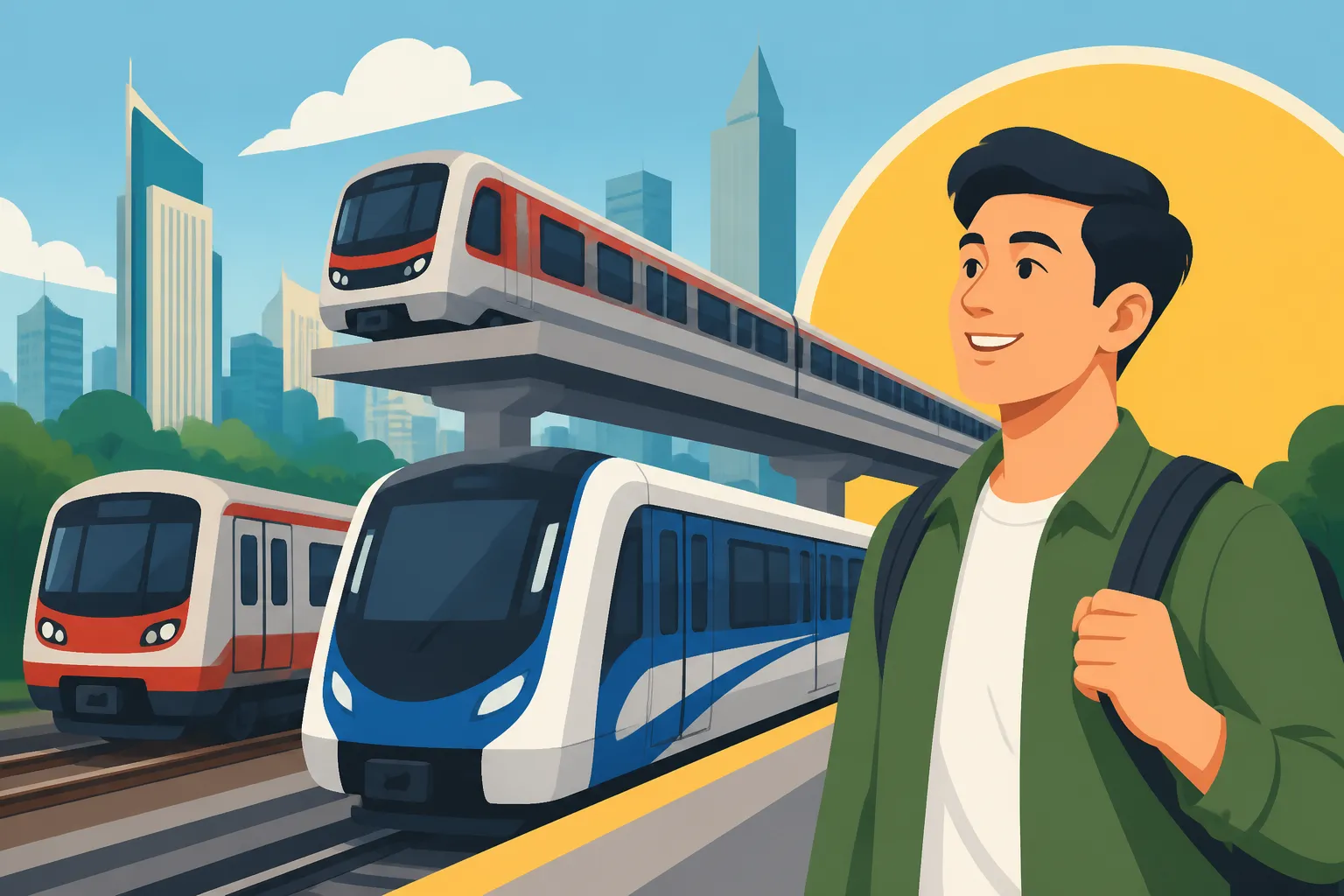
The MRT (Mass Rapid Transit) was a total game-changer for those of us living in the south. Before it opened, traveling from the residential pockets of Lebak Bulus to the offices in the SCBD could take two hours on a bad day. Now, it is a predictable, air-conditioned 30-minute breeze. It represents the "new" Jakarta—efficient, clean, and incredibly punctual. Most expats find this the easiest system to start with because the signage is bilingual and the stations are world-class.
Route Overview and Key Stations
Currently, the Phase 1 line runs from Lebak Bulus in South Jakarta to Bundaran HI in the city center. If you are staying at a hotel, choosing a spot near the Bundaran HI or Dukuh Atas stations will give you the best access to the city’s heart. Key stops include Senayan, which drops you right at the doorstep of the major malls like Senayan City and Plaza Senayan, and Istora Mandiri, which is the gateway to the SCBD office towers.
Expansion is underway for Phase 2, which will eventually connect the center to the historic Old Town (Kota). For now, the existing line serves the most popular expat areas. If you’re looking at Where to Live in Jakarta: Neighborhood Guide for Expat Families and Singles, the MRT makes areas like Cilandak and Cipete much more attractive because you can skip the traffic entirely when heading north for work or social events.
Ticketing and the Multi-Trip Card System
The MRT uses a "tap-and-go" system. You can purchase a single-trip ticket, but as a resident, you’ll want a Multi-Trip Card (MTT) or a bank-issued e-money card. Most locals and veterans use e-money cards like BCA Flazz or Mandiri e-money because they work everywhere—on the MRT, buses, and even for paying tolls. You can easily top these up using Shopee or at any Indomaret or Alfamart convenience store.
There is also the "Marti" app, which allows you to buy tickets via QR code. However, the physical cards are generally more reliable if your phone battery dies or your data is spotty. If you’ve just landed and haven’t set up a local SIM yet, using a service like Airalo for an eSIM will ensure you can at least use the navigation apps to find the station entrances, which are sometimes tucked away behind office buildings.
Expat Perspective: Safety and Comfort
One of the first things you’ll notice about the MRT is the security. There are guards at every entrance and on the platforms. It feels significantly safer than the metro systems in many Western capitals. The "Women Only" carriages at the ends of the train during peak hours are also a welcome feature for female commuters, though generally, the mixed carriages are respectful and orderly.
The air conditioning is powerful—sometimes too powerful. I always tell newcomers to carry a light scarf or jacket, even if it’s 35 degrees outside, because the MRT stations and trains are kept at "arctic" levels. It’s also important to note that eating and drinking are strictly prohibited on the trains and inside the paid areas of the stations. The staff is quite vigilant about this, and following these rules is part of what keeps the system so pristine.
The New Suburb Link: LRT Jabodebek and LRT Jakarta
The LRT (Light Rail Transit) is often confused by newcomers because there are actually two separate systems: the LRT Jakarta and the LRT Jabodebek. The latter is the one you’ll likely use if you live in the outskirts or need to visit the eastern suburbs. It’s a massive elevated network that offers some of the best views of the Jakarta skyline while soaring above the gridlocked toll roads.
Distinguishing Between LRT Jabodebek and LRT Jakarta
LRT Jakarta is a short, localized line in North-East Jakarta connecting Kelapa Gading to the Velodrome. It’s great if you’re heading for some of the city's best Chinese food in Kelapa Gading, but it doesn't yet connect to the wider rail network. On the other hand, the LRT Jabodebek is the "big" one. It connects the city center (Dukuh Atas) to the massive residential hubs of Bekasi and Cibubur.
Understanding the difference is crucial when planning your commute. If you are Commuting in Jakarta: Surviving the MRT, TransJakarta, and Macet (Traffic), the LRT Jabodebek is your primary tool for long-distance travel. The trains are driverless and modern, though the platforms can be quite a walk from the street level. Be prepared for plenty of stairs and long walkways, often referred to as "jembatan penyeberangan orang" or JPO.
Connecting the Suburbs (Cibubur and Bekasi)
For expats working in the manufacturing sectors of Bekasi or living in the greener pastures of Cibubur, this line is a lifesaver. Before the LRT, the commute from Bekasi to Central Jakarta was a gamble with your sanity. Now, the Bekasi line stops at key hubs like Halim (where you can catch the Whoosh high-speed rail to Bandung) and Cawang.
Living further out becomes much more feasible with this system. If you’re checking Jakarta Neighborhoods: Kemang, SCBD, Pondok Indah, and Menteng, you might find that the LRT opens up more affordable housing options in the east while still allowing you to reach the SCBD in under 45 minutes. The reliability of the rail means you can actually set an alarm clock and know exactly when you’ll arrive at your desk.
Integration with TransJakarta and MRT
The "holy grail" of Jakarta transit is the Dukuh Atas Multi-Purpose Bridge (Jembatan Penyeberangan Multiguna). This massive pedestrian bridge connects the LRT Jabodebek station, the Sudirman KRL station, the MRT Dukuh Atas station, and the Airport Rail Link. It’s a bit of a hike, but it allows you to switch between systems without ever touching the actual road.
This integration is part of the city’s "JakLingko" initiative, which aims to unify all transport under one payment and routing system. While it’s not 100% seamless yet, it’s getting closer. You can use your Shopee app to pay for many of these connections, making the physical act of commuting much less of a headache than it was five years ago.
The Workhorse: KRL Commuter Line
The KRL is the oldest and most extensive part of the rail network. It’s the "people’s train," carrying millions of commuters from the greater satellite cities of Bogor, Depok, Tangerang, and Bekasi (collectively known as Jabodetabek). It is cheaper than the MRT and LRT, but it is also much more crowded. If you want the "real" Jakarta experience, the KRL is it.
Navigating the Chaos of Manggarai Station
Manggarai is the central hub where almost all KRL lines intersect. To be honest, it can be overwhelming for a first-timer. It’s a multi-level station with platforms that seem to change at a moment's notice. You will see thousands of people moving with purposeful speed; my advice is to stay to the side while you find your bearings.
If you are trying to reach the specialized medical centers mentioned in the Finding Medical Care in Indonesia: Clinics, Hospitals, and International Facilities, the KRL can often get you closer than the MRT. For example, the Cikini station is right next to several major hospitals. Just give yourself an extra 20 minutes to navigate the transfers at Manggarai, and always follow the crowd—they usually know which platform the next train to the city center is arriving at.
Women-Only Carriages and Cultural Etiquette
The KRL pioneered the use of "Kereta Khusus Wanita" (Women Only Carriages), which are the first and last cars of every train. They are painted pink and are strictly enforced. For female expats, these carriages provide a much more comfortable space during the "sardine-can" hours of 7:00 AM and 5:30 PM.
Etiquette on the KRL is quite specific. You are expected to give up your seat for the elderly, pregnant women, and people with disabilities—this is taken very seriously, and guards will often tap you on the shoulder if you’re a healthy young person sitting while an elder is standing. Also, keep your backpack on your front. This isn’t just for pickpocket prevention; it’s to save space and avoid hitting people behind you in the packed cars.
Practical Tips for Peak Hour Survival
If you don't have to travel during peak hours, don't. Between 7:00 and 9:00 AM, the KRL is intense. However, if you must, try to board at the very ends of the platform where it’s slightly less crowded. If you find yourself squeezed into a car, don't panic. The "push" is normal, and people are generally trying to be helpful despite the lack of personal space.
One "pro tip" I’ve learned is to check the train's final destination. Trains marked "Bogor" are notoriously the most crowded. If you can take a train that terminates earlier, like "Depok," you might actually find a square inch of floor space to yourself. If you're feeling overwhelmed, you can always hop off at a station like Sudirman and grab a coffee at one of the nearby malls until the rush subsides.
Comparison of Jakarta Rail Systems
| Feature | MRT Jakarta | LRT Jabodebek | KRL Commuter Line |
|---|---|---|---|
| Primary Route | Lebak Bulus – Bundaran HI | City Center – Bekasi/Cibubur | Greater Jabodetabek |
| Punctuality | Extremely High | High | Moderate |
| Cost (Approx) | IDR 3,000 – 14,000 | IDR 5,000 – 20,000 | IDR 3,000 – 6,000 |
| Crowd Level | Moderate | Moderate | Very High (Peak) |
| Best For | Business/SCBD access | Suburban commuting | Budget/Old Town visits |
TransJakarta: The World’s Longest BRT System
While not a rail system, TransJakarta is the "connective tissue" of the city. It’s a Bus Rapid Transit (BRT) system with dedicated lanes, meaning the buses can zip past the traffic. It has its own elevated stations that often connect directly to MRT and KRL stations via skywalks.
Dedicated Lanes and the Busway Experience
The magic of TransJakarta is the "Busway." These are lanes separated by concrete barriers that are (theoretically) only for buses. During heavy rain or peak hour, these lanes are the only things moving. The buses are divided into "Regular" (stops at all stations) and "Express" (skips smaller stops).
If you’re traveling to South Jakarta, specifically the Kemang area, you’ll find that the Finding an English-Speaking Clinic in South Jakarta (Kemang and SCBD) locations are often a short "Gojek" ride away from a TransJakarta corridor. The system is incredibly cheap (IDR 3,500 flat rate), but be prepared for "the gap." The platforms are often a few inches away from the bus door, and the height can be a bit of a jump.
Feeder Buses and MicroTrans
Beyond the main corridors, there are thousands of smaller "MicroTrans" minivans (often called Angkot). These are integrated into the JakLingko system. If you have a JakLingko card, these rides are often free. They go deep into the residential "gangs" (small alleys) where big buses can't fit.
For an expat, these can be a bit daunting because they don't have fixed stops—you just tell the driver "Kiri, Pak!" (Left, Sir!) when you want to get out. However, they are essential for reaching local markets or hidden gems for dining. It’s a great way to practice the phrases you’re learning in Learning Bahasa Indonesia: BIPA Certification, Tutors, and Workplace Usage.
Safety Tips for Solo Travelers
TransJakarta is generally safe, but like any major city’s bus system, you should stay alert. Pickpocketing can happen at the crowded transfer stations like Harmoni or Semanggi. Keep your phone in your front pocket and your bag zipped.
The stations are well-lit and have staff present until the system closes (around 10:00 PM or 11:00 PM, with some 24-hour routes). If you are ever unsure of which bus to take, the staff at the "Tapping" gates are usually very helpful, even with limited English. They will point you to the correct "pintu" (gate) for your destination.
Payment Systems and Connectivity Apps
The most important thing you can do when you arrive is to get your payment sorted. You cannot pay with cash on any of these systems. Everything is electronic. Having a loaded card or a working app is the difference between a smooth ride and being stuck at the turnstile.
E-Money, Flazz, and TapCash: Which One to Get?
These are plastic "stored-value" cards issued by banks. BCA Flazz is the most popular because BCA has the most ATMs for easy top-ups. However, Mandiri e-money and BNI TapCash are equally accepted across all transport modes. You can buy these cards at the airport, at major bus terminals, or at Shopee.
A new development is the integration of these cards with your NIK (National ID) or your KITAS number for residents. While not mandatory for tourists, residents are encouraged to register their cards so they can be blocked and the balance recovered if lost. This is a huge improvement over the old "lost is lost" system.
Using Digital Wallets for Transit
Apps like GoPay and Shopee are becoming increasingly integrated into the transit network. On the MRT and LRT, you can often generate a QR code in the app, scan it at the gate, and the fare is deducted directly from your balance. This is incredibly convenient if you forget your physical card.
However, a word of caution: the QR scanners can sometimes be finicky or slow. If there is a long line of impatient commuters behind you, it’s always faster to use a physical card. I usually keep my BCA Flazz card in a lanyard or an easy-access pocket in my bag to ensure a "one-tap" entry.
Digital Tools: Google Maps vs. Local Apps
Google Maps is surprisingly accurate for Jakarta’s rail systems, including real-time delays. However, for the buses, an app called "Moovit" or the local "Trafi" app can provide more granular data on the feeder routes. These apps are essential for Commuting in Jakarta: Surviving the MRT, TransJakarta, and Macet (Traffic) because they factor in the current "macet" levels.
Another essential tool is the "Halodoc" app, which isn't for transit but is vital if you get caught in the pollution during your commute. If the "AQI" levels are high, many expats use these apps to order masks or medicine if they start feeling the "Jakarta cough" after a long day of using the semi-open bus stations.
Troubleshooting Common Commuter Issues
Even with the best planning, things can go wrong. The power might flicker, a train might be delayed due to a "gangguan sinyal" (signal interference), or you might simply get on the wrong train heading to the wrong end of Java.
Handling Overcrowding and Delays
If you see a train that is absolutely packed to the brim, it’s often worth waiting five minutes for the next one. On the MRT, trains come every 5 to 10 minutes, so there is no need to risk being crushed. On the KRL, however, the next train might be 20 minutes away, which is why people are more desperate to squeeze in.
In the event of a major delay, the stations will make announcements in Bahasa Indonesia. If you don’t understand, look for the younger commuters with headphones—they usually speak excellent English and will be happy to explain what’s going on. Jakarta's "gotong royong" (communal help) spirit is very much alive on the trains.
What to Do If You Lose Your Card or Phone
If you lose your tapping card inside the system, don’t try to jump the turnstile. Go to the "Passenger Service" booth. They can check your entry point (if you remember it) and issue a "Exit Only" ticket for a small fee. They are used to this happening and are generally very patient.
If you lose your phone, hopefully you have your "find my phone" settings on and a backup of your IMEI number. As mentioned in our guide on Phones and Tech: IMEI Registration, SIM Cards, and Duty Tax Explained, having your device properly registered with the government makes it much easier to report it lost or stolen to the police, which you will need for any insurance claims.
Navigating the Last Mile: Gojek and Grab
The rail stations will get you 90% of the way there, but the "last mile" is where the motorbikes come in. Every MRT and LRT station has a designated "Ojek" (motorbike taxi) pickup point. Using the Gojek or Grab app to call a bike to take you from the station to your final destination is the ultimate Jakarta hack.
It’s often faster than a car for short distances and costs less than a dollar. If you’re worried about hygiene, the drivers usually provide a hairnet to wear under the helmet. It’s a bit of a thrill the first time, but soon it will become a completely normal part of your daily routine.
Disclaimer
This guide is intended for informational purposes only. While every effort has been made to ensure the accuracy of the transport routes, costs, and regulations as of 2026, Jakarta's infrastructure is rapidly evolving. Always check the official MRT Jakarta, LRT, and PT KAI websites or mobile apps for the most current schedules and fare adjustments. The author is an expat sharing personal experiences and is not an official representative of the Indonesian transport authorities.