Dressing Modestly: What ‘Sopan’ Means Outside of Beach Resort Areas
Walking into a local government office in Jakarta for the first time, I felt confident in my tidy linen shorts and a high-quality tank top, only to be stopped at the gate by a security guard pointing at my knees and shaking his head. I learned the hard way that "casual" in the West is often "disrespectful" in Indonesia. This guide breaks down the essential cultural concept of sopan to help you navigate life outside the beach bubbles with ease.
The Philosophy of Sopan Santun and Why It Matters
To live comfortably in Indonesia, you must move beyond the "tourist" mindset and embrace the local social fabric. The term sopan (polite/appropriate) is part of a larger cultural pillar called sopan santun, which dictates how people interact, speak, and—most importantly for this guide—dress. In many Western cultures, clothing is viewed as a form of individual self-expression. In Indonesia, however, your clothing is viewed as a sign of respect toward the people you are visiting or the environment you are entering.
When you dress appropriately, you are signaling that you value the local culture and the people around you. This opens doors. People will be more helpful, more patient, and more welcoming. Conversely, dressing "immodestly" in a non-tourist area doesn't usually result in hostility—Indonesians are incredibly polite and conflict-averse—but it does create a social barrier. You might notice people being more guarded, or you might find yourself receiving the "cold shoulder" during administrative tasks.
If you are staying in a hotel booked via Agoda, you might feel like you are in a globalized space where anything goes, but the moment you step outside the lobby, you are entering a community with deep-rooted traditions. Understanding the nuance of these traditions is the first step toward a successful long-term stay.
The Difference Between Private and Public Spaces
One of the biggest hurdles for new expats is defining where a "public" space begins. In a Western city, a sidewalk is a neutral zone. In an Indonesian kampung (neighborhood), the area in front of a house is a semi-private space where community norms are strictly observed. While you might feel perfectly fine walking to a nearby convenience store in workout leggings and a sports bra, this is often seen as "undressed" by your neighbors.
A good rule of thumb is to look at your surroundings. If you are in a high-density residential area, modesty is the default. Even if it is 35 degrees Celsius with 90% humidity, you will notice locals wearing jeans and long-sleeved shirts. They aren't just used to the heat; they are prioritizing sopan over physical comfort. This is why many expats choose to live in specific areas like those mentioned in our Where to Live in Jakarta: Neighborhood Guide for Expat Families and Singles, where the community is more used to international standards, though the rules of respect still apply when you leave your immediate street.
Visual Cues and Local Reactions
Indonesians rarely confront foreigners directly about their clothing. Instead, you will experience "indirect feedback." This might manifest as a lingering look, a subtle giggle among a group of friends, or a sudden lack of availability when you ask for help. This is part of the "saving face" culture.
If you are out and about using Airalo to navigate your way through a new city, pay attention to how people of your same gender are dressed. If 90% of the women are wearing sleeves to the elbow and trousers or skirts to the ankle, and you are in a sundress with spaghetti straps, you are likely pushing the boundaries of what is considered sopan. It’s not about being "covered" for religious reasons—though that is a major factor—it’s about matching the level of formality and modesty of the community.
The Dress Code for Daily Life and Errands
Living in Indonesia means constant interaction with the service sector and government bureaucracy. Whether you are shopping, banking, or visiting a doctor, your attire serves as your first introduction. There is a direct correlation between how "sopan" you look and how smoothly your administrative tasks will go.
Navigating Government Offices and Banks
If you are heading to the Imigrasi office to handle your KITAS Explained: Working, Dependent, and Investor Temporary Stay Permits, the dress code is non-negotiable. Most government buildings have a sign at the entrance illustrating the required attire: no shorts, no flip-flops, and no sleeveless tops. This applies to both men and women.
I have seen expats in Bali try to enter the immigration office in board shorts and singlets, only to be told they must go home and change or buy a sarong from a nearby vendor at a significant markup. The same applies to Opening a Bank Account in Indonesia: Document Checklists (KITAS, NPWP, Passport. While banks are private institutions, they maintain a high standard of formality. Dressing in business-casual attire—a polo shirt or blouse with long trousers and closed-toe shoes—will often result in faster service and a more professional interaction with the bank staff.
Shopping at Traditional Markets vs Modern Malls
The "mall culture" in Indonesia is massive, especially in Jakarta and Surabaya. In high-end malls, the dress code is quite relaxed. You will see young Indonesians in trendy outfits that wouldn't look out of place in London or New York. However, the moment you transition to Navigating the Traditional Market (Pasar Tradisional) Early Morning Rush, the expectations shift.
In a pasar, you are interacting with local vendors who may have more conservative values. Wearing very short shorts or revealing tops in these environments can make you a target for unwanted attention or, at the very least, make bargaining more difficult. If you look like a "wealthy tourist" who doesn't respect local norms, vendors are less likely to give you the local price when you are Supermarkets and Groceries: Finding Imported Goods without Breaking the Bank. A simple t-shirt that covers the shoulders and "city shorts" that reach the mid-thigh are usually sufficient for these errands.
Dressing for Different Environments
| Setting | Recommended Attire (Men) | Recommended Attire (Women) | The "Sopan" Factor |
|---|---|---|---|
| Government Offices | Collared shirt, long trousers, shoes | Blouse (shoulders covered), trousers/long skirt, shoes | High – Strictly enforced |
| Traditional Markets | T-shirt, knee-length shorts, sandals | T-shirt/Tunic, capris or long skirt, sandals | Medium – For respect and safety |
| High-End Malls | T-shirt/Polo, jeans/shorts, sneakers | Any modest trendy wear, sundresses (keep a shawl) | Low – Modern and international |
| Religious Sites | Long trousers or Sarong, shirt | Long skirt/trousers, shoulders covered, Sarong | Very High – Mandatory |
| Local Weddings | Long-sleeved Batik shirt, trousers | Formal dress (modest) or Kebaya | High – Shows social status |
Special Occasions and Sacred Spaces
Indonesia is a deeply spiritual country, and nowhere is the concept of sopan more vital than in religious or ceremonial settings. Whether you are visiting the lush landscapes described in our Bali Neighborhoods: Seminyak, Canggu, Sanur, Ubud, and the Bukit or attending a work function, your outfit is a reflection of your character.
Visiting Religious Sites: Mosques and Temples
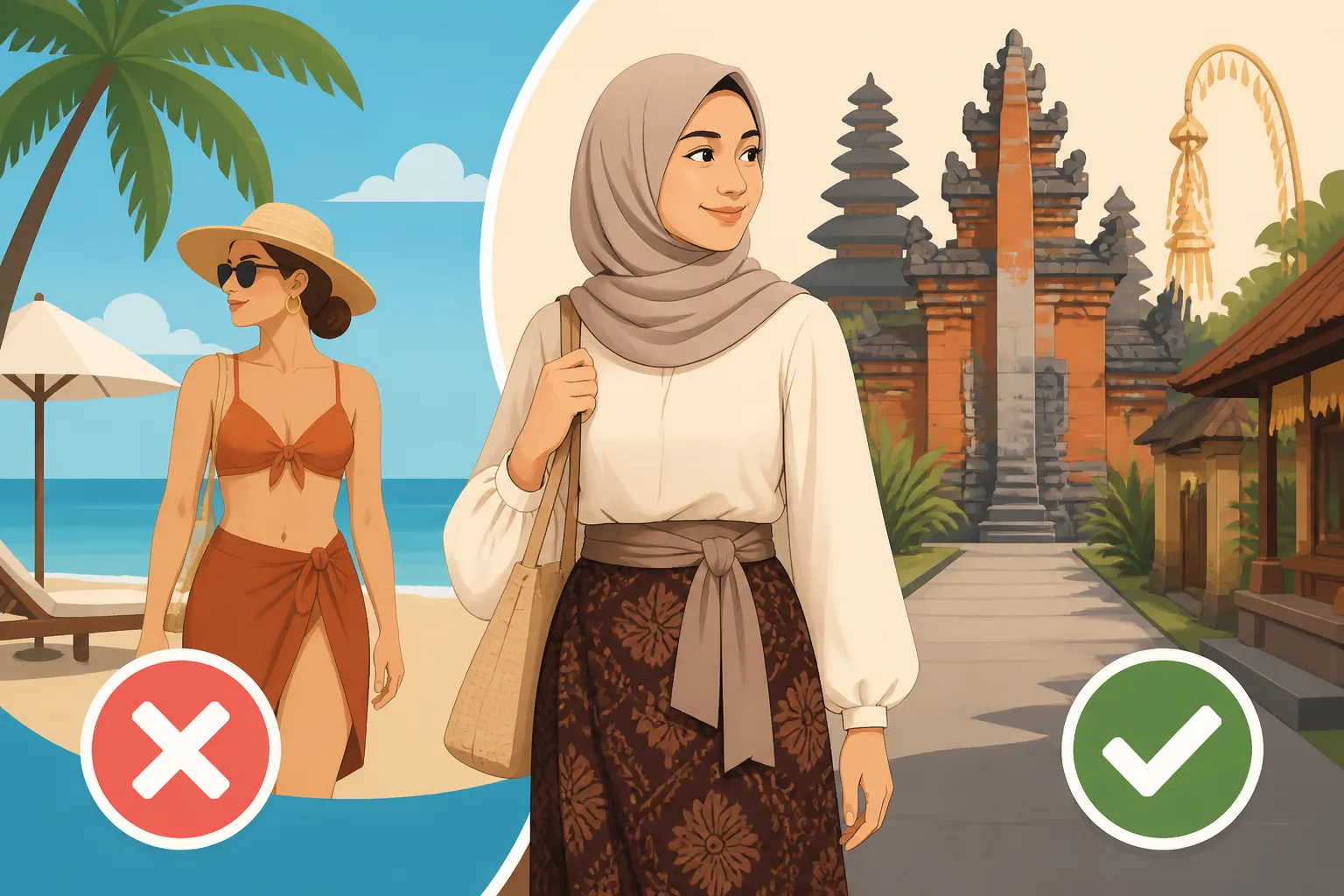
When entering a mosque, both men and women must ensure their legs are covered to the ankles. Women should also cover their arms to the wrists and are generally expected to wear a headscarf (hijab) as a sign of respect, even if they are not Muslim. Always remove your shoes before entering the prayer hall. If you are unprepared, many larger mosques like Istiqlal in Jakarta provide robes for visitors.
In Balinese Hindu temples, the rules are slightly different but equally strict. Everyone, regardless of what they are wearing, must wear a sarong and a waist sash (selendang). Even if you are wearing long trousers, the sarong is a ritual requirement. It is also important to ensure your upper body is covered; a t-shirt is usually acceptable, but a sleeveless tank top is not. These rules are part of the Everyday Etiquette: Religion, Culture, Garbage, and Community Norms that every resident should memorize.
The Power of Batik
If there is one "cheat code" for dressing in Indonesia, it is the Batik shirt. For men, a high-quality, long-sleeved Batik shirt is considered formal wear, equivalent to a suit and tie in the West. You can wear it to weddings, high-level business meetings, and even state events. For women, Batik can be worn as a blouse, a dress, or a traditional skirt.
Wearing Batik is perhaps the easiest way to show you have transitioned from a visitor to a resident. It demonstrates an appreciation for Indonesian heritage. When I first started attending community meetings, I noticed a palpable shift in how I was treated once I traded my western button-downs for local Batik. It signals that you are "one of us." You can find beautiful Batik options on Shopee for everyday wear or visit specialized boutiques for hand-painted Batik Tulis.
Practical Tips for Building a Modest Tropical Wardrobe
The challenge for most expats is balancing the need for modesty with the reality of the Indonesian climate. Sweat is an inevitable part of life here, but with the right fabric choices, you can stay cool while remaining sopan.
Materials and Fabrics for the Tropics
Avoid synthetic fabrics like polyester at all costs. They don't breathe and will lead to skin irritation in the humidity. Instead, look for:
- Linen: Perfect for trousers and long-sleeved shirts. It’s naturally cooling and dries quickly.
- Cotton-Voile: A very light, semi-sheer cotton that is great for layering.
- Rayon: Many local clothes are made of rayon because it is cheap and incredibly breathable, though it does wrinkle easily.
When you are out and about, perhaps heading to a medical appointment to use your Using Your BPJS Card (Kartu JKN): How to Register and Book at Local Faskes, carrying a light "emergency shawl" or a thin cardigan in your bag is a lifesaver. It allows you to dress in a lighter top for the walk and quickly cover up when you enter a more formal or air-conditioned environment.
Where to Buy Sopan Clothing
While international brands are available in major cities, they often design for European or North American climates. Local Indonesian brands are much better at creating "modest-chic" clothing that accounts for the heat.
- Online Platforms: Shopee is the go-to for affordable, local fashion. You can search for terms like pakaian sopan (polite clothing) or baju kerja (work clothes) to find appropriate options.
- Local Boutiques: Look for "Concept Stores" in neighborhoods like Senopati or Kemang. They often feature local designers who specialize in breathable, modest silhouettes.
- Tailoring: One of the perks of living in Indonesia is the affordability of custom tailoring. You can buy high-quality fabric and have a local penjahit (tailor) create trousers and shirts that fit you perfectly and meet all the cultural requirements of your specific region.
Regional Variations: From Aceh to Bali
It is important to remember that Indonesia is an archipelago of over 17,000 islands, and what is considered "modest" varies significantly by region.
- Aceh: The most conservative province. Sharia law is in effect here, and non-Muslim women are expected to dress very modestly (long sleeves, long trousers/skirts), though the headscarf is not legally required for non-Muslims.
- Jakarta and Java: Generally conservative but cosmopolitan. In the business districts, global standards apply, but in the residential kampungs, modesty is the rule.
- Bali: The exception to the rule. In tourist areas like Canggu or Seminyak, beachwear is normalized. However, as soon as you head north to the villages or enter a local home, the standard sopan rules apply instantly.
- Eastern Indonesia: In Christian-majority areas like Flores or Papua, the dress code is often slightly more relaxed regarding headcoverings, but modesty in terms of leg and shoulder coverage remains a sign of respect.
By taking the time to observe and adapt, you aren't "losing your identity"—you are gaining a deeper connection to your new home. Dressing with sopan in mind is a small price to pay for the incredible warmth and hospitality the Indonesian people offer in return.
Disclaimer
The information provided in this guide is based on cultural observations and general social norms in Indonesia as of 2026. While we strive for accuracy, cultural expectations can vary significantly between individuals, families, and specific sub-regions. This guide does not constitute legal advice regarding local sumptuary laws where applicable.