Splitting Bills: Why Indonesian Restaurants Rarely Let You Split by Item
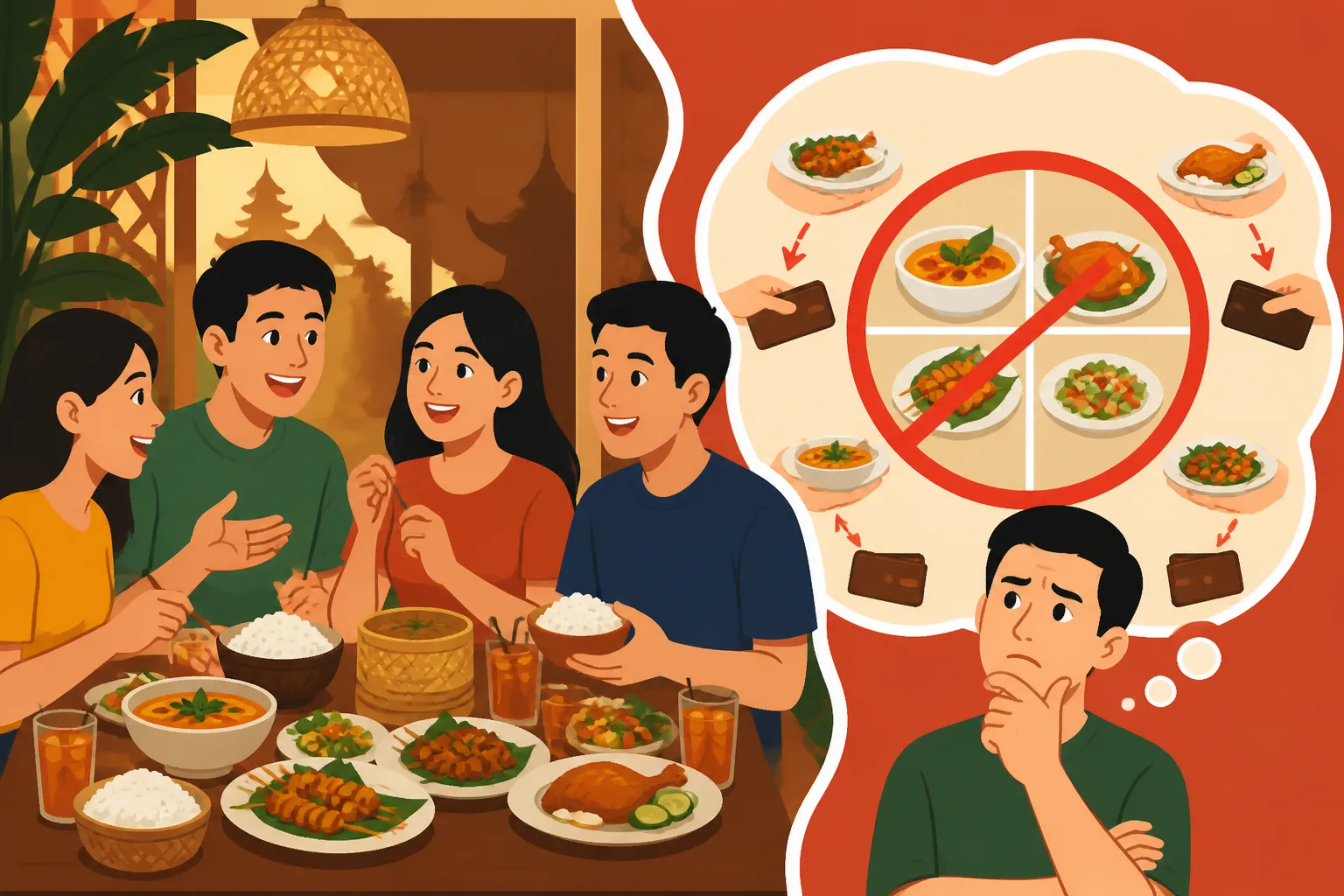
You are sitting at a bustling cafe in Senopati or a beach club in Canggu, the table is covered in empty plates of satay and empty Bintang bottles, and then comes the moment of truth: the bill arrives. I remember my first group dinner in Jakarta where I tried to pay for exactly what I ate, only to watch three waiters huddle around a single monitor in total confusion for fifteen minutes while the rest of my party waited awkwardly by the door. This guide dives into the administrative, cultural, and technical reasons why splitting by item is so rare in Indonesia and gives you the exact strategies you need to avoid social and logistical awkwardness.
The Administrative Hurdle of the POS System
The primary reason you will be met with a hesitant "Maaf, tidak bisa" (Sorry, we can't) when asking to split a bill by item is the Point of Sale (POS) software used across the country. Whether it is a high-end restaurant in one of the Jakarta Neighborhoods: Kemang, SCBD, Pondok Indah, and Menteng or a small local bistro, many businesses use digital systems like Moka, Jurnal, or Majoo. These systems are often configured to "close" a table's order once the first sub-total is printed.
Software Limitations and Accounting Rigidities
In many Western countries, POS systems are designed with individual "seats" in mind, allowing a server to shift a glass of wine or a burger to a specific person with a swipe. In Indonesia, the order is typically tied to a single "Open Table" or "Transaction ID." Once the bill is requested, the system generates a single invoice. To split this by item, the server would often have to void the entire transaction—which usually requires a manager’s key or fingerprint—and then re-input every single item as individual bills.
From the waiter's perspective, this isn't just a click of a button; it is a five-to-ten-minute administrative nightmare that risks accounting errors. If they are in the middle of a dinner rush, they simply do not have the time to do this for a table of eight people. If you are staying at a luxury resort booked through Agoda, you might find the hotel restaurants more accommodating because their high-end property management systems are more flexible, but even then, it is often seen as a significant burden.
The Tax and Service Charge Complication
Another massive bottleneck is the "Plus-Plus" (++) system. Most menus in Indonesia do not include the 10% government tax and the service charge (which usually ranges from 5% to 10%). When a bill is split by item, the tax and service charges must be recalculated for every individual receipt. Doing this manually or via a rigid POS system is prone to error, and in a culture where accuracy in the "Kasir" (cashier) department is strictly monitored, staff are terrified of having their daily balance not match their receipts.
Cultural Nuances and the Concept of Patungan
To understand why restaurants aren't set up for individual billing, you have to understand the local social fabric. Indonesians are deeply communal, and the idea of "going Dutch" in a granular, item-by-item way is often viewed as "pelit" (stingy) or overly transactional. Instead, groups tend to lean toward one of two extremes: the "Traktir" or the "Patungan."
The Traktir Culture
"Traktir" means to treat others. It is very common for one person—the boss, the birthday celebrant, or the person who just got a promotion—to pay the entire bill for everyone. This simplifies the process for the restaurant significantly. If you are ever invited to a meal and someone says "Saya traktir ya," it means they are picking up the tab. It is polite to offer to pay, but if they insist twice, you should accept graciously and perhaps offer to buy the next round of drinks or coffee later.
Understanding Patungan
When a treat isn't on the cards, the group does Splitting the Bill (Patungan): Social Money Etiquette in Indonesian Dining. "Patungan" is the Indonesian version of splitting the bill, but it is almost always done by dividing the total amount by the number of people, rather than auditing who had the extra side of sambal. It is a "rough justice" system that prioritizes speed and social harmony over mathematical precision.
If you are out with local friends and try to calculate that you owe 142,500 IDR while someone else owes 160,000 IDR, you might get some funny looks. Usually, someone will just say, "Okay, it's 1.5 million total, we are 10 people, so it's 150k each." This cultural preference is reflected in the way restaurants operate; they expect one payment or a simple split by a fixed amount.
Technical Solutions for Modern Expats
Thankfully, we are living in 2026, and the digital landscape in Indonesia is incredibly advanced. Even if the restaurant cannot split the bill by item for you, you can do it yourself in seconds using local fintech. This is where having a reliable data connection via Airalo becomes essential, as you will need to access your banking apps or e-wallets the moment the bill hits the table.
The Power of QRIS and E-Wallets
Indonesia has pioneered one of the world's most seamless payment systems: QRIS (Quick Response Code Indonesian Standard). You will see this square barcode everywhere. While the restaurant still wants one person to pay the main bill, the rest of the group can instantly reimburse that person using apps like GoPay, OVO, or Dana. You can learn more about setting these up in our guide on Digital Banking and E-Wallets: How to Register for GoPay, OVO, and Dana.
Using Bill-Splitting Apps
Many expats and tech-savvy locals now use apps to do the heavy lifting. One person pays the full bill (often to collect credit card points or ShopeePay rewards) and then uses an app like "Line Bank" or even the built-in "Split Bill" feature in the GoJek app. You simply take a photo of the receipt, the app uses OCR (Optical Character Recognition) to read the items, and you assign items to each person. The app then calculates the tax and service for each person and sends them a payment request.
The Role of E-Commerce Loyalty
Frequently, locals will compete to be the one who pays the whole bill because they want to use their Shopee Pay or other e-wallet balances to get "cashback" points. If you see your friend jumping to pay the bill with their phone, they might be harvesting points that they can use for their next grocery delivery or coffee. In these cases, just ask them, "Berapa bagian saya?" (How much is my share?) and send it to them via a bank transfer or e-wallet immediately.
Strategies for a Stress-Free Dinner
If you are the organizer of a large group dinner, perhaps celebrating a move to Bali Neighborhoods: Seminyak, Canggu, Sanur, Ubud, and the Bukit, you need a game plan to avoid a 30-minute standoff at the cashier.
| Strategy | Best For | Pros | Cons |
|---|---|---|---|
| The Banker Method | Large groups (6+) | Fastest exit; restaurant loves you. | One person carries the "debt" until repaid. |
| Split by Amount | Casual lunch with colleagues | Fairly fast; easy for the POS system. | Someone who ordered less pays more. |
| Cash Pool | Traditional settings/Pasar | No tech needed; clear. | Handling change and "plus-plus" math is hard. |
| The QRIS Shuffle | Tech-savvy groups | Precise; no physical money involved. | Requires everyone to have a local bank app. |
Designating a "Banker" Early
Before the food even arrives, decide who will be the "Banker." This person will handle the final payment. At the end of the meal, the Banker takes a photo of the bill and posts it to the WhatsApp group. Everyone then calculates their own total (don't forget the 15-21% tax/service!) and transfers the money to the Banker. This allows the group to leave the restaurant immediately while the "accounting" happens on the ride home.
Factoring in Tax and Service
The biggest mistake foreigners make is forgetting the "++". If your Nasi Goreng was 100,000 IDR on the menu, your actual contribution to the bill is likely closer to 121,000 IDR. When you are doing your own math to pay back the "Banker," always look at the bottom of the bill for the tax and service percentages. A quick way to do this is to take your item total and multiply it by 1.21. This ensures the person who paid the bill isn't left covering everyone's tax.
Dealing with Alcohol
Alcohol is heavily taxed in Indonesia and can often be the most expensive part of the meal. If half the group is drinking and the other half isn't, the "split evenly" method becomes unfair. In these cases, it is standard practice to calculate the "Food + Soft Drinks" split evenly among everyone, and then have the drinkers split the "Alcohol" portion among themselves. This follows the general principles of Everyday Etiquette: Religion, Culture, Garbage, and Community Norms where we try to remain respectful of different lifestyles and budgets.
When You Can Actually Ask to Split
There are very rare occasions where asking to split by item might work, but you should use these sparingly. If you are in a very quiet cafe during off-peak hours and you ask before you order, the waiter might be able to open separate transactions for each person.
However, even if they say yes, keep in mind that Using QRIS: The Cashless Payment System Revolutionizing Indonesian Commerce has made it so easy to reimburse friends that the "split by item" request is increasingly seen as an unnecessary hurdle. If you find yourself in a situation where you are struggling with the local language to explain a complex bill, remember that you can find assistance via our guide on Finding an English-Speaking Clinic in South Jakarta (Kemang and SCBD) if the stress of the situation actually leads to a headache—though hopefully, it won't come to that!
Always remember to be patient. The "Bapak/Ibu" culture in Indonesia values politeness over efficiency. If the waiter is struggling with your bill, getting frustrated will only make the process slower. A smile and a "Terima kasih, maaf merepotkan" (Thank you, sorry for the trouble) goes a long way.
Understanding Tipping in the Context of Splitting
If you do manage to get the restaurant to split the bill, or if your "Banker" handles everything, don't forget the staff. While a service charge is usually included, it doesn't always go directly to the person who waited on you. If the service was exceptional—especially if they handled a complex group payment with grace—leaving an extra 20,000 or 50,000 IDR on the table is a great gesture. You can read more about the nuances of this in our article on Tipping Culture in Indonesia: Gojek Drivers, Waitstaff, and Spa Therapists.
By following these cultural and technical shortcuts, you can focus on what really matters: the incredible food and the company of your friends, without the "bill dread" that haunts so many newcomers to the archipelago.
Disclaimer
The information provided in this guide is for informational purposes only and reflects the general practices in Indonesia as of 2026. Payment regulations, POS technology, and tax laws are subject to change. Always verify current prices and policies with the specific establishment you are visiting.