Buying an iPhone in Singapore vs Indonesia: Tax Math and IMEI Hassles
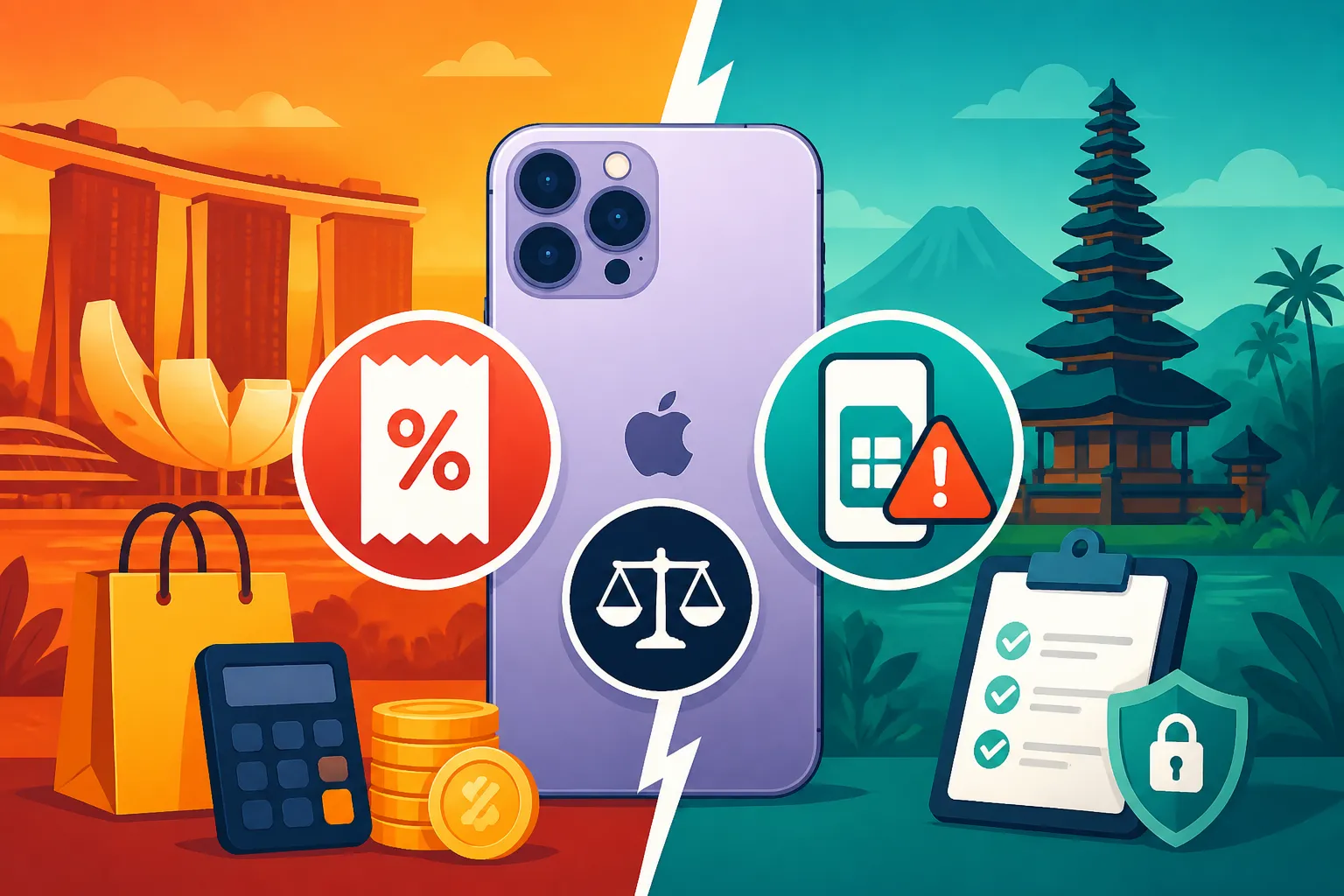
Landing at Soekarno-Hatta and realizing your brand-new "cheaper" Singaporean iPhone has suddenly become a high-end paperweight is an expat rite of passage I wouldn't wish on anyone. I remember standing in the humid customs hall, clutching a receipt and wondering if my weekend flight to Orchard Road actually saved me a single cent after the signal bars vanished. This guide solves the complex math of Singapore versus Indonesia iPhone purchases, breaking down the taxes, the IMEI registration hurdles, and the hidden costs of bringing tech across the border.
The iPhone Price Gap: Singapore vs. Indonesia
When you look at the Apple Singapore website and compare it to the prices at iBox or Erafone in Jakarta, the gap seems obvious. Singapore typically enjoys the earliest release dates in Southeast Asia and a retail price that doesn't include the heavy import duties found in Indonesia. For many of us living here, the temptation to "hop over" for a weekend and grab the latest model is strong. However, the sticker price is only the beginning of the story.
Analyzing the MSRP and Currency Conversion
In Singapore, the MSRP is straightforward. You pay the price listed, and as a tourist, you can even claim a portion of the GST back at Changi Airport. When you bring that device into Indonesia, however, you aren't just comparing SGD to IDR. You are navigating the volatility of the Rupiah. If you are using an Indonesian bank account to fund your purchase, you'll need to be aware of the conversion rates used by your provider. I’ve found that using Money in Indonesia for Foreign Residents: Banking, Tax, and Financial Setup (2027) can help you understand how to manage these larger foreign currency transactions without getting hit by massive bank fees.
The price in Indonesia is higher because authorized resellers have already baked in the import taxes, luxury taxes, and the costs of local certification (TKDN). While you might pay 15% to 20% more at a local mall, that price includes the peace of mind that the device is already registered in the national database. You won't have to worry about the 90-day "honeymoon period" before the Ministry of Communication and Information (Kemkominfo) cuts off your cellular access.
Availability and the Shopee Marketplace Factor
Another factor is stock availability. During launch months, Jakarta stores often run dry, leading expats to look toward the Shopee marketplace. On platforms like Shopee, you will see two types of listings: "Official Warranty" (Garansi Resmi) and "International Warranty" (Garansi Internasional). This is where things get dangerous. International warranty phones are often "gray market" imports. While they are cheaper, many sellers do not properly register the IMEI.
If you buy a phone from a marketplace that hasn't been registered, you will eventually face a permanent signal block. I always tell newcomers that if a deal looks too good to be true on a local app, it’s likely because the seller is bypassing the Mandatory IMEI Registration: The 90-Day Rule and Airport Customs Process. Always verify that the seller provides a "Bukti Bayar Bea Cukai" (Proof of Customs Payment) if you aren't buying from an authorized reseller like iBox.
The Hidden Costs: Calculating IMEI Customs Tax
This is where the "Singapore savings" often evaporate. Indonesia's Directorate General of Customs and Excise (Bea Cukai) is very efficient at spotting new iPhones. If you bring a phone from Singapore, you are legally required to declare it. The tax calculation is not based on the full price, but it is still significant enough to bridge the price gap between the two countries.
The $500 Exemption Rule
The most important thing to know is the $500 USD exemption. Every traveler entering Indonesia is allowed $500 USD worth of personal goods tax-free. If your iPhone 15 or 16 costs $1,200 USD, you only pay tax on the remaining $700 USD. This sounds simple, but I’ve seen people get tripped up when they bring multiple gadgets. That $500 is your total allowance for the trip, not $500 per device.
To understand how this fits into your broader financial obligations, it’s worth reviewing Taxes in Indonesia for Expats: NPWP, PPh 21, and the 183-Day Rule. Knowing your tax status can actually save you money at the customs desk, as I'll explain in the next section regarding your Tax ID.
The NPWP Discount and Tax Brackets
The total tax you pay consists of three parts: Import Duty (Bea Masuk), Value Added Tax (PPN), and Income Tax (PPh). This is where having an Indonesian Tax ID (NPWP) becomes a massive advantage. If you have a valid NPWP, your Income Tax (PPh) rate is 10%. If you do not have one, that rate doubles to 20%.
For a high-value item like an iPhone, the difference between having an NPWP and not having one can be upwards of $70 to $100 USD. If you haven't linked your tax records yet, see Registering for an NPWP (Tax ID): How Expats Link NIK to Tax Records in 2027 to ensure you are prepared before you head to the airport customs desk.
| Tax Component | Rate with NPWP | Rate without NPWP |
|---|---|---|
| Import Duty (Bea Masuk) | 10% | 10% |
| Value Added Tax (PPN) | 11% | 11% |
| Income Tax (PPh) | 10% | 20% |
| Estimated Total Tax | ~21-25% of value > $500 | ~31-35% of value > $500 |
The Logistics of Registration: Airport vs. Post-Arrival
Once you've done the math, you have to deal with the bureaucracy. There are two ways to handle this, and one of them is significantly more painful than the other. I learned this the hard way after trying to save time at the airport and ending up in a government office two weeks later.
Registering at the Airport: The Easy Way
The absolute best way to register a Singaporean iPhone is at the customs desk immediately after you clear immigration but before you exit the arrivals hall. You must fill out your Electronic Customs Declaration (e-CD) online before you land. When you reach the "Red Line" (Goods to Declare), show them the QR code and the phone.
The officers will check the current market value (they have a database; you can't just lie about the price), apply the $500 discount, and ask for your NPWP. You can pay the tax on the spot using a credit card or through Digital Banking and E-Wallets: How to Register for GoPay, OVO, and Dana. Once paid, your IMEI is usually whitelisted within 24 to 48 hours. This is the smoothest way to transition to Tourist SIM vs Local SIM: Telkomsel, XL, and eSIM Options for New Arrivals without any service interruptions.
The 60-Day Post-Arrival Window
If you forget to register at the airport, or if you were too tired to wait in line, you have a 60-day window to register at a local Customs office (Kantor Bea Cukai). However, there is a catch: you lose the $500 USD exemption. If you register in the city instead of the airport, you pay tax on the full value of the phone.
I’ve had friends try to navigate Registering IMEI at the Customs Office After Leaving the Airport (60 Day Limit) and the frustration level is high. You have to make an appointment, bring your passport, your boarding pass, and the device. It is much more efficient to just handle it at the airport, even if it adds 30 minutes to your arrival time.
Is the Singapore Trip Worth It?
When you factor in the flight, the taxes, and the time spent at the customs desk, the "cheap" Singapore iPhone often ends up costing nearly the same as a local one. However, there are lifestyle perks to the trip that many expats enjoy, provided they plan correctly.
Travel Costs and Using Agoda for Quick Stays
If you are heading to Singapore specifically for a phone, you need to minimize your overhead. I usually check Agoda for last-minute deals in areas like Little India or Bugis, which are close enough to the Orchard Apple Store but much cheaper than staying on the main strip. If the cost of your Agoda booking plus your flight exceeds $300 USD, you have almost certainly spent more than the "Indonesia premium" you would have paid at an iBox in South Jakarta.
However, if you are already planning a trip to handle errands or enjoy some Supermarkets and Groceries: Finding Imported Goods without Breaking the Bank that are unavailable in Indonesia, then the iPhone purchase becomes a logical "add-on" rather than the sole purpose of the trip.
Connectivity Concerns and Airalo Solutions
One thing people forget is that your phone needs to work while you are in Singapore. I highly recommend using Airalo for the Singapore leg of your journey. Since your Indonesian SIM might have expensive roaming, an Airalo eSIM allows you to stay connected while you're navigating the city or checking stock levels at the Apple Store.
Once you return to Indonesia, you'll need to be careful. If you put your Indonesian SIM into the new, unregistered phone, it will work for a few days (or even up to 90 days for some tourists), but the block will eventually happen. If you want to avoid the hassle entirely, you can look into Calculating IMEI Customs Tax: The $500 Exemption and NPWP Discount to see if the final numbers truly make sense for your budget.
Final Verdict and Decision Matrix
So, should you buy in Singapore or Indonesia? If you are a high-income earner with an NPWP and you are already heading to Singapore for a holiday, buying there and registering at the airport is a great way to save a bit of money and get the latest model early. You get the "Global" version of the device and a fun weekend away.
On the other hand, if you are a busy professional who values time over a $50 saving, just go to a local iBox or order through an official store on Shopee. The "Garansi Resmi" means you walk out of the store with a working signal, a local warranty, and zero paperwork at the airport. For most expats, the peace of mind of a local purchase outweighs the complex "tax math" of the Singapore route.
Disclaimer
This guide is intended for informational purposes only and is based on Indonesian customs regulations as of 2026. Import duties, tax rates (PPN/PPh), and IMEI registration policies are subject to change by the Indonesian government without notice. Always verify current rates and procedures on the official Directorate General of Customs and Excise (Bea Cukai) website or mobile app before making international purchases. The author is an expat sharing personal experiences and does not provide legal or financial advice.