Getting SIM A and C: Age Requirements, Medical Checks, and SATPAS Police Visits
One of the most nerve-wracking experiences for a foreigner in Indonesia is seeing a police officer wave a neon wand at you for a roadside document check. I still remember the sweat on my palms the first time I was pulled over in Denpasar, praying my International Driving Permit was still valid. This guide solves the confusion around obtaining a local license, ensuring you drive legally and confidently.
Understanding SIM A and SIM C Categories for Expats
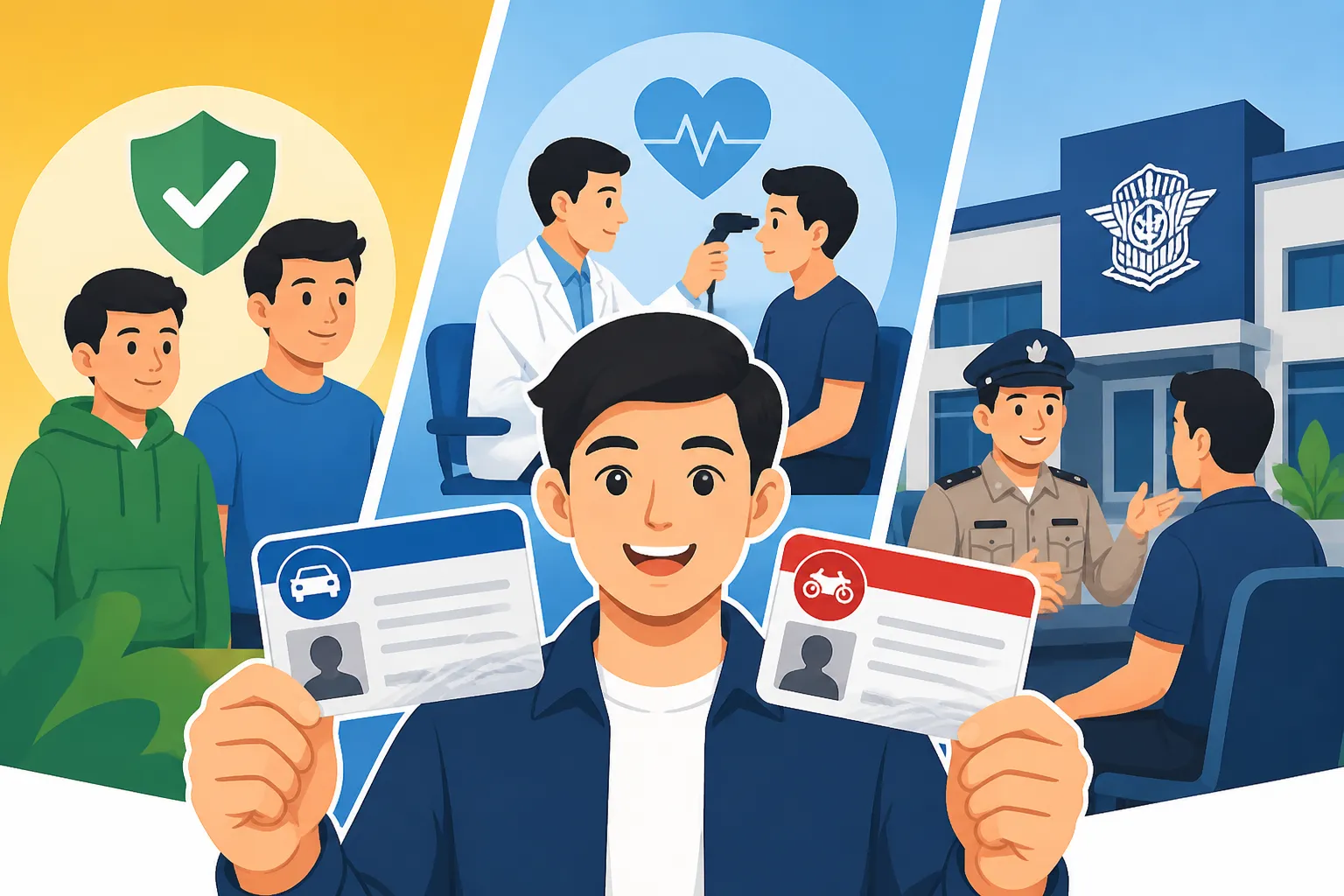
Navigating the Indonesian road system requires more than just guts; it requires the correct Surat Izin Mengemudi (SIM). For most expats, the journey starts with two specific categories: SIM A and SIM C. SIM A is your standard license for private passenger cars, essentially anything under 3,500kg. If you are planning to navigate the winding roads of Ubud or the traffic-clogged arteries of Jakarta in a SUV, this is your primary goal. SIM C, on the other hand, is the mandatory license for motorcycles. Given that scooters are the lifeblood of transport here, almost every expat eventually finds themselves needing this.
It is a common misconception that a car license covers a small scooter. In Indonesia, these are strictly separate. If you are caught riding a Honda Vario with only a SIM A, you are technically driving without a license for that vehicle class. This distinction is vital for your insurance coverage as well. Many international health policies will void a claim if they discover you were operating a vehicle without the specific local license required. Interestingly, as of 2025 and 2026, Indonesian licenses have gained broader recognition, and Indonesian Driver's Licenses Are Now Valid Across ASEAN (2025/2026 Rules), making the effort to get one even more valuable for regional travelers.
For those riding larger bikes, be aware that SIM C is now subdivided based on engine displacement. The standard SIM C covers bikes up to 250cc. If you have a passion for heavy cruisers or performance bikes above 250cc, you will eventually need to look into SIM C1 or C2, though the vast majority of expats stick to the standard C for their daily NMAX or Vespa. Before you even head to the police station, make sure you have the basics of Living in Indonesia as an Expat: The Complete Starter Guide (2027) under your belt, as your residency status dictates everything that follows.
Age Requirements and the Document Checklist
The bureaucracy in Indonesia is legendary, but it is manageable if you arrive with the right stack of papers. First, let’s talk age. You must be at least 17 years old to apply for SIM A and SIM C. While this covers most working expats and retirees, it is something to keep in mind for those with teenage children who might be eager to jump on a scooter.
The most critical document in your folder will be your KITAS or KITAP. You cannot obtain a standard five-year driving license on a tourist visa or a Visa on Arrival; those visitors must rely on an International Driving Permit paired with their home country license. As a resident, your KITAS proves your right to be in the country and is the anchor for your SIM application. If you are still in the process of moving, you might find it helpful to stay at a place booked via Agoda near the immigration or police offices to save yourself the multi-hour commutes that define Indonesian cities.
Your checklist should include:
- A valid passport with at least six months of validity.
- Original KITAS/KITAP and several high-quality photocopies.
- A Domicile Letter (Surat Keterangan Domisili) from your local village head or building management.
- Photocopies of your existing home country license (if you are attempting a conversion).
I always suggest keeping digital copies of these on your phone. Because the wait times at the SATPAS (Satuan Penyelenggara Administrasi SIM) offices can be unpredictable, I highly recommend having a reliable data connection. Using an eSIM from Airalo can be a lifesaver here, allowing you to look up translated terms or message your HR department if a specific document is questioned by the officer. If you are looking to skip the full testing process, you should read into Converting a Foreign Driving License to an Indonesian SIM A or SIM C to see if you qualify for a more streamlined path.
The Mandatory Medical Check and Psychology Test
Before you even see a police officer, you must pass two hurdles: the medical check (Kir Dokter) and the psychology test (Tes Psikologi). These are usually conducted in small, satellite offices located very close to the main SATPAS building. You don't need to make an appointment weeks in advance, but arriving early—think 8:00 AM—is essential to beat the rush of local applicants.
The medical check is relatively straightforward. A licensed doctor will check your vision (including color blindness), hearing, and blood pressure. It is less about a full physical and more about ensuring you aren't a high-risk liability on the road. If you wear glasses, make sure you bring them; you will be tested with them on, and your license will reflect that you are a "kacamata" (glasses) wearer. If you haven't yet secured a local plan, remember that Private Health Insurance in Indonesia: Bridging the Gap When BPJS Isn't Enough is a smart move for any resident.
The psychology test is a newer addition to the process and often causes the most anxiety for expats. It is essentially a series of multiple-choice questions designed to gauge your emotional stability, focus, and reaction times. While the test is available in an English version at many major offices like Daan Mogot in Jakarta or the Renon office in Denpasar, the translations can be "creative." You will face questions about how you react to aggressive drivers or your level of patience in a traffic jam. My advice? Answer as the most patient, rule-following version of yourself. This is not the time for radical honesty about your road rage during a monsoon downpour. Since these offices often lack Wi-Fi, having your Airalo data active allows you to use translation apps if the proctor only speaks Bahasa Indonesia.
The SATPAS Police Visit: Theory and Practical Exams
Once you have your medical and psychology certificates, you head into the belly of the beast: the SATPAS office. This is where you will register your data, have your fingerprints taken, and sit for your digital photo. This is a "Sopan" (respectful) environment. You must wear a collared shirt, long trousers, and closed shoes. I’ve seen expats turned away for wearing flip-flops and tank tops—don't be that person. If you forgot proper attire, you can often find affordable basic clothing on Shopee and have it delivered to your villa the day before.
The theory test is conducted on a computer. You’ll be presented with various traffic scenarios and asked to identify the correct course of action. Some questions are intuitive, while others focus on specific Indonesian road signs that might be unfamiliar. If you fail, don't panic; you are usually allowed to return after a week to retake it. It helps to study the local signs beforehand, as Driving Legally: International Driving Permits (IDP) Validity in Bali provides some context on the rules of the road that are often ignored in practice but strictly tested in theory.
Then comes the practical test. For SIM C, this involves a series of maneuvers on a marked course. You will likely have to navigate a zig-zag through cones, a tight figure-eight, and a sudden braking test. The bike provided is usually a small manual or semi-automatic, which can be tricky if you’ve only ever ridden an automatic Scoopy. For SIM A, the test involves basic driving, reverse parking, and a hill-start. The trick here is not speed, but precision. The officers are looking for your ability to use mirrors and indicators correctly. If you are nervous about your scooter skills, spending some time Renting a Scooter in Bali: Avoiding Fines, Helmet Laws, and Police Checks on quiet backroads before your test date is a wise investment in your confidence.
Costs, Fees, and Official Benchmarks
One of the most confusing aspects of getting your license is the price. There is the "official" price, known as the PNBP (Penerimaan Negara Bukan Pajak), and then there are the cumulative costs of the various sub-steps. In years past, the "agency" route was the norm, where you paid a significantly higher fee to skip the tests. However, the government has cracked down on this, and the process is becoming much more transparent and standardized.
| Item | SIM A (New) | SIM C (New) | Notes |
|---|---|---|---|
| Official Fee (PNBP) | IDR 120,000 | IDR 100,000 | Paid at the bank counter inside SATPAS |
| Medical Check | IDR 25,000 – 50,000 | IDR 25,000 – 50,000 | Varies by location |
| Psychology Test | IDR 50,000 – 100,000 | IDR 50,000 – 100,000 | Usually paid in cash at the test site |
| Total Estimated | ~IDR 270,000 | ~IDR 250,000 | Does not include "agency" help |
While these are the official rates, many expats still choose to use a "Biro Jasa" (service agency). An agency might charge anywhere from IDR 1,500,000 to IDR 2,500,000. For this premium, they handle the queuing, help navigate the language barrier, and often provide a "guided" experience through the testing. If your time is more valuable than your money, or if your Bahasa Indonesia is non-existent, this is a popular path. You can read more about Costs and Fees for Converting a Foreign License Through an Agency to decide if the convenience justifies the expense. Regardless of the route you choose, once you have the physical card in hand, you'll need to think about Car Ownership: Processing the STNK and BPKB on a Foreign Passport if you plan to buy your own vehicle rather than renting.
Avoiding Common Pitfalls and Staying Legal
After the adrenaline of the SATPAS visit fades and you have your shiny new SIM A or C, your responsibilities don't end there. One major pitfall is forgetting the expiration date. Unlike some Western licenses that last a decade, Indonesian SIMs for foreigners are typically tied to the length of your KITAS, or a maximum of five years. You must renew it before it expires. If you let it lapse even by one day, you cannot "renew" it; you must start the entire application process, including the theory and practical tests, from scratch.
Another common issue is the address on the license. If you move from South Jakarta to Canggu, you are technically required to update your domicile with immigration and, by extension, your driving license. This is where the Surat Domisili (Domicile Letter): How to Get it from the Village Head becomes essential. Police are increasingly tech-savvy; they can scan your license and see if your registered address matches your current residency status.
Lastly, always carry the original card. A photocopy or a photo on your phone is rarely accepted during a formal "Razia" (roadblock). I keep mine in a small waterproof pouch under my seat or in my wallet at all times. If you are ever involved in a minor scrape, having a valid SIM is your primary defense against being blamed solely because you are a "bule" (foreigner). It shows you respect the local laws and are a legitimate resident. To keep your vehicle just as legal as your license, stay on top of your Annual Vehicle Taxes (Pajak Kendaraan): How to Pay at Samsat to avoid heavy fines or vehicle impoundment.
Final Preparations for the Big Day
Before you head out, do a final gear check. Ensure your phone is fully charged—you'll be doing a lot of waiting. If you aren't staying in a hotel nearby via Agoda, make sure your Gojek or Grab app is topped up for the ride to the SATPAS office, as parking for private cars can be a nightmare. Bring a bottle of water and perhaps a portable fan; the testing yards are usually outdoors and the tropical sun is unforgiving.
If you are feeling overwhelmed, remember that thousands of expats go through this every year. The process has become significantly more professional, with clearer signage and more English-speaking staff in major hubs. Getting your SIM A and C is more than just a legal requirement; it’s a rite of passage that grants you the freedom to explore every corner of this incredible archipelago. If you find yourself needing to buy gear for your new riding life, like a phone mount or a high-quality rain poncho, Shopee is your best friend for quick, local delivery.
Once you have your license, the country opens up. You can drive to the high-altitude plantations of Puncak or navigate the coastal highways of Lombok with the peace of mind that you are fully compliant with Indonesian law. Just remember to drive defensively, watch out for the ubiquitous "emak-emak" on scooters who might turn without looking, and always keep your documents close at hand.
Disclaimer
The information provided in this guide is for general informational purposes only and does not constitute legal or professional advice. While we strive to keep the information up to date and correct, regulations regarding driving licenses (SIM) in Indonesia can change frequently and without prior notice. Always verify the latest requirements with the local SATPAS (Satuan Penyelenggara Administrasi SIM) or the Indonesian National Police (Polri) before proceeding with your application. We are not responsible for any issues, fines, or legal complications that may arise from the use of this information.