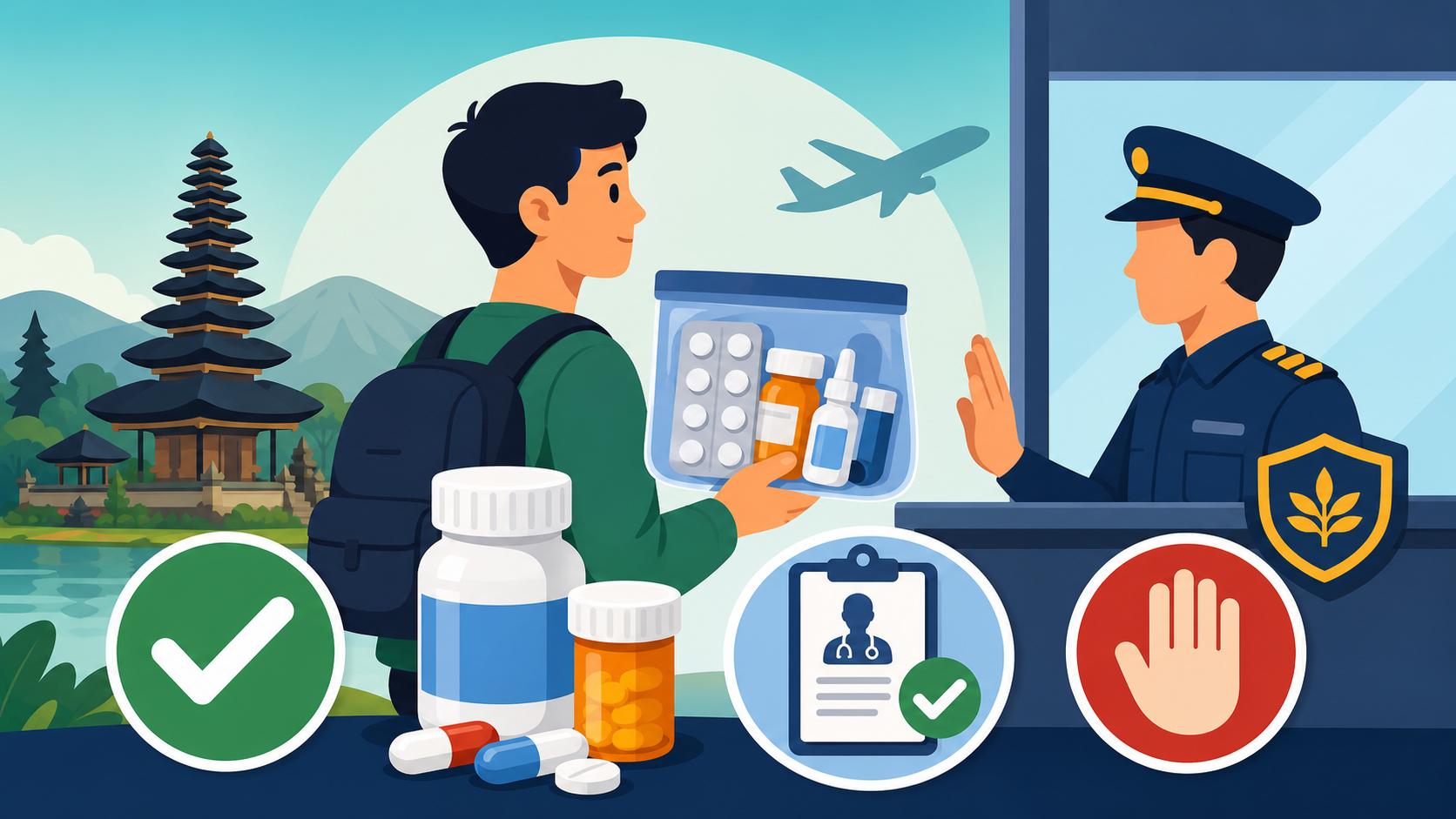
Bringing Medication Into Indonesia: Customs Rules, Limits, and Required Letters
Navigating the "Red Channel" at Soekarno-Hatta or Ngurah Rai with a bag full of essential prescriptions can feel like a high-stakes gamble. I remember my first landing in Jakarta, clutching a bottle of blood pressure meds like it was contraband, terrified a misunderstanding would lead to a room without a view. This guide breaks down the complex reality of bringing medication into Indonesia so you can land with confidence.
Understanding the Indonesian Customs Landscape for Meds
When you first arrive, the sheer volume of paperwork and the stern looks from Bea Cukai (Customs) officers can be overwhelming. Indonesia takes drug control extremely seriously, often making no distinction in its initial approach between a life-saving antidepressant and an illegal narcotic. The system is governed by the National Agency of Drug and Food Control (BPOM), and their rules are designed to prevent the illicit entry of restricted substances while allowing legitimate patients to carry what they need.
The Classification of Your Medicine General vs Controlled
Not all pills are created equal in the eyes of Indonesian law. General medications—think antibiotics, birth control, or standard heart medications—are usually treated with a lighter touch, provided the quantity is reasonable. However, if you are carrying anything that falls under the "Psychotropic" or "Narcotic" labels, you are entering a different tier of scrutiny altogether. This includes many medications used for ADHD, severe pain management, or chronic anxiety.
The distinction is critical because while a missing prescription for an inhaler might result in a lecture, a missing letter for a stimulant could lead to immediate confiscation or legal detention. You must categorize your own kit before you pack. If your medication alters your mood, sleep, or focus, assume it is controlled and prepare accordingly. This is where having a robust international plan, such as one provided by Cigna Global, becomes invaluable, as they often provide the resources to help you understand how your specific prescriptions are viewed globally.
Why the Red Channel Is Not Always Your Enemy
There is a common expat myth that you should always breeze through the Green Channel and hope for the best. In my experience, if you are carrying more than a week’s supply of any prescription, the Red Channel is your friend. By declaring your medication on the Electronic Customs Declaration (ECD), you are demonstrating transparency. If an officer finds undeclared "suspicious" pills in the Green Channel, you are immediately viewed with suspicion.
When you declare, you are simply saying, "I have medicine, and I have the paperwork to prove it." Most of the time, the officer will glance at your doctor's letter, check the labels, and wave you through. It is the hidden items that trigger the deep-dive luggage searches. Being honest from the start saves you hours of stress in a humid arrivals hall.
Essential Paperwork What You Must Have in Your Carry-On
Never, under any circumstances, pack your medications in your checked luggage. Not only do bags go missing, but you need those meds within arm's reach if Customs asks for a spot check. The paperwork is the "shield" that protects you from the complexities of Indonesian bureaucracy. Without it, you are just a person with a bag of chemicals.
The Doctors Letter Non-Negotiable Requirements
A standard prescription slip is rarely enough for Indonesian Customs. You need a formal letter from your prescribing physician, written on official clinic or hospital letterhead. This letter needs to be explicit. It should state your full name (matching your passport exactly), your diagnosis, the generic and brand name of the medication, the exact dosage, and the total quantity you are carrying.
I’ve found that it helps to have the letter signed in wet ink, not just a digital scan. If your doctor can include a line stating that the medication is "essential for the patient's health and must be carried during travel," it adds an extra layer of legitimacy. This is especially true for those navigating Family Health in Indonesia: Pregnancy, Childbirth, and Pediatric Care, where the medications for children are often scrutinized even more closely to ensure they are age-appropriate and genuine.
Validating Your Prescriptions for Local Authorities
In addition to the doctor's letter, bring the original pharmacy packaging. Do not use those "days of the week" plastic pill organizers for your flight. Indonesian officers want to see the pharmacy label that matches the name on your passport. If the labels are peeling or illegible, get the pharmacy to print fresh ones before you leave.
If you are moving for the long term, consider how you will replace these once you arrive. You will likely need to find a local doctor who can issue an Indonesian version of your script. Learning how to navigate this is part of the transition, and you can find more detail in our guide on Finding Medical Care in Indonesia: Clinics, Hospitals, and International Facilities. Having your original home-country paperwork makes the "hand-off" to an Indonesian doctor much smoother.
Navigating Controlled Substances ADHD and Anxiety Medications
This is the area where expats most frequently run into trouble. Indonesia’s drug laws are among the strictest in the world. Substances that are common in the West, such as Adderall, Ritalin, or various benzodiazepines, are strictly regulated under the Indonesian Law on Narcotics and Psychotropics.
The Narcotic and Psychotropic Trap
If you are carrying stimulants for ADHD, you must be aware that some of these are considered "Group I" or "Group II" substances in Indonesia. While you are generally allowed to bring a 30-day supply for personal use, you must have every single "i" dotted and "t" crossed. I have seen travelers spend hours in questioning because they brought a three-month supply of Xanax without a sufficiently detailed doctor's letter.
The quantity is the biggest red flag. If you show up with 500 pills of a controlled substance, no amount of paperwork will convince a Customs officer that it is for "personal use." They will suspect intent to distribute. Stick to a 30-day supply and plan to visit a local specialist for a refill. For more on the specifics of these restricted items, check out our deep dive on Controlled Substances: ADHD and Anxiety Meds Banned in Indonesia.
Prohibited Substances vs Restricted Items
There is a fine line between "restricted" (allowed with a permit/letter) and "prohibited" (illegal regardless of a script). Some medical cannabis products or certain high-strength synthetic opioids might be outright banned. If your medication contains any derivative of cannabis, even for medicinal purposes, do not bring it. Indonesia does not recognize foreign medical marijuana cards, and the penalties are severe.
If you are unsure, you can check the latest BPOM "Restricted List" or consult with a high-end insurance provider like Cigna Global to see if they have updated data for 2026 arrivals. It is always better to leave a questionable medication behind and find a legal local alternative than to risk a "Category 1" drug charge at the border.
| Medication Category | Documents Required | Quantity Limit | Channel to Use |
|---|---|---|---|
| General (Antibiotics, BP) | Script/Original Packaging | 90 Days | Green (if small) |
| Psychotropic (Anxiety, ADHD) | MD Letter + Original Script | 30 Days | Red (Mandatory) |
| Narcotic (Strong Painkillers) | MD Letter + Notarized Script | 30 Days | Red (Mandatory) |
| Supplements/Vitamins | Label in English/Indonesian | Reasonable Use | Green |
| Medical Cannabis/CBD | Prohibited | 0 Days | DO NOT BRING |
Practical Strategies for Smooth Entry
Success at Customs is 50% paperwork and 50% attitude. If you approach the desk looking nervous or defensive, you are inviting a bag search. If you are organized and polite, the process is often a breeze.
Quantity Limits How Much Is Too Much
The general rule of thumb for "personal use" is a 30-day supply. However, BPOM regulations sometimes allow up to 90 days for non-controlled substances if you can prove you are on a long-term residency permit (KITAS). If you are arriving on a tourist visa, stick to 30 days. Bringing a six-month supply of anything—even vitamins—can lead to the officer classifying your goods as "commercial import," which requires a whole different set of licenses you likely don't have.
If you run out of your imported supply, don't panic. Indonesia has a vast network of pharmacies. You can learn how to source what you need safely in our Apotek Guide: Prescription Workflow, Refills, and Communicating with Pharmacists. Many common medications are available over the counter here, though the brands will differ.
Filling Out the Electronic Customs Declaration ECD
Indonesia has moved entirely to an electronic declaration system. You can fill this out online up to 72 hours before you land. Under the "Goods" section, there is a specific question about whether you are carrying "Narcotics, psychotropics, precursor drugs, or other medicines."
If you have a prescription, you must check "Yes." When you arrive at the Customs barrier, you will show your QR code. The officer will see the "Yes" and likely ask to see your bag. This is when you calmly present your folder with the doctor's letter and the original bottles. In 90% of cases, once they see the name on the letter matches the passport and the name on the bottle, they will scan your QR code and let you through.
What to Do If Your Meds Are Confiscated
Sometimes, despite your best efforts, an officer might decide a certain medication isn't allowed. This usually happens with high-volume supplements or specific brands of psychotropics that aren't in their database.
Dealing with Customs Officers Bea Cukai
If an officer tells you they must seize your medication, stay calm. Getting angry or raising your voice will only escalate the situation. Ask for a formal receipt of seizure (Surat Bukti Penindakan). This document is essential if you need to explain the loss to your doctor or if you want to try and reclaim the items later through an agent.
Explain clearly that the medication is for a chronic condition. If it is an emergency medication (like an EpiPen or insulin), emphasize this. Sometimes, if you have a valid script, they may allow you to keep a "travel dose" while seizing the rest. For those who encounter issues with emergency supplies, knowing the Emergency Medical Care in Indonesia: Ambulances, ERs, and Evacuation Protocols can be a literal lifesaver.
Finding Local Equivalents in Indonesia
If your meds are taken, your first stop after checking into your hotel or villa should be a reputable clinic. Show them your seizure receipt and your original doctor's letter. Indonesian doctors are familiar with international brands and can often find the local equivalent (generic name).
Be aware that some specific formulas used in the US or Europe may not be available here. In those cases, you might be prescribed a "close match." For routine items like high-quality vitamins or specific supplements that you can't find in local malls, many expats rely on iHerb for international shipping, though keep in mind that these will also be subject to import taxes when they arrive at your door.
Long-Term Management After Arrival
Once you have cleared Customs and settled into your new life, the challenge shifts from "importing" to "sourcing." You cannot keep flying back to your home country every 30 days to refill a prescription.
Sourcing Supplements and Refills Locally
For non-prescription supplements, you’ll find that local shops carry the basics, but for specific high-potency brands, iHerb is a staple for the expat community. Just be sure to keep your orders under the $500 threshold to avoid the heavy import duties that apply to "luxury" health goods.
For prescription refills, you will need to establish a relationship with a local hospital. If you are living in the capital, the Jakarta Healthcare Guide for Expats: International Clinics and After-Hours Options provides a list of facilities where doctors are accustomed to working with foreigners and can bridge the gap between your home-country medical records and the Indonesian system. They can also help you understand how to use Pharmacies and Medication in Indonesia: Apotek Guide, Prescriptions, and Safe Use to get your monthly supplies without a hitch.
Healthcare Budgeting for Medication
Don't forget that if you are working here, you will likely be enrolled in the national system. You should check BPJS Kesehatan for Expats: Registration, Costs, and the New KRIS System to see if your chronic medications are covered under the public formulary. While many expats prefer private care for its speed, the BPJS system can significantly lower the cost of long-term maintenance drugs for conditions like diabetes or hypertension.
If you prefer to stay entirely private, ensure your insurance plan covers outpatient prescriptions. Some local plans only cover medications given during a hospital stay. A global policy from Cigna Global often includes a "Pharmacy Rider" that allows you to claim back the cost of expensive imported medications purchased at local premium pharmacies like Guardian or Century.
Final Checklist for Your Journey
Before you head to the airport, do one final sweep of your medical kit. Ensure every bottle has a label, every letter has a signature, and your ECD is filled out truthfully.
- Doctor’s letter on official letterhead (English or Indonesian)
- Original pharmacy packaging with your name visible
- Maximum 30-day supply for controlled meds
- Electronic Customs Declaration (ECD) marked "Yes" for medication
- Contact details for your home doctor in case Customs needs to verify
- A copy of your Health Checklist for Your First 30 Days in Jakarta or Bali to stay organized
By following these steps, you turn a potentially nerve-wracking encounter into a standard administrative task. Indonesia is a beautiful place to live, and managing your health shouldn't be the thing that keeps you from enjoying it.
Disclaimer
The information provided in this guide is for general informational purposes only and does not constitute legal or medical advice. Indonesian customs regulations and BPOM policies are subject to change without notice. Always verify the current requirements with the Indonesian Embassy or Consulate in your home country before traveling with medication. The author and publisher are not responsible for any legal issues, confiscations, or medical complications that may arise from following this guide.