Emergency Medical Care in Indonesia: Ambulances, ERs, and Evacuation Protocols
In the middle of a tropical night, the last thing you want to realize is that you have no idea how to call an ambulance or which hospital can actually handle a trauma case. I still remember the sheer panic I felt when a friend had a motorcycle accident in Bali; we stood on the side of the road with a dying phone battery, realizing that "911" does nothing here. This guide solves that life-threatening confusion by mapping out Indonesia's emergency protocols, dispatch numbers, and evacuation realities.
The Indonesian Emergency Number System: 112, 118, and 119
The first thing you realize as an expat is that the emergency infrastructure in Indonesia is fragmented. Unlike the centralized systems in Europe or North America, Indonesia is currently in a transition phase. While the government is pushing for 112 to be the "one-stop" emergency number, the reality on the ground is often different depending on which island or city you are in.
If you are in a major city like Jakarta or Surabaya, calling 112 will usually get you through to a central operator who can dispatch police, fire, or medical services. However, in my experience, the response time can be sluggish because the operator has to relay the information to the specific department. For medical emergencies, the dedicated numbers 118 and 119 are often more direct. 119 is the National Command Center for health emergencies, and it is theoretically linked to the Emergency Numbers in Indonesia: 118/119 for Ambulance and What to Expect system.
The most important thing to remember is the language barrier. Do not assume the dispatcher speaks fluent English. In a high-stress situation, your ability to communicate your location (using landmarks, not just street names) is vital. I always suggest having a "cheat sheet" on your fridge with your address written in Bahasa Indonesia, along with the nearest major intersection or "Gedung" (building) name. Dispatchers will often ask for a WhatsApp share-location if you are calling from a mobile, so be ready to use your data.
When to Call 112 vs 119
The 112 number is intended to be the primary emergency line, similar to 911 or 999. It is toll-free and can be dialed even if your SIM card is locked or you have no credit. This is your best bet for multi-agency disasters, such as a fire that also requires medical attention or a car accident. In many regions, 112 operators are better trained to handle "foreigner" calls, though this is still a work in progress in 2026.
Conversely, 119 is specifically for the "Sistem Penanggulangan Gawat Darurat Terpadu" (Integrated Emergency Response System). This is the line you call for heart attacks, strokes, or severe trauma where you need an ambulance equipped with medical personnel. If you are using Public vs Private Healthcare in Indonesia: BPJS Kesehatan and Expat Insurance, your coverage might dictate which ambulance service is sent, but in a true life-or-death moment, the 119 system is designed to take you to the nearest stabilizing facility, regardless of your insurance status.
The Challenge of Dispatch and Localization
The biggest hurdle isn't just dialing the number; it’s the dispatch process. Indonesian addresses can be notoriously difficult to find. A "Gang" (narrow alleyway) in Bali might not show up accurately on GPS, and a house number in a Jakarta "Kampung" might be out of sequence.
When you call, stay calm and use the phrase "Ada gawat darurat medis" (There is a medical emergency). Be prepared to stay on the line. I’ve seen many expats hang up out of frustration when they aren't understood, but in the Indonesian system, persistence is key. If you are at home, send a staff member or a neighbor to the main road to "jemput" (pick up/guide) the ambulance. Without a physical guide standing on the street waving them down, the ambulance might spend twenty minutes circling your block.
Ambulances in Indonesia: Public vs Private Realities
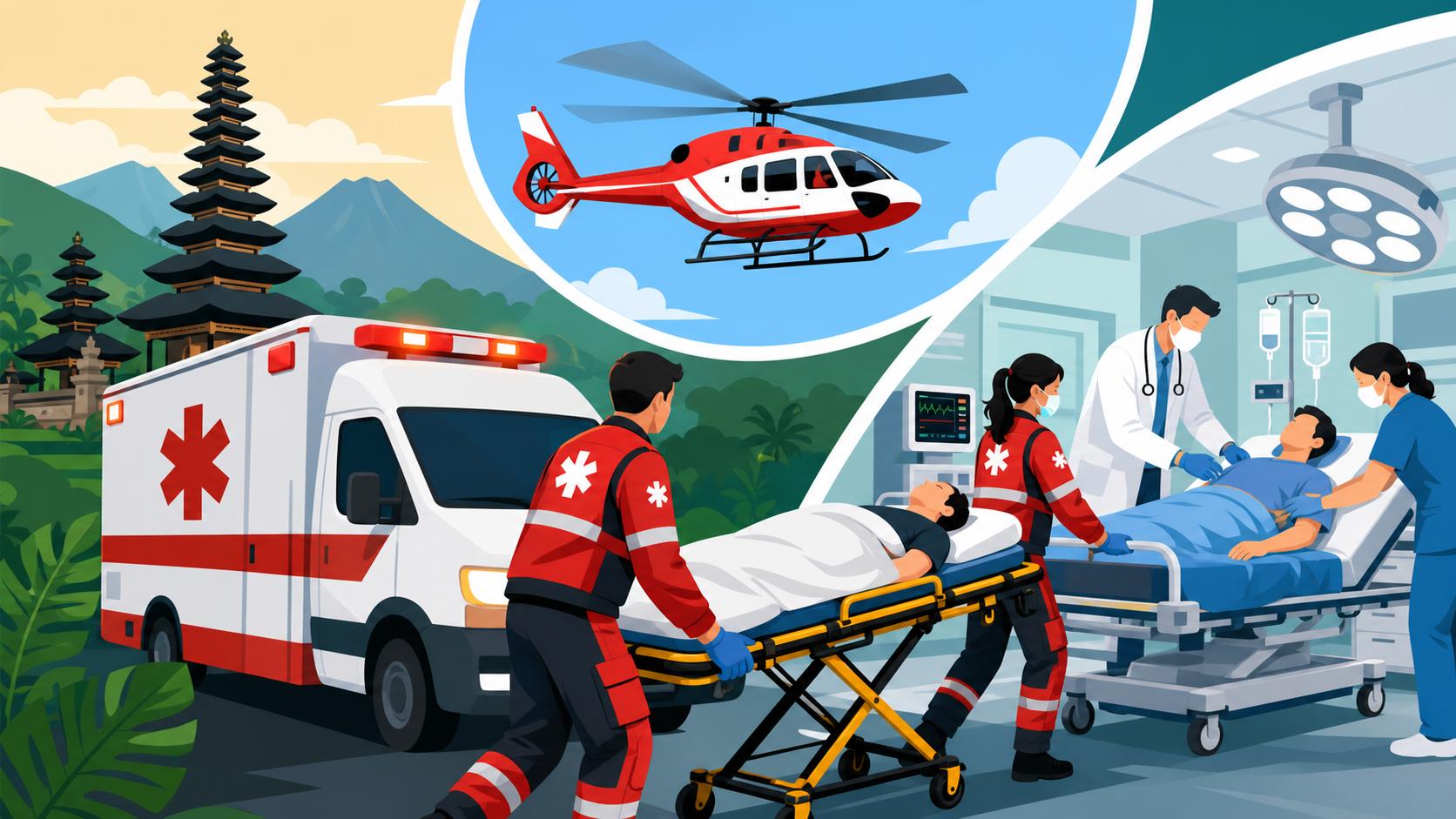
One of the most jarring realizations for newcomers is that not all ambulances are created equal. In many Western countries, an ambulance is essentially a mobile ER. In Indonesia, many public ambulances are simply "transport" vehicles with a stretcher and perhaps an oxygen tank, but very little in the way of advanced life support (ALS) equipment.
If you are in a situation that isn't immediately life-threatening but requires professional transport, you have the choice between a public ambulance and a private hospital ambulance. Many high-end facilities, like Siloam or BIMC, have their own dedicated fleets. These are often much better equipped and staffed by English-speaking paramedics. For expats, especially those covered by Cigna Global, utilizing a private hospital’s ambulance service is often the preferred route for both speed and quality of care.
The Red Ambulance and the Puskesmas System
The government-run ambulances, often referred to as "Ambulans Gawat Darurat" (AGD), are the backbone of the public system. These are usually linked to the 118/119 dispatch. While the service is often free or very low-cost for those enrolled in BPJS, the equipment can be basic. If you are in a rural area, the ambulance might be dispatched from a local Puskesmas (community health center).
It is a common "expat myth" that public ambulances won't treat foreigners. They will, but the triage level might be different if the paramedics feel you have the means to call a private service. If you are in a remote part of Lombok or Flores, the Calling an Ambulance Without Bahasa Indonesia: Language Support Expectations guide becomes your bible. In these areas, you may need to rely on a local "Bapak" with a large SUV more than a formal ambulance, which is a reality of island life that we all have to accept eventually.
Private Hospital Ambulances: The Gold Standard
For those living in Jakarta or Bali, the most reliable option is often to call a private hospital directly. Large networks like Siloam or Mayapada have their own dispatch numbers. These ambulances are usually "mini-ERs" and can begin treatment on-site. However, they will almost always take you back to their own facility, which might not be the closest one.
Before an emergency happens, save the direct emergency room numbers for the two closest international-standard hospitals to your house. In Jakarta, this might be SOS Medika or Medistra. In Bali, it’s usually BIMC or Siloam. Having these numbers saved can save you the five minutes of "operator lag" you’d experience with the 112 system. For a deep dive into these locations, check out the Jakarta Healthcare Guide for Expats: International Clinics and After-Hours Options for specific contact details.
Understanding the Traffic Factor (Macet)
We have to talk about the elephant in the room: traffic. In Jakarta, an ambulance can be stuck in "macet" just like any other car. While drivers are getting better at pulling over, the sheer density of motorcycles often makes it impossible for an ambulance to weave through. This is why many private hospitals now employ "Motorcycle Paramedics." These are first responders on motorbikes equipped with AEDs and trauma kits who can reach you 15 minutes before the van arrives.
If you are in a critical situation in South Jakarta during rush hour, don't be surprised if the dispatcher suggests you meet the ambulance at a major landmark or if they send a bike first. It’s a pragmatic solution to a geographical nightmare. Always ask, "Bisa kirim motor dulu?" (Can you send a motorbike first?) if you are in a high-traffic zone.
The ER Experience: Navigating UGD and IGD
In Indonesia, the Emergency Room is called the "Unit Gawat Darurat" (UGD) or "Instalasi Gawat Darurat" (IGD). When you arrive, the experience can feel chaotic, especially if you are used to the quiet, partitioned ERs of the West. Indonesian ERs are often open-plan, loud, and bustling with family members.
The first thing that will happen is Triage. Unlike the "first-come, first-served" approach of a standard clinic, the IGD uses a color-coded system (Red, Yellow, Green, Black). If you are walking and talking, you are Green. If you are Green, you might wait a long time while the doctors deal with the victims of the latest "ojek" (motorcycle taxi) accident. Understanding Emergency Rooms (UGD) in Indonesia: Triage, Payment Upfront, and Documentation is essential to keeping your cool during this process.
The Administrative Deposit: A Necessary Evil
This is the part that catches every expat off guard. Even in a private hospital, you will likely be asked for an "Administrative Deposit" or a credit card swipe before you are fully admitted to a room. While they will stabilize you in a life-threatening situation without payment, further treatment often halts until the financial paperwork is cleared.
This can feel incredibly cold when you are in pain, but it is the standard operating procedure. This is where having a high-tier insurance provider like Cigna Global pays off. If the hospital has a "Direct Billing" agreement with your insurer, the process is much smoother. If they don't, you—or a friend—must be prepared to pay anywhere from 5 million to 50 million IDR upfront. I always tell new expats to keep a credit card with a high limit specifically for medical emergencies. If you can't pay, the hospital may suggest transferring you to a government facility (RSUD), which can be a stressful transition during a crisis.
Documentation You Need On Hand
In the heat of an emergency, you won't be thinking about paperwork, but the hospital will. You need your passport (or a very clear photo of it on your phone), your KITAS (residency permit), and your insurance card. If you are using BPJS Kesehatan for Expats: Registration, Costs, and the New KRIS System, you must have your JKN app ready or your physical card.
I recommend keeping a "Hospital Folder" in your "Go-Bag." This should include your blood type, any chronic conditions, a list of allergies, and current medications. If you have recently bought supplements or specialized medicine from iHerb, make sure to list those as well, as some herbal supplements can interact with emergency anesthesia or blood thinners.
The Role of the "Family Caregiver"
In Indonesian medical culture, the family is expected to do a lot of the "non-medical" work. This includes getting medications from the hospital pharmacy (Apotek), bringing extra pillows, or even helping the patient use the restroom. As an expat, if you are alone, this can be a massive disadvantage.
The nurses are there for medical procedures, but they are often stretched thin. If you are admitted through the ER, try to have a friend or a "pembantu" (household staff) come to the hospital with you. They can handle the "Apotek runs" and deal with the administrative staff while you focus on recovery. If you don't have anyone, you may need to hire a private nurse or "Suster," which is a common and affordable practice in Indonesia.
Medical Evacuation (Medevac) Protocols
Sometimes, the care available in Indonesia—even in the best Jakarta hospitals—isn't enough for complex neurosurgery, specialized oncology, or specific cardiac procedures. In these cases, a Medical Evacuation (Medevac) to Singapore, Bangkok, or your home country becomes necessary. This is a massive logistical undertaking that can cost anywhere from $20,000 to over $100,000.
Medevac is not something you "order" like an Uber. It requires a "fit to fly" certificate from your current doctor, an accepting physician at the destination hospital, and a specialized air ambulance team. For a detailed look at the companies involved, see our guide on Medical Evacuation (Medevac) Services in Indonesia: Costs and Insurance Coverage.
When to Consider Evacuation
The decision to evacuate is usually based on two factors: the complexity of the surgery required and the quality of post-operative care. While Indonesian surgeons are often highly skilled, the nursing care and "step-down" facilities can sometimes lag behind international standards.
If a doctor mentions that a procedure is "high risk" or if they seem hesitant about the equipment available, that is your cue to contact your insurance provider’s emergency assistance hot-line. Companies like Cigna Global have 24/7 teams that specialize in coordinating these transfers. They will talk to the local doctors "doctor-to-doctor" to determine if a Medevac is medically necessary. If it is, they handle the planes, the ambulances on both ends, and the border clearances.
Logistics of an Air Ambulance
An air ambulance is essentially a flying ICU. It will have a doctor and a nurse on board, along with ventilators, monitors, and specialized medication. These flights usually operate out of Halim Perdanakusuma Airport in Jakarta or Ngurah Rai in Bali.
One thing people forget is the "Ground Ambulance" transition. The air ambulance team will meet you at the local hospital, stabilize you for transport, and then take you by road to the airport. This is often the most dangerous part of the journey due to the vibrations and the "macet" we discussed earlier. In Bali, BIMC Hospital Bali: Services, Costs, and Insurance Direct Billing Options is often the primary hub for coordinating these international transfers because of its proximity to the airport.
The Singapore vs. Australia Choice
For expats in Indonesia, Singapore is the default destination for Medevac. It is close (less than 2 hours from Jakarta), has world-class hospitals like Mount Elizabeth or Gleneagles, and the visa process for medical emergencies is streamlined.
However, if you are in Bali, some insurers might suggest Darwin or Perth, Australia, depending on the nature of the injury (especially for "scooter trauma"). Keep in mind that getting an emergency medical visa for Australia can be more complex than for Singapore. Always check with your coordinator about the "Visa On Arrival" or emergency entry protocols for the destination country.
Emergency Medical Contacts Comparison
| Service Type | Primary Number | Best For | English Level |
|---|---|---|---|
| National Emergency | 112 | General crisis, fire, police | Variable |
| Health Ministry | 119 | Public medical emergency, BPJS | Low to Moderate |
| Jakarta AGD | 118 | Public ambulance in the capital | Moderate |
| Siloam Hospitals | (Area Code) + 1500911 | Private high-end care | High |
| BIMC Bali | (0361) 761263 | Tourist/Expat trauma in Bali | Very High |
| SOS Medika | (021) 7506001 | International clinic care (JKT) | Very High |
Paying for Emergency Care: BPJS and Private Insurance
Who pays the bill? This is the question that haunts every ER waiting room. In Indonesia, the answer depends entirely on your residency status and the type of insurance you carry. If you are a working expat, you are likely enrolled in BPJS Kesehatan for Expats: Registration, Costs, and the New KRIS System, but you probably also have a private international plan.
In an emergency, the "Coordination of Benefits" (CoB) between BPJS and private insurance is notoriously tricky. Most private hospitals will ask which one you want to use upfront. If you choose BPJS, you must follow the strict referral system, which usually means starting at a lower-level facility. In a life-threatening emergency, this rule is waived, and you can go to the nearest hospital, but "life-threatening" is a clinical definition that the hospital administrators will scrutinize.
The BPJS "Emergency" Loophole
Under Indonesian law, any hospital (even a private one that doesn't normally accept BPJS) must stabilize a patient in a true emergency under the BPJS scheme. However, "stabilize" only means getting you out of immediate danger of death. Once you are stable, the hospital will either ask you to pay private rates to stay or arrange a transfer to a BPJS-contracted hospital.
This is why we always recommend Private Health Insurance in Indonesia: Bridging the Gap When BPJS Isn't Enough. Using a private plan allows you to stay in the higher-quality facility where you were stabilized, avoiding the risks of a mid-crisis transfer.
Direct Billing vs. Reimbursement
Most local Indonesian insurance plans work on a "reimbursement" basis for smaller ER visits, but offer "cashless" or "direct billing" for inpatient stays. For expats, the "Gold Standard" is direct billing. This is where the hospital sends the bill directly to Cigna Global or your specific provider.
To make this work, you must present your insurance card at the "Admissions" or "Cashier" desk immediately. The hospital will then contact the insurer for a "Letter of Guarantee" (LoG). Until that LoG arrives, you are personally liable for the bill. This is why having a digital copy of your insurance policy and the 24-hour member services number on your phone is non-negotiable.
Out-of-Pocket Costs and "Extras"
Even with great insurance, there are always out-of-pocket costs. This might include medical supplies that the hospital deems "extra," certain high-end medications, or the cost of the "administrative fee."
If you are hospitalized for a few days after an ER visit, you might find that you want better quality food or specialized vitamins to speed up recovery. I often order my post-hospitalization supplies, like high-grade Vitamin C or Probiotics, from iHerb because the selection is often better than what you’ll find in a local "Apotek." Just remember that while insurance covers the "medical," it rarely covers the "wellness" items you'll want during convalescence. For more on managing your medical budget, see Healthcare Budgeting: BPJS Caps, Out-of-Pocket Costs, and Private Copays.
Local Realities: Regional Differences in Care
Indonesia is a massive archipelago, and the "standard of care" drops significantly once you leave the major urban hubs of Java and Bali. If you are living in a remote mining camp in Kalimantan or a dive resort in Raja Ampat, your emergency protocol is completely different.
In these areas, the "Ambulance" might be a speedboat or a chartered Cessna. The "ER" might be a single room with a dedicated but overwhelmed doctor. If you are traveling or living in these regions, you must be self-reliant. This means carrying a more robust first-aid kit and having a satellite communication device if you are outside of cell range.
Bali: The Tourist Infrastructure
Bali has some of the best emergency care for foreigners in the country because the island’s economy depends on it. Hospitals like BIMC and Kasih Ibu are very used to handling everything from "Bali Belly" to major "Scooter Trauma."
The challenge in Bali is the "Banjar" system. In some villages, the local community security (Pecalang) might be the first on the scene of an accident. They are generally helpful but may not have medical training. In a crisis, defer to the Bali Healthcare Guide: Hospitals, Clinics, and Emergency Contacts for Residents to find the closest facility that actually has an ICU, as many smaller "Medical Centers" in Ubud or Canggu are only equipped for basic stitches and IV drips.
Jakarta: The Specialist Hub
Jakarta is where the specialists live. If you have a complex cardiac issue or a stroke, you want to be in Jakarta. The city has several "Centers of Excellence." However, the sheer size of the city means that being "in Jakarta" doesn't mean help is close.
If you live in South Jakarta (Kemang/Cipete), you should look at SOS Medika Clinics in Cipete and Kuningan: Services for Jakarta Expats as your primary emergency contact. If you are in the North, your go-to might be Pantai Indah Kapuk (PIK) Hospital. Never try to cross the city during an emergency; go to the nearest reputable facility to stabilize first.
The "Remote" Reality
If you are in a place like Labuan Bajo or Sumba, the local hospital (RSUD) will be your only option. These facilities are often clean and the staff is dedicated, but they lack the high-tech diagnostic tools (like MRI or CT scans) that you might expect.
In these regions, your "emergency protocol" should always include an early decision to evacuate. Don't wait for a condition to worsen. If the local doctor says they can't perform a specific test, that is the moment to call your Medevac provider.
Preparing Your Emergency Kit and Documentation
Being a "veteran" expat means knowing that the system might fail, and you need a backup. Your "Emergency Preparedness" isn't just about a first-aid kit; it’s about a "System of Response."
I recommend every expat household does a "Dry Run." Call the local private hospital's ambulance number just to see how long it takes them to answer and if they can understand your address. It sounds paranoid, but doing this once can identify a fatal flaw in your plan before you actually need it.
The Medical Go-Bag
Every expat home should have a "Medical Go-Bag" near the front door. This isn't just for earthquakes; it’s for the 2 AM dash to the ER. It should contain:
- Physical copies of Passports/KITAS for everyone in the house.
- A list of all current medications (and the physical bottles if possible).
- Your insurance cards and the 24-hour contact numbers.
- At least 5 million IDR in cash (for taxis, deposits, or immediate pharmacy needs).
- Power banks and extra-long charging cables.
- A basic "trauma kit" (tourniquets, gauze, antiseptic) to use while waiting for the ambulance.
For those managing long-term health, I recommend keeping a stock of your essential meds. If you source specific brands from iHerb, make sure you have at least a two-week buffer, as an emergency hospital stay can disrupt your shipping cycles.
Using Technology: Halodoc and Alodokter
In a "near-emergency" (like a very high fever or a deep cut that might need stitches), you can use apps like Halodoc or Alodokter. These apps allow you to video-call a doctor in minutes.
The doctor can tell you if you actually need to go to the IGD or if you can wait until the morning. They can even send an "Ambulance" or a "Home-Care Nurse" to your house through the app. This is a fantastic resource for parents of young children. For more on these digital tools, see How to Book a Doctor Appointment via Halodoc or Alodokter Apps.
The Importance of a "Point Person"
Finally, you need a "Point Person" who is not your spouse or partner. If both of you are in an accident, who will talk to the insurance company? Who will feed the dogs? Who will notify your employer?
Give a trusted friend a spare key to your house and a folder with your "Emergency Plan." Make sure they know which hospital you prefer and that they have the authority to talk to your insurance provider. In Indonesia, things move through "Hubungan" (relationships), and having a local or a long-term expat friend who can advocate for you at the hospital cashier's desk is worth their weight in gold.
Emergency Medical Care Disclaimer
The information provided in this guide is for informational purposes only and does not constitute professional medical advice, diagnosis, or treatment. Emergency protocols and contact numbers in Indonesia are subject to frequent changes by the Ministry of Health and local authorities. Always seek the advice of a qualified healthcare provider with any questions regarding a medical condition. In a life-threatening emergency, please dial 112, 118, or 119 immediately, or proceed to the nearest Emergency Room (IGD/UGD). The author and publisher are not responsible for any actions taken based on the information provided in this article.