Dealing with Termites (Rayap) in Wooden Villas: Prevention and Treatment
There is nothing quite like the heart-sinking moment of finding a pile of fine, sawdust-like powder on your beautiful teak floor in the morning. I remember the first time I swept up a "bubuk" pile in my Seminyak villa, only to realize my magnificent roof beams were actually being hollowed out while I slept. This guide solves the mystery of identifying, treating, and preventing termite infestations in the unique Indonesian climate.
Identifying the Enemy: How to Spot Rayap Before Your Villa Crumbles
In the lush, humid environment of Indonesia, termites—or "rayap"—are not just a possibility; they are an inevitability if you do not stay vigilant. The tropical archipelago provides the perfect breeding ground for several species, primarily subterranean termites and drywood termites. Understanding which one is eating your home is the first step in mounting a defense.
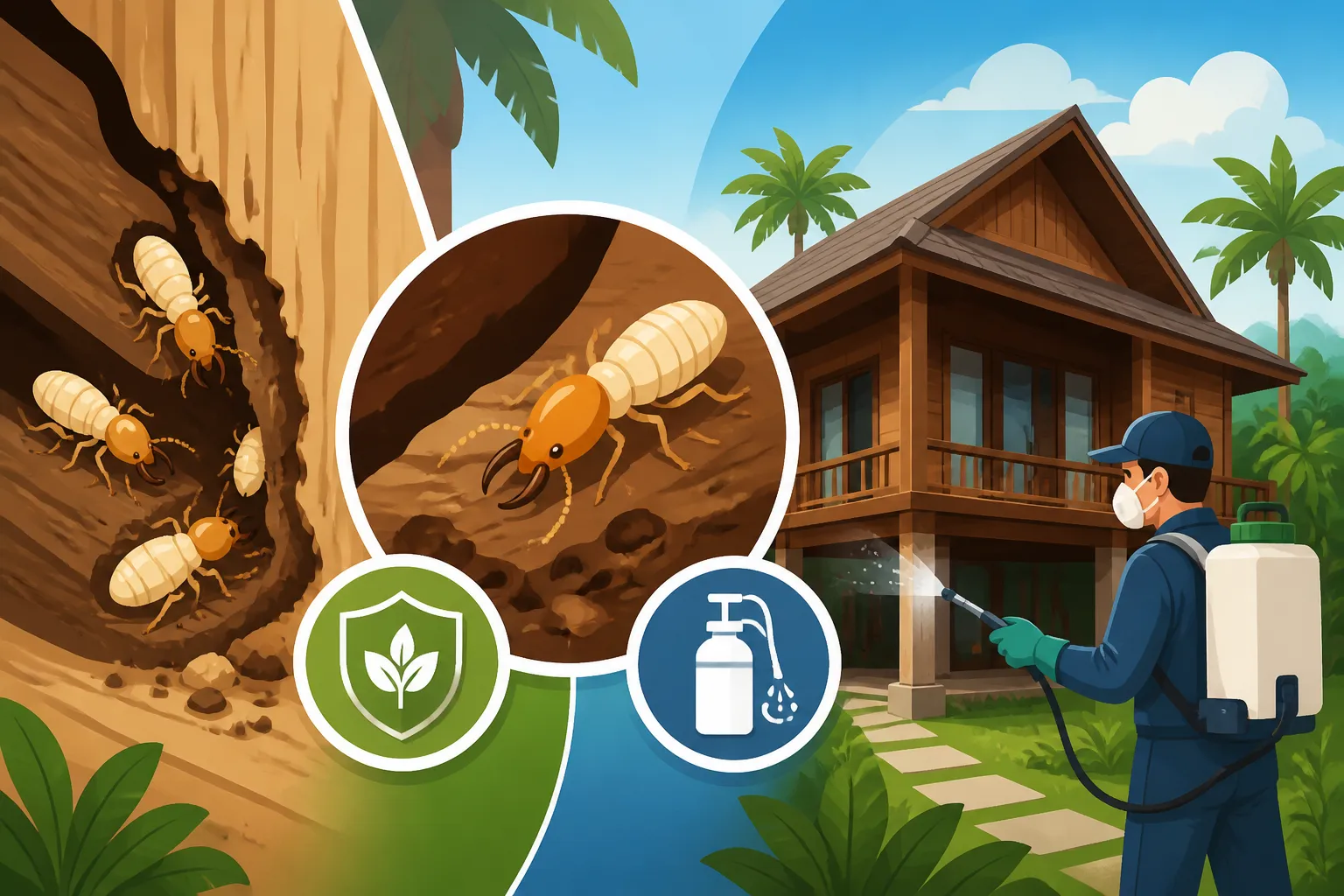
Subterranean termites are the most destructive. They live in the soil and build elaborate "mud tubes" to travel from the ground into your wooden structures. These tubes look like thin, brown veins of dried mud climbing up your concrete foundation or along the edges of your floorboards. If you see these, you have a highway of thousands of workers moving between the earth and your villa’s structural timber. I have seen these mud tubes appear overnight in villas in Bali Neighborhoods: Seminyak, Canggu, Sanur, Ubud, and the Bukit, particularly after heavy monsoon rains when the soil is saturated and the termites are seeking higher, drier ground.
Drywood termites, on the other hand, do not need contact with the soil. They live entirely within the wood they consume. The most common sign of their presence is "frass"—the technical term for their droppings, which looks like tiny, uniform granules of sand or sawdust. In Indonesia, locals call this "bubuk kayu." You will often find these small mounds directly beneath door frames, window sills, or the intricate carvings of a traditional Joglo. If you tap on the wood and it sounds hollow or like thin paper, the damage is already extensive.
Another tell-tale sign is the presence of "laron" or winged swarmers. During the change of seasons, usually at the beginning of the rainy season, you will see thousands of winged insects swarming around your lights at night. They shed their wings quickly, leaving a carpet of translucent discarded wings on your floor. While most of these will die, the survivors are looking to start new colonies in your roof or foundation. If you are currently staying in a rental found via Agoda and notice a sudden influx of these wings inside, it is time to notify the management immediately.
Prevention Strategies: Keeping the Wood Hungry and the Foundation Dry
Prevention in Indonesia is a multi-layered process that begins before a villa is even built. If you are involved in the construction process while Buying Property as a Foreigner: Hak Pakai, Hak Milik Nominees, and Risks, you must insist on a "pre-construction soil treatment." This involves drenching the ground under the foundation with termiticides to create a chemical barrier that subterranean termites cannot cross. Without this, your villa is essentially sitting on a ticking time bomb.
For those already living in a villa, moisture control is your best friend. Termites thrive in damp environments. Leaking pipes, clogged gutters, and poor drainage around the villa’s perimeter will attract them like a magnet. I’ve seen many expats overlook the importance of AC Maintenance: Routine Servicing and Freon Rules for Tropical Climates, not realizing that a leaking AC unit dripping down a wooden wall is an open invitation for a rayap colony to move in. Ensure that all condensation lines are directed away from the house and that your bathrooms are well-ventilated to prevent humidity from soaking into the wooden door frames.
The choice of wood is also a critical factor in prevention. Not all Indonesian wood is created equal when it comes to termite resistance. Teak (Jati) is world-famous for its high oil content and density, which makes it naturally resistant—though not immune—to termites. However, many modern villas use cheaper, softer woods for secondary structures.
| Wood Type | Local Name | Resistance Level | Common Use in Villas |
|---|---|---|---|
| Teak | Jati | High | Main beams, flooring, high-end furniture |
| Ironwood | Ulin | Very High | Outdoor decking, structural pillars |
| Camphor | Kamper | Medium | Door frames, window sills |
| Meranti | Meranti | Low | Plywood, interior trim, cheap furniture |
| Coconut | Kayu Kelapa | Low | Decorative pillars, gazebo structures |
If you are Furnishing Your Home: Buying at IKEA, Informa, and Jepara Furniture Makers, always ask if the wood has been kiln-dried (oven-dried) and treated with anti-termite chemicals. Untreated Meranti or coconut wood can be decimated by a colony in less than a year.
Treatment Options: Professional Intervention vs DIY Tactics
When you discover an active infestation, you need to move fast. In my early days in Jakarta, living in Jakarta Neighborhoods: Kemang, SCBD, Pondok Indah, and Menteng, I tried the "natural" route with vinegar and orange oil. While these might kill a few individual termites on contact, they do absolutely nothing to stop the thousands of others hidden deep within the walls or the queen producing more daily.
For DIY enthusiasts, you can find industrial-strength termiticides on Shopee such as "Latrex" or "Termidor." These are effective but must be handled with extreme caution. In Indonesia, many locals use a "spot treatment" method where they drill small holes into the infested wood and inject the chemical directly. This can work for small, localized drywood termite issues in furniture, but it rarely solves a structural problem.
Professional pest control in Indonesia is relatively affordable compared to Western countries, and it is usually the only way to get a guarantee. Professionals use two main methods: baiting and barriers. Baiting systems involve placing stations around your property that contain slow-acting toxins. The workers eat the bait and carry it back to the colony, eventually killing the queen. This is the most "eco-friendly" long-term solution. Barrier treatments involve "trenching and drilling," where they inject chemicals into the soil and through your floor tiles to create a toxic moat around your home.
If you are a newcomer and haven't set up a local phone line yet, you can use an eSIM from Airalo to stay connected while you research reputable local pest control companies. Look for companies that provide a written warranty—usually 1 to 3 years. Be prepared for the smell; chemical treatments in Indonesia are often quite pungent, and you may need to vacate the villa for 24 to 48 hours to let the fumes dissipate.
The Landlord Dilemma: Responsibility and Negotiation
One of the most frustrating aspects of being an expat is dealing with maintenance issues in a rental property. Because of the common Why Landlords Demand 1-to-3 Years Rent Upfront and How to Negotiate rule in Indonesia, you often have very little leverage once the money has changed hands. If you find termites six months into a three-year lease, getting the landlord to pay for treatment can be a battle.
Standard Indonesian lease agreements often state that the tenant is responsible for "routine maintenance," while the landlord covers "structural repairs." Termites sit in a gray area. Landlords may argue that you didn't keep the villa clean or dry enough, while you can rightly claim that the infestation is a structural failure of the building. To avoid this headache, always include a specific "termite clause" in your contract before signing. This clause should state that the landlord is responsible for an annual pest control inspection and any costs related to structural termite damage.
If you are currently Renting in Indonesia: The 1-Year Upfront Rule, Contracts, and Avoiding Scams, and you find termites, document everything. Take high-resolution photos of the mud tubes, the frass, and any damaged wood. Send these to the landlord or the agent immediately via WhatsApp. In my experience, most reasonable landlords will agree to split the cost of professional treatment because they know that if the termites eat your villa, they are losing a valuable asset.
If the damage is so severe that the villa becomes uninhabitable—for example, if the roof beams are compromised—you have a legal right to request a repair or a pro-rated refund. However, legal battles in Indonesia are long and expensive, so negotiation and "keeping the peace" are usually more effective. Remind the landlord that a small investment in pest control now prevents a total roof collapse later.
Everyday Etiquette: Religion, Culture, and the "Pest" Mindset
It is worth noting that the way you approach pest control might intersect with local customs. In some parts of Bali, there is a deep respect for all living things based on the local philosophy of Tri Hita Karana (harmony between humans, nature, and the divine). While most Balinese understand the necessity of protecting a home from rayap, you might find that your local staff or "tukang" (workman) has a more relaxed attitude toward "pests" than you do.
When hiring a team to treat your villa, explain clearly that you are protecting the structure of the building. If you are observant of Everyday Etiquette: Religion, Culture, Garbage, and Community Norms, you will find that a polite, respectful approach gets much better results than an aggressive demand for total eradication. Many local pest control companies are very professional, but they may need clear instructions on which areas of the villa are off-limits (such as small shrines or ceremonial areas) during the chemical application.
Finally, keep a "termite diary." Every three months, do a walk-around of your villa. Check the dark corners of the pantry, the backs of wardrobes, and the underside of your wooden stairs. If you catch them early, a termite infestation is a minor annoyance. If you ignore it, it can be a financial catastrophe. In the tropics, we share our space with many creatures, but the one that eats the roof over your head is the one guest you can never afford to host.
Disclaimer
This guide is for informational purposes only. Termite treatments involve hazardous chemicals and structural assessments that should ideally be performed by licensed professionals. The author and publisher are not liable for any property damage or health issues arising from DIY treatments or the use of specific brands mentioned. Always consult with a local pest control expert in Indonesia to verify current regulations and safety standards.