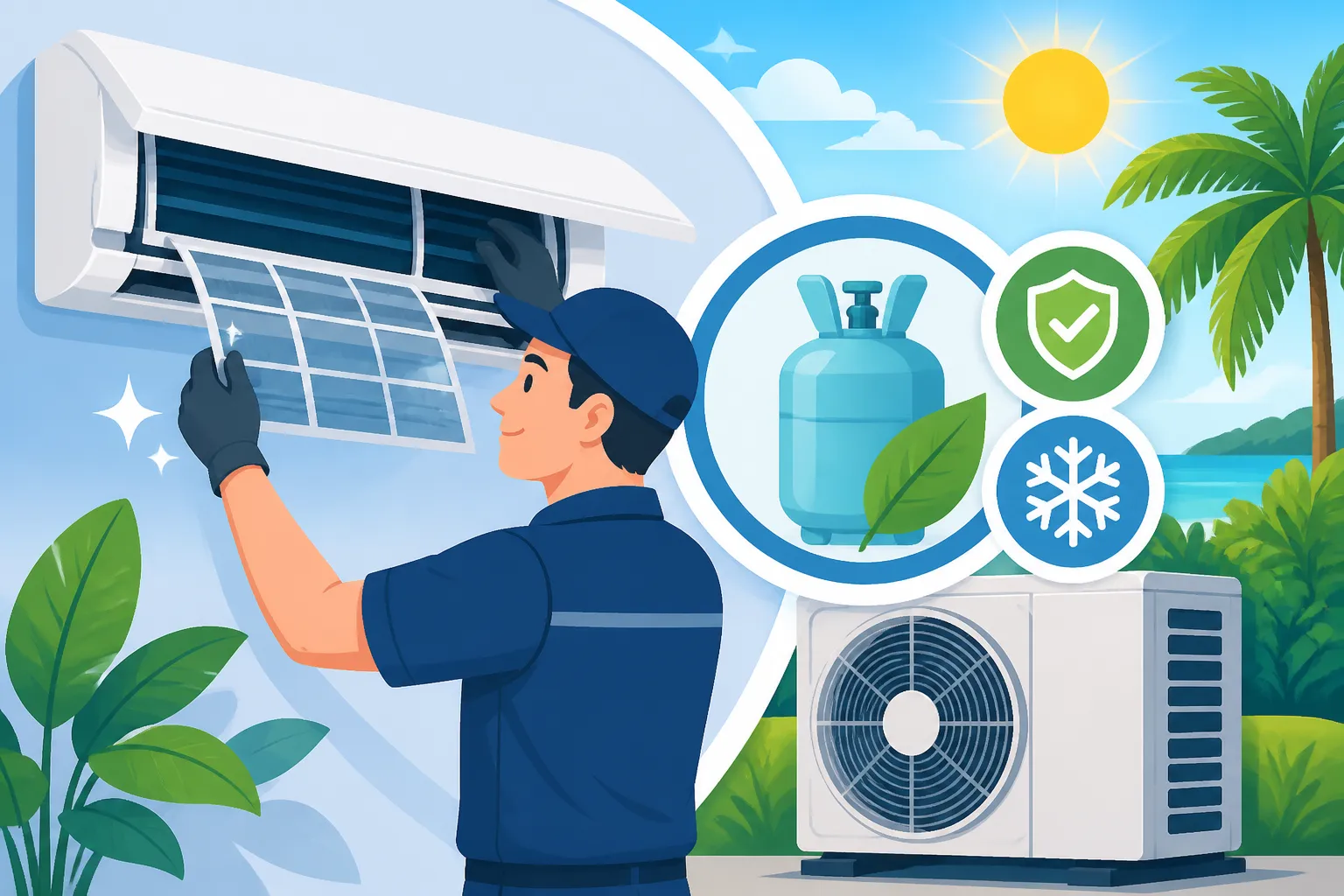
AC Maintenance: Routine Servicing and Freon Rules for Tropical Climates
Waking up at 3 AM in a pool of sweat because your AC unit decided to start "spitting" water or simply blowing lukewarm air is a rite of passage for every foreigner in Indonesia. I still remember my first month in Jakarta, staring helplessly at a puddle on my parquet floor, wondering why "modern" appliances struggled so much here. This guide solves the mystery of tropical AC maintenance, ensuring you never get scammed by a "Freon top-up" again.
Why Indonesian Humidity is the Enemy of Your AC
Living in a tropical climate like Indonesia means your air conditioner isn't just a luxury; it’s a dehumidifier that works overtime. In cities like Jakarta or Surabaya, the ambient humidity rarely drops below 70%, and during the monsoon season, it hits the 90s. This moisture is the primary reason why AC units in Indonesia require far more attention than they would in Europe or North America.
The Battle Against Mold and Mildew
In the high-humidity environment of the archipelago, the dark, damp interior of your AC unit becomes a five-star hotel for mold. When the evaporator coils cool the air, moisture condenses on them. In a perfect world, this water flows out through a drainage pipe. However, dust often mixes with this moisture, creating a sludge that traps fungal spores. If you start noticing a damp, earthy smell when you turn on the unit, you’re likely breathing in mold. This is a common complaint among new arrivals who find themselves developing "unexplained" respiratory issues shortly after moving into a new villa or apartment.
Dust, Pollen, and Air Quality Challenges
Indonesia’s urban areas, particularly Jakarta, face significant air quality challenges. Fine particulate matter (PM2.5) and general street dust are sucked into your AC’s intake every single hour it’s running. While the basic mesh filters catch the big stuff, the finer dust settles on the cooling fins and the blower fan (the cylindrical fan that spins inside the indoor unit). Over time, this dust acts as an insulator, forcing the compressor to work harder to achieve the same cooling effect. This doesn’t just make your room warmer; it sends your electricity bill through the roof. If you are still setting up your home, checking out Utilities and Setup: PLN Electricity, PDAM Water, and Home Internet in Indonesia is essential to understand how these efficiency drops affect your monthly costs.
Salt Air Issues in Bali and Coastal Areas
For those living in Bali Neighborhoods: Seminyak, Canggu, Sanur, Ubud, and the Bukit, there is an additional villain: salt air. If your villa is within a few kilometers of the ocean, the salt in the air accelerates the corrosion of the outdoor condenser unit. The aluminum fins on the condenser can "white rust" and crumble away within just two years if not rinsed regularly. Veteran expats in Sanur or Uluwatu often have their technicians spray down the outdoor unit with fresh water more frequently than those living inland in Ubud just to prevent the metal from disintegrating.
Routine Servicing: The Golden Three-Month Rule
In Indonesia, the standard recommendation for AC maintenance is once every three months. This might sound excessive to someone used to "once a year" check-ups, but the "Cuci AC" (AC Wash) is a local necessity. Neglecting this window usually leads to the dreaded "AC Bocor" (leaking AC) where water begins dripping from the indoor unit onto your electronics or bed.
What Happens During a Standard Cuci AC
A standard service in Indonesia is surprisingly invasive but effective. The technician (tukang AC) will cover your furniture with plastic sheets and then proceed to dismantle the plastic housing of the indoor unit. They use a high-pressure water sprayer to blast the evaporator coils and the blower fan. You will be shocked the first time you see the color of the water coming out of the drainage bag—it’s often jet black. They should also go outside to blast the dust out of the condenser unit. If they don’t go outside, they haven't finished the job. This deep cleaning is vital for maintaining the air quality and efficiency that Living in Indonesia as an Expat: The Complete Starter Guide (2027) emphasizes for a comfortable long-term stay.
Finding Reliable Technicians via Apps and Word of Mouth
Gone are the days of having to flag down a guy on a motorbike with a ladder strapped to the side. While those local "tukang" are often skilled, the language barrier can be tough for newcomers. Apps like Shopee often have service sections, and there are dedicated home-service apps like Seekmi or HaloJasa. These platforms offer fixed pricing and a bit more accountability. However, many expats still prefer the "resident expert" recommended in community WhatsApp groups. If you’ve just arrived and are staying in an apartment booked through Agoda while you look for long-term housing, ask the building management for their preferred vendor list. Having a reliable "AC guy" is as important as having a good doctor in this country.
DIY Maintenance: What You Can and Should Not Do
As a veteran expat, I always tell people: do not try to deep-clean the unit yourself. The high-pressure washing requires a specific catchment bag and a steady hand to avoid soaking the internal circuit boards. However, you must clean the mesh filters yourself every two weeks. It takes five minutes: pop the front cover, slide out the two mesh screens, rinse them in the shower, dry them, and pop them back in. This simple act can extend the time between professional services and keep your air crisp. If you are waiting for a technician and need to stay connected to coordinate their arrival, having a reliable data connection via Airalo ensures you aren't stuck in a "dead zone" when they call for directions to your "gang" (alleyway).
Understanding Freon: Myths, Refills, and R32 vs R410A
This is the section where most expats lose money. There is a common practice among some less scrupulous technicians to tell you that your "Freon is low" and needs a top-up (tambah Freon).
The Great Freon Scam: Does It Really Need To Be Topped Up?
Air conditioning is a closed system. Freon (refrigerant) does not get "used up" like gasoline in a car. If your Freon is actually low, it means you have a leak. Simply topping it up is like pouring water into a bucket with a hole in it; it’s a temporary and expensive fix. If a technician tells you that you need more gas every time they visit, they are either scamming you for an extra IDR 200,000–400,000 or they are ignoring a leak in your copper piping. Always ask them to show you the pressure gauge and, more importantly, ask them to find the leak if the pressure is indeed low. Understanding these nuances is a key part of Healthcare Budgeting: BPJS Caps, Out-of-Pocket Costs, and Private Copays because, believe it or not, poor AC maintenance can lead to health-related expenses.
Decoding Refrigerant Types in Indonesia
Most modern units in Indonesia use R32 or R410A refrigerant. R32 is the current standard because it is more efficient and has a lower global warming potential. You can usually find the type of gas your unit uses on a sticker on the side of the outdoor compressor. Never let a technician mix gases; putting R22 (an older, environmentally harmful gas) into an R32 system will destroy the compressor. If you are Renting in Indonesia: The 1-Year Upfront Rule, Contracts, and Avoiding Scams, make sure to check the age of the AC units during your walkthrough. Older units using R22 are much more expensive to run and harder to repair.
Environmental Impact and Regulation Updates
Indonesia has been phasing out HCFCs (like R22) in line with international agreements. By 2026, finding R22 for older units is becoming increasingly difficult and expensive. If your rental has these "ancient" units, it might be worth negotiating with the landlord to replace them with modern Inverter R32 units. The energy savings alone can be 30-50%, which is a significant chunk of change over a one-year lease. This is often a point of negotiation covered in Who Pays for Repairs? Typical Maintenance Responsibilities in Leases, where you can argue that the energy inefficiency of an old unit constitutes an unfair cost to the tenant.
| Service Type | Frequency | Estimated Cost (IDR) | What's Included |
|---|---|---|---|
| Filter Cleaning | Every 2 Weeks | Free (DIY) | Rinsing mesh filters |
| Standard Cuci AC | Every 3 Months | 75,000 – 150,000 | High-pressure wash indoor/outdoor |
| Freon Top-up (R32) | Only if leaking | 200,000 – 400,000 | Adding refrigerant gas |
| Chemical Wash | Once a Year | 350,000 – 500,000 | Deep solvent clean for stubborn mold |
| Capacitor Replacement | As Needed | 150,000 – 300,000 | Fixing units that won't kick on |
Common AC Problems and Troubleshooting in the Tropics
When things go wrong, and they will, it helps to know the "Indonesian" version of the problem. Local technicians have their own terminology that you’ll quickly pick up.
Dealing with Water Leaks (AC Bocor)
The most common call I make to my AC guy is for a "bocor." This almost always happens because the drainage pipe is clogged with "lendir" (jelly-like slime) formed by dust and algae. The technician will usually fix this by blowing high-pressure air or water through the drainage pipe from the inside out. If the leak persists, it might be because the unit wasn't leveled properly during installation, causing water to pool and overflow the internal tray. If you are experiencing this in a managed apartment, this should be covered under your Apartment vs Landed House (Rumah Tapak): Pros and Cons for Expats agreement, where building maintenance handles the primary repairs.
Smelly Units and the Infamous Sock Smell
If your AC smells like dirty socks, it’s a sign that bacteria are growing on the cooling fins. This happens when the unit is turned off and stays damp. A trick I learned from a veteran expat in Jakarta is to run the unit in "Fan Mode" for 15 minutes before turning it off completely. This helps dry out the internal components. If the smell is already there, you likely need a "Cuci Besar" or a chemical wash. They use a specific foaming agent that kills the bacteria. Just be sure to vent the room afterward, as the fumes can be quite strong.
Electrical Surges and Voltage Stabilizers
Indonesian power grids, especially in developing areas of Bali or outside the main "Golden Triangle" of Jakarta, can be prone to voltage fluctuations. AC compressors are sensitive to this. If you notice your lights flickering often, you should consider a voltage stabilizer for your larger AC units. Many "Inverter" models are particularly sensitive to power spikes. If your unit suddenly stops blowing cold air but the fan is still running, there’s a high chance the "kapasitor" (capacitor) has blown due to a surge. It’s a cheap and easy fix, but one that happens far more often here than in more stable power markets.
Budgeting and Logistics for AC Care
Managing the costs of AC maintenance is part of your overall Everyday Budgeting in Indonesia: Cost of Living in Jakarta vs Bali vs Regional strategy. It’s a small recurring cost that prevents a massive "broken compressor" bill later.
Standard Pricing for Servicing and Repairs
As of 2026, a standard "Cuci" for a single split unit (up to 1.5 PK) should cost between IDR 75,000 and IDR 125,000 in Jakarta. In Bali, prices can be slightly higher due to the "tourist tax" in areas like Canggu, sometimes reaching IDR 150,000. If you have multiple units in a house, you should always negotiate a "package price." For a 3-bedroom house with 4 units, I typically pay IDR 350,000 total for a full service. Be wary of any technician who quotes you in USD or tries to charge significantly more without a clear explanation of parts needed.
Managing Repairs with Landlords
One of the biggest friction points in an expat's life is the "who pays?" debate. In Indonesia, the general rule is that the tenant pays for routine maintenance (the 3-month wash), while the landlord pays for "major" repairs (replacing a compressor, fixing a major leak in the copper pipes, or replacing the unit). However, if you haven't serviced the unit for a year and the compressor dies, the landlord may rightfully claim that your negligence caused the failure. Always keep your service receipts! I keep a folder of every AC service. When the AC eventually breaks—and it will—you can prove you did your part. This is a vital tip for anyone navigating the legalities mentioned in Understanding Indonesian Lease Agreements: Notarized Contracts and Stamp Duty.
Buying New: Energy Efficiency and Inverter Units
If you are in a position to buy a new unit (perhaps for a long-term villa lease or a home you own), always go for an Inverter model. While the upfront cost is higher, the "Electricity Token" system in Indonesia (where you prepay for power) makes you very aware of your consumption. An Inverter unit slows down its motor once the room is cool, rather than turning it on and off constantly. This is much better for the Indonesian grid and your wallet. You can find a wide range of brands like Daikin, Sharp, and Panasonic on Shopee or at local electronic stores like Electronic City. I personally swear by Daikin for its durability in the tropical heat, but regardless of the brand, make sure the service center is nearby.
Disclaimer
The information provided in this guide is based on personal expat experiences and general market practices in Indonesia as of 2026. While we strive for accuracy, local regulations regarding refrigerants and service pricing may vary by region. Always consult with a certified technician before attempting any repairs on electrical appliances. We are not responsible for any damages or disputes arising from the use of the advice contained herein.