How to Handle Encounters with Street Dogs (Anjing Kampung) Safely
Walking down a quiet Canggu gang or a Jakarta alleyway and hearing that first low growl is a rite of passage for every expat. I remember my first month in Sanur, frozen in place as three "Anjing Kampung" blocked my path home. This guide solves the anxiety of navigating Indonesian streets by teaching you how to read local dog behavior and protect yourself without escalating the situation.
Decoding the Indonesian Street Dog
The first thing you need to realize as an expat is that the "Anjing Kampung" (Village Dog) is not quite the same as the stray dogs you might see in Eastern Europe or South America. These dogs are deeply woven into the fabric of Indonesian society, particularly in Bali. While they might look like strays, they often have a very specific place in the community hierarchy. They are remarkably intelligent, highly territorial, and possess a "street smarts" that domestic golden retrievers simply don't have.
Village Dogs vs Stray Dogs
In most of Indonesia, an Anjing Kampung is technically a "community dog" rather than a stray. While they roam freely, they are often loosely "owned" by a specific family or a warung owner who provides them with scraps. They serve as a natural alarm system for the neighborhood. Understanding this is crucial because when a dog barks at you, it isn't necessarily being "mean"—it is doing its job. It is alerting the household and the other dogs in the gang that a stranger (you) is entering their territory.
When you are walking through different Bali Neighborhoods: Seminyak, Canggu, Sanur, Ubud, and the Bukit, you will notice that the dogs in more tourist-heavy areas like Canggu are generally more desensitized to foreigners. However, as soon as you step into a residential "gang" (narrow alleyway), the rules change. These dogs see that specific 50-meter stretch of pavement as their kingdom. If you understand that their aggression is usually defensive and territorial rather than predatory, it becomes much easier to manage your own fear response.
The Cultural Context of Dogs in Indonesia
The way dogs are treated varies wildly depending on where you are in the archipelago. In Muslim-majority areas like Jakarta or West Java, dogs are less common in the streets because they are considered "najis" (ritually unclean) in Islamic tradition. However, you will still encounter them in Christian enclaves or around Chinese-Indonesian neighborhoods. In Bali, the relationship is entirely different. Dogs are everywhere, believed by some to be protectors against unseen spirits.
Because of this cultural layering, the dogs have different "vibes" depending on the region. A dog in a Jakarta suburb might be more skittish because it isn't used to much human interaction, whereas a Bali dog might be bold and demanding. Regardless of where you are, observing Everyday Etiquette: Religion, Culture, Garbage, and Community Norms is vital. Never kick or throw things at a dog unless it is a life-threatening emergency, as this can deeply offend the local "owners" and actually make the dog pack more aggressive toward the next expat who walks by.
Practical Safety and Defensive Techniques
The moment you see a pack of dogs standing in the middle of the road, your heart rate is going to spike. I have been there, sweating in the midday sun, wondering if I should turn around or push through. The key to handling these encounters safely is all about your body language and your "energy." Indonesian street dogs are masters at reading human fear. If you project "victim," they will act like "predators."
The Golden Rule: Do Not Run
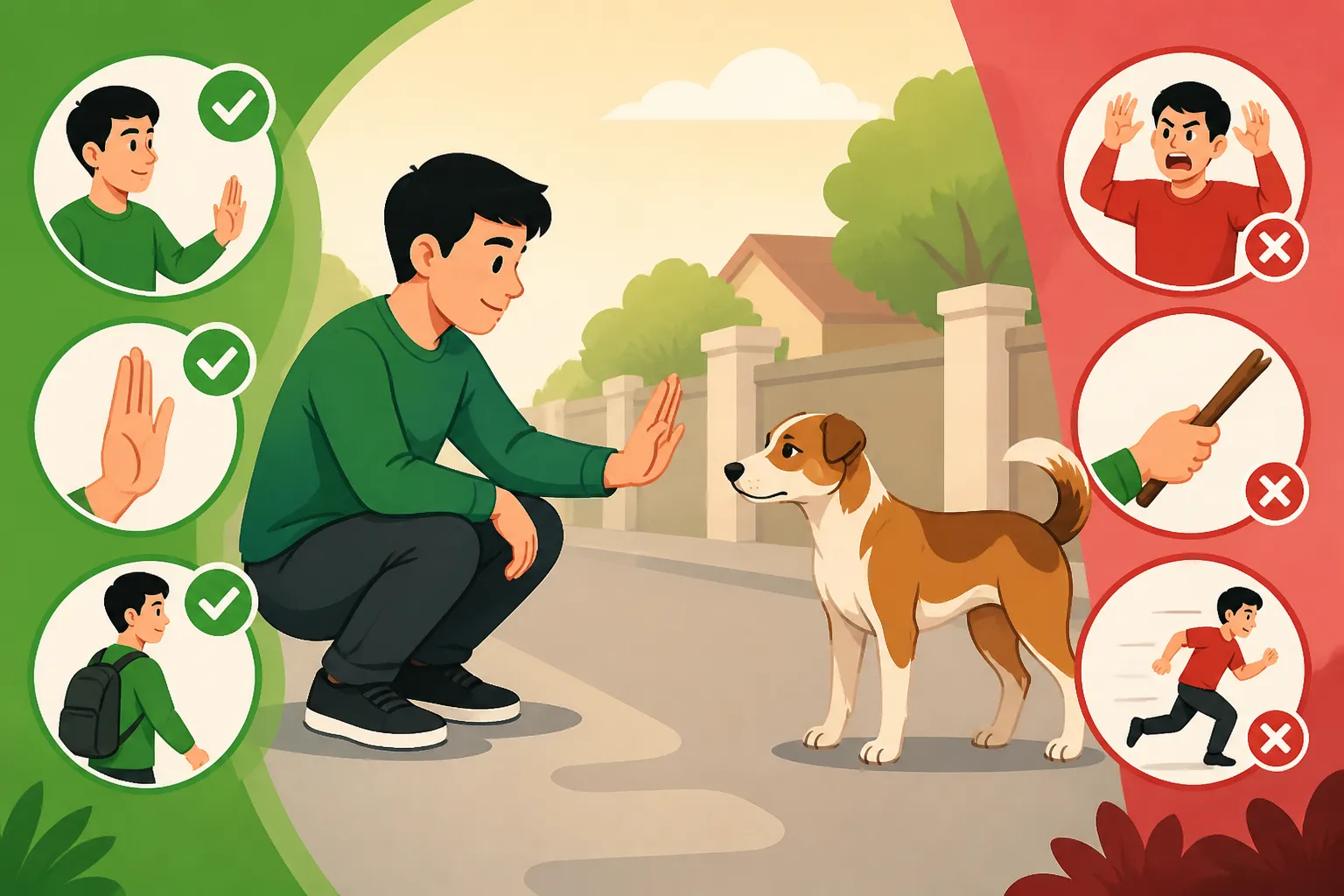
This is the most important piece of advice anyone can give you: never, under any circumstances, run away from an Anjing Kampung. These dogs have a powerful chase instinct. The second you turn your back and bolt, you have triggered their "prey drive," and even the most cowardly dog will suddenly feel emboldened to nip at your heels.
Instead, you should stop. Stand your ground, but don't challenge them. Keep your body turned slightly to the side rather than facing them head-on, which can be seen as an act of aggression. If you must keep moving, do so at a slow, deliberate walking pace. When I’m exploring new areas, I always make sure I have a working data connection via an Airalo eSIM so I can check my maps and ensure I’m not walking into a dead-end alleyway where I might get cornered. Being able to see your exit route on a map prevents the kind of "lost and panicked" look that dogs love to exploit.
The Fake Stone Gesture
This is a legendary "life hack" among veteran expats in Indonesia. Most street dogs have, at some point in their lives, been shooed away by locals throwing small stones. Consequently, they have developed a conditioned fear of the "picking up a stone" motion.
If a dog is charging at you or growling aggressively, simply bend down quickly and pretend to pick something up from the ground. You don't even need an actual stone. Just the motion of reaching down and then making a throwing gesture is usually enough to make a pack of five dogs scatter instantly. They know the pain of a well-aimed pebble, and they won't stick around to find out if you’re a good shot. It’s a bluff, but it’s the most effective bluff in the country. You can even find "ultrasonic" deterrent devices on Shopee that emit a high-pitched sound only dogs can hear, which can be a great backup if the "fake stone" doesn't work.
Scooter Safety and Dogs
Encounters aren't limited to walking. Many expats find themselves being "chased" while on their motorbikes. This is particularly common at night on empty roads. The dogs aren't trying to eat your bike; they are reacting to the high-pitched noise of the engine and the fast movement.
If a dog starts running alongside your scooter and snapping at your legs, do not speed up blindly. This often causes you to lose control or drive into a pothole. Instead, try "pulsing" your brakes. Slowing down suddenly often confuses the dog and breaks their "chase" cycle. Most of the time, they will stop as soon as you are 20 meters past their invisible territory line. If you are planning a long-term stay, check the Health Checklist for Your First 30 Days in Jakarta or Bali to ensure you are prepared for the general chaos of Indonesian roads, dogs included.
| Dog Behavior | Meaning | Recommended Action |
|---|---|---|
| Low growl/stiff tail | Warning: "This is my territory." | Stop, look away, and walk slowly in a wide arc. |
| Rapid barking/circling | Alert: "I'm calling the pack." | Use the "Fake Stone" gesture; do not run. |
| Tail between legs/yelping | Fear: "I'm scared of you." | Keep moving; the dog is unlikely to attack. |
| Lunging/snapping | Aggression: "I am going to bite." | Use a bag or umbrella as a shield; shout firmly. |
Health Risks and Medical Management
While most encounters end with nothing more than a few loud barks and a racing heart, we have to talk about the "R" word: Rabies. Indonesia, and specifically Bali, has had ongoing issues with rabies for years. As an expat, you cannot afford to be "chill" about a dog bite, no matter how small or "clean" the dog looks.
The Reality of Rabies in Indonesia
Rabies is 100% fatal once symptoms appear, but it is 100% preventable if you act fast. Even if you had your pre-exposure vaccinations before moving here, you still need "booster" shots if you are bitten. The pre-exposure shots don't make you immune; they just buy you more time and reduce the number of shots you need after a bite.
When you are researching places to stay on Agoda, it’s worth looking at the proximity to international-standard clinics. If you are in a remote village in North Bali or a rural part of Sumatra, getting the life-saving Rabies Vaccine and HRIG (Human Rabies Immune Globulin) can be a logistical nightmare. Always read up on Rabies in Bali and Beyond: Post-Exposure Protocols and Vaccine Access before you start exploring off-the-beaten-path locations.
Immediate First Aid for Bites
If the worst happens and a dog manages to nip you, do not just wipe it with a wet wipe and move on. The virus lives in the saliva. You need to wash the wound with soap and running water for at least 15 minutes. This mechanical washing is actually one of the most effective ways to reduce the viral load.
After washing, head immediately to a reputable hospital. In major cities, you should refer to the Bali Healthcare Guide: Hospitals, Clinics, and Emergency Contacts for Residents or the equivalent for Jakarta. Do not wait until the next morning. If the bite is severe, you may need to call for help; knowing the Emergency Numbers in Indonesia: 118/119 for Ambulance and What to Expect is critical, although for a dog bite, taking a Grab or Gojek to the ER is usually faster.
Harmonious Living and Community Relations
Living as an expat means you aren't just a guest; you are a neighbor. If you have a pack of dogs living outside your villa, your life will be much easier if you make friends with them rather than treating them like enemies.
Building Rapport with Neighborhood Packs
The "Alpha" of the local dog pack is the one you want to win over. Usually, this is the oldest, grumpiest-looking dog that spends most of its time sleeping in the shade of a parked car. When I first moved into my house in Sanur, I started carrying a small bag of dog treats I bought on Shopee. Every time I walked past the local pack, I would toss a few treats from a distance.
After a week, the barking stopped. After two weeks, they started wagging their tails when they saw me. By the end of the month, they were essentially my unpaid security guards. If a "stranger" bule walked down the street, they would bark their heads off, but they would let me pass in total silence. This is the ultimate way to How to Secure Your Property When Traveling Abroad for Extended Periods—having a local pack that knows you and watches your gate is better than any CCTV camera.
The Role of the Banjar and Local Authorities
If there is a truly aggressive dog that is making it impossible for you to leave your house, do not try to handle it yourself with poison or violence. This is a surefire way to get into massive trouble with your neighbors and the local "Banjar" (village council).
In Indonesia, community problems are solved through "Musyawarah" (consultation). Talk to your landlord or the local RT/RW (neighborhood head). Explain the situation calmly. Often, they will know who the dog belongs to and can ask the owner to keep it inside or tied up during the day. If the situation is a broader public health concern, they might contact the local animal welfare groups or the government for a vaccination drive. For more serious health crises, the Emergency Medical Care in Indonesia: Ambulances, ERs, and Evacuation Protocols framework is there, but for dog management, the solution is always local and social.
Summary Checklist for Expat Dog Safety
To ensure your daily walks remain stress-free, keep these "veteran" tips in mind:
- Carry a "Prop": An umbrella or a walking stick can act as a physical barrier between you and a snapping dog. Even just holding it often discourages them from getting too close.
- Stay Connected: Use an Airalo eSIM to ensure you always have GPS. Getting lost in a maze of alleys is when you are most likely to stumble into a territorial pack.
- Use Shopee for Prep: Buy high-quality, closed-toe shoes. Flip-flops make it harder to stand your ground or move deliberately, and they leave your toes vulnerable to "ankle nippers."
- Check Reviews: Before booking a villa on Agoda, search the reviews for keywords like "dogs," "barking," or "stray." If several people mention a "scary dog pack" at the entrance, believe them.
- Learn the Lingo: Shouting "Sst!" or "Hus!" (the local version of "shoo") is often more effective than "Go away!" because the dogs recognize the sound.
Managing encounters with Anjing Kampung is less about animal handling and more about cultural navigation. Once you stop seeing them as a threat and start seeing them as part of the neighborhood landscape, your anxiety will drop—and the dogs will sense that, too. Treat them with a mix of healthy caution and "I'm-the-boss" confidence, and you'll find that life in Indonesia becomes much smoother.
Disclaimer
This guide is based on personal expat experiences and general observations of local conditions in Indonesia. It does not constitute professional veterinary or medical advice. Dog behavior can be unpredictable, and rabies is a serious health risk in many parts of the country. Always consult with a medical professional regarding vaccinations and emergency treatment for animal bites. Neither the author nor this publication is responsible for any injury or loss resulting from encounters with animals or the use of information in this article.