Troubleshooting Noisy Water Pumps and Septic Tank Issues in Villas
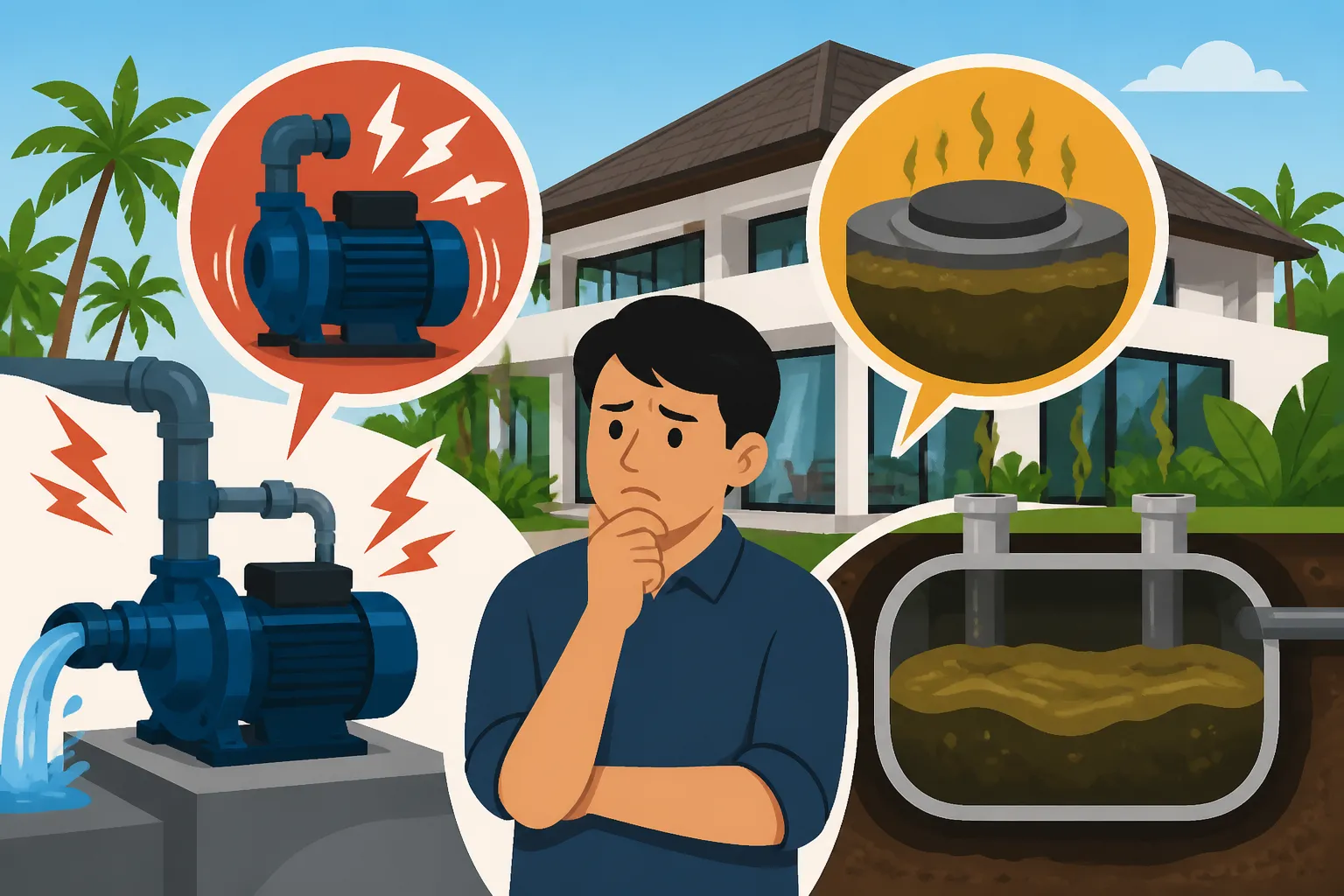
Nothing ruins a peaceful Bali night like a water pump that sounds like a jet engine taking off in your garden. I remember my first month in Canggu, waking up convinced a helicopter had landed on my roof, only to realize my jet pump was just thirsty. This guide dives into fixing those noisy pumps and handling the dreaded septic tank odors common in Indonesian villas.
The Anatomy of the Indonesian Villa Water System
To understand why your villa is making strange noises or emitting unwanted scents, you first need to understand how water moves through a typical Indonesian property. Most villas rely on a "Sumur Bor" (borewell), which is a deep hole drilled into the ground to tap into the local water table. Because the municipal water supply is inconsistent in many areas, having your own well is the standard. However, this means you are essentially running your own mini-utility company, and when things break, it is your responsibility to fix them.
In a standard setup, a pump pulls water from the well and sends it either directly to your taps or up to a "Toren" (water tower). The Toren is that large orange or blue plastic tank you see perched on roofs or high metal stands. Gravity then feeds the water down into your house. Some villas use a booster pump to ensure you have enough pressure for those luxury rain showers. If you are just moving in, check out Living in Indonesia as an Expat: The Complete Starter Guide (2027) to get a better sense of how these basic utilities differ from what you might be used to back home.
Understanding your setup is the first step in troubleshooting. Are you using a submersible pump that sits deep in the well, or a surface-level jet pump that sits in a little "rumah pompa" (pump house) in your garden? Submersible pumps are generally much quieter because the water and earth muffle the sound. If you have a surface pump and it is screaming, you are likely dealing with mechanical wear or an air leak in the suction line. Navigating these setups is part of the Utilities and Setup: PLN Electricity, PDAM Water, and Home Internet in Indonesia experience that every long-term resident eventually masters.
Why Indonesian Pumps are Notoriously Noisy
The noise usually comes down to three things: vibration, cavitation, or the dreaded "rapid cycling." Vibration occurs when the pump isn't properly bolted to a heavy concrete base. In many hastily built villas, the pump is simply sitting on a few loose bricks. As the motor spins, it rattles against the bricks and the PVC pipes, creating a resonance that can vibrate through the walls of your bedroom.
Cavitation is a more technical issue where air bubbles form in the water due to pressure changes. This sounds like the pump is trying to chew on a bag of marbles. It’s incredibly damaging to the internal impellers and usually means your well level is low or there is a crack in the intake pipe. If you hear this during the dry season, it is a sign that your Water Supply in Indonesia: PDAM City Water vs Borewells (Sumur Bor) might be struggling with a dropping water table.
Rapid cycling is that annoying "click-clack" sound where the pump turns on and off every few seconds. This is usually caused by a faulty pressure switch or a water-logged pressure tank. When this happens, the pump doesn't know when to stop, leading to massive electricity spikes. Since power can be expensive, you’ll want to fix this quickly to avoid a shock when you check your PLN bill. You can find replacement pressure switches easily on Shopee if you feel like a bit of DIY, or you can call a local specialist.
Common Water Pump Types and Noise Profiles
| Pump Type | Common Noise Issue | Sound Description | Urgency Level |
|---|---|---|---|
| Jet Pump (Surface) | Worn Bearings | High-pitched grinding/whining | High (Motor may seize) |
| Jet Pump (Surface) | Air Leak/Priming | Spluttering and "chewing" sounds | Medium (Check foot valve) |
| Submersible | Clogged Intake | Dull, heavy hum with no water flow | High (Pump can overheat) |
| Booster Pump | Pressure Switch | Rapid "Tak-tak-tak" clicking | Medium (Waste of electricity) |
Troubleshooting the Screaming Water Pump
When the noise becomes unbearable, the first thing I always do is check the "foot valve." This is a one-way valve at the bottom of your well pipe that keeps the water from falling back down when the pump is off. If this valve is leaking, the pump loses its "prime" and has to work twice as hard to suck water up, leading to a lot of air-related noise. If you’ve ever had to pour a bucket of water into a hole in the top of your pump just to get it started, you’ve experienced the "priming" ritual.
Another common culprit is the mounting. If the pump is shaking, I recommend buying a thick rubber mat—even a piece of an old car tire works—and placing it between the pump and the ground. This simple dampening technique can reduce the noise by 50% instantly. If the noise is coming from the pipes themselves, look for where they touch the walls. Wrapping these sections in foam or old rags can stop the "hammering" sound that echoes through the villa.
If you are dealing with the rapid clicking of a pressure switch, look for a small plastic box attached to the side of the pump with two wires going into it. There is usually a screw inside that allows you to adjust the sensitivity. However, these are cheap components that frequently fail due to the high humidity in Indonesia. If adjusting it doesn't work, don't overthink it; just buy a new one. While waiting for a repair, if the noise is driving you crazy, you might even consider booking a quiet night away via Agoda just to get some actual sleep.
When to Replace the Bearings or the Motor
If the pump is making a continuous, high-pitched metallic scream, your bearings are likely shot. This often happens because the "seal" has failed, allowing water to leak into the motor housing. In the West, you might just buy a new pump, but in Indonesia, the "tukang" (handyman) culture is all about repair. A local shop can often pull the pump apart, replace the bearings and the seal, and have it back to you for a fraction of the cost of a new unit.
Before you send it for repair, check the voltage. During peak hours in some neighborhoods, the electricity can drop below 200V. When a pump doesn't get enough voltage, it struggles to spin, creating a heavy, angry hum. If this is a recurring problem, you might need a "stabilizer." This is a common piece of equipment in Indonesian households that regulates the flow of electricity to sensitive appliances.
Septic Tank Nightmares: Odors and Overflows
There is a specific kind of panic that sets in when you realize your villa’s bathrooms are starting to smell like a swamp. In tropical climates, the high heat and humidity accelerate the breakdown of organic waste, and if your septic system isn't breathing correctly, that gas has nowhere to go but back up your drains. Most Indonesian villas use a "bioseptic" tank or a traditional two-chamber concrete soak-pit.
The most common cause of "bau" (smell) is a blocked vent pipe. Every septic tank needs a small pipe that leads up to the roof or away from the house to release methane gas. Often, these pipes get clogged by bird nests, spider webs, or even falling leaves. If that gas can't escape outside, it will push through the "U-trap" in your toilets or floor drains. If you’re living in a flood-prone area, the situation can get even worse during the rainy season. For more on managing your environment during the wet months, see Typhoon and Monsoon Prep: Keeping Your Roof and Drainage Clear.
Another issue is the "bakteri" balance. If you use too many harsh chemicals or bleach to clean your toilets, you kill the healthy bacteria that digest the waste. When the bacteria die, the waste just sits there and rots, creating a massive odor. I’ve learned the hard way to only use septic-safe cleaners. If the smell is already there, you can buy "debitur" (septic bacteria packets) from any local hardware store or even on Shopee. You just flush them down the toilet, and they "reboot" the tank’s ecosystem.
Managing Overflows During the Rainy Season
In places like Bali or parts of Jakarta, the water table rises significantly during the monsoon. If your septic tank is a traditional soak-pit (where liquid seeps into the ground), it may stop working because the ground around it is already saturated with rainwater. This leads to the terrifying "backflow" where things don't want to flush.
If this happens, you have to call a "Sedot WC" service. These are the brightly colored trucks you see driving around with phone numbers painted on the side. They will pump out the tank and give you a fresh start. It’s a messy job, but they are incredibly efficient. If you are worried about the local environment and want to prevent these issues, it is worth checking if your neighborhood is prone to drainage problems by reading Flooding in Jakarta: How to Check if a Neighborhood is Prone to 'Banjir'.
Maintaining Your Drains to Prevent Clogs
Indonesian plumbing often uses smaller pipe diameters than you might be used to in Europe or North America. This means they clog much more easily. A golden rule for villa living: never, ever flush toilet paper or feminine hygiene products. Most villas provide a small "bum gun" (handheld bidet) and a waste bin for a reason.
If you do get a clog, avoid using high-pressure air plungers, as many Indonesian PVC pipes are not glued as securely as they should be. I’ve seen people blow their own pipes apart under the house trying to clear a simple hair clog. Instead, use a "snake" or a liquid enzyme cleaner. If the problem is persistent, it might be worth discussing with your landlord, as it could be a structural issue with the pipe's "slope."
Finding and Managing Reliable Help
You don't have to be a master plumber to live in a villa, but you do need to know how to talk to one. When you need a "Tukang Ledeng" (plumber), the best place to start is your villa's "Banjar" (local community group) or a Facebook expat group for your specific area. If you’re struggling to communicate, having a translation app ready on your phone via Airalo data can be a lifesaver.
When the tukang arrives, don't just point at the problem and walk away. Stay and watch. Ask them to explain what they are doing. This isn't just to make sure the job is done right; it’s so you can learn how your specific villa works. Most repairs are quite affordable, but it is always good practice to agree on the price "borongan" (all-in) before they start the work. If you have full-time staff, they often have a "regular" guy they call. To manage these relationships better, take a look at Hiring a Domestic Helper (Pembantu): Salaries, THR, and Live-In Arrangements.
Communication Tips for Plumbing Issues
| English | Bahasa Indonesia | Context |
|---|---|---|
| Water pump | Pompa air | Generic term for the machine |
| It's broken | Rusak | Use this for any malfunction |
| Noisy | Berisik | Specifically for the sound issues |
| Foul smell | Bau | For septic or drain issues |
| To leak | Bocor | For pipes or tanks |
| To fix | Perbaiki | The action you want them to take |
Dealing with the quirks of villa maintenance is a rite of passage. It teaches you patience and gives you a deep appreciation for the "silent" infrastructure we usually take for granted. Whether it's the roar of a pump at midnight or the subtle "bau" of a failing septic tank, these issues are usually solvable with a bit of local knowledge and the right "tukang" on speed dial.
Remember that most of these systems are built with "gotong royong" (communal help) in mind. Don't be afraid to ask your neighbors for advice. They’ve likely dealt with the exact same pump model or the same drainage issues during the last big storm. For more tips on navigating your local community and the unwritten rules of villa life, check out Dealing with Neighborhood Noise: Mosques, Roosters, and Construction Etiquette. Stay proactive, keep your filters clean, and keep an ear out for those early warning sounds. A little maintenance today prevents a massive, smelly headache tomorrow.
Finally, always keep a basic "emergency kit" in your villa: a few spare PLN tokens, some septic bacteria packets, and the number of a reliable plumber. If you feel like your villa has become a "money pit" of repairs, take a breath and remember why you moved here in the first place—likely for the sun, the culture, and the lifestyle that outweighs a few noisy pipes. For general safety and peace of mind, it’s also worth reviewing Safety 101: Petty Theft, ATM Skimming, and Home Security in Indonesia to ensure your home is secure while you're focusing on the internal mechanics.
Disclaimer
This guide is for informational purposes only and does not constitute professional engineering or plumbing advice. Always consult with a qualified local technician before attempting major electrical or structural repairs in your villa. Water and electricity can be a dangerous combination; prioritize your safety at all times.