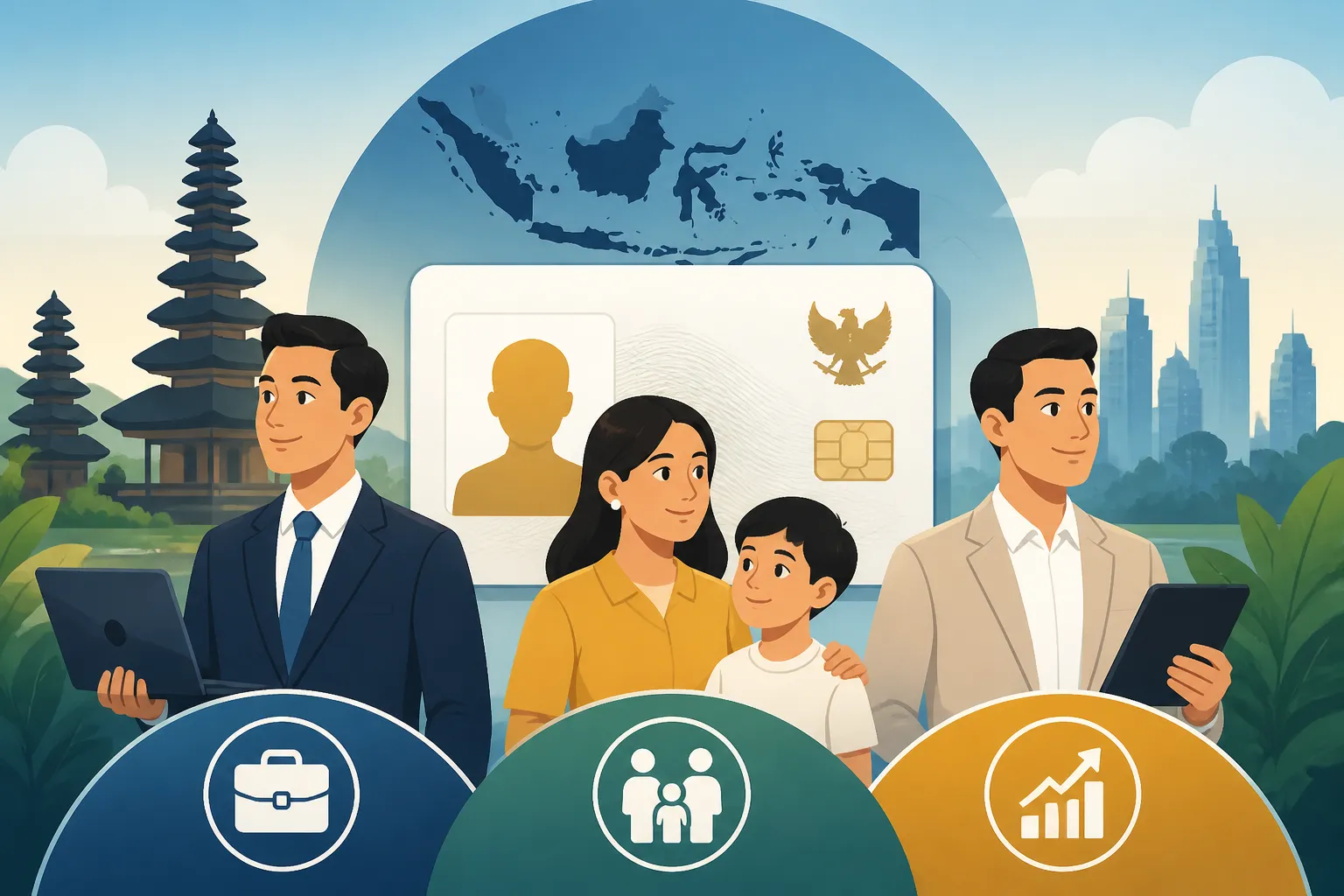
KITAS Explained: Working, Dependent, and Investor Temporary Stay Permits
Navigating the labyrinth of Indonesian immigration often feels like trying to find a specific street in Jakarta during a monsoon without GPS. I remember sitting in a plastic chair at the South Jakarta immigration office for five hours, clutching a folder of documents that seemed to grow every time I spoke to an officer. This guide breaks down the complexities of the KITAS (Temporary Stay Permit), ensuring you don't make the same rookie mistakes I did.
Understanding the KITAS Ecosystem: Why the Plastic Card Matters
When you first arrive in Indonesia, the sheer variety of stamps and stickers in your passport can be overwhelming. The KITAS, or Kartu Izin Tinggal Terbatas, is the backbone of your legal residency. It is no longer a physical yellow card as it was in the old days; today, it is predominantly an e-ITAS, a digital document sent to your email. However, the weight it carries is immense. Without it, you are a perpetual tourist, limited by the restrictive 30 or 60-day windows of a Visa on Arrival or a B211A.
Transitioning to a KITAS changes your relationship with the country. It allows you to open a bank account at BCA or Mandiri, obtain a local driver's license, and, most importantly, it stops the constant anxiety of the "visa run." While services like iVisa are fantastic for getting your initial entry foot in the door, the KITAS is where your real life in Indonesia begins. It represents a commitment to the country, and in return, the country grants you a level of stability that tourists never experience.
The system has seen massive updates in 2025 and 2026. The shift toward the "Molina" online portal has digitized much of the process, but don't let the shiny interface fool you—the underlying requirements remain as stringent as ever. You still need to prove your worth to the Indonesian state, whether through specialized skills, significant investment, or legitimate family ties.
The Legal Framework of Temporary Residency
A KITAS is not a "work permit" on its own, though many expats use the terms interchangeably. The KITAS is your stay permit, while for workers, the IMTA (or its modern equivalent under the RPTKA system) is your actual permission to labor. This distinction is vital because immigration officers are meticulous. If you have a stay permit but are found working without the specific work authorization attached to your NIB (Business Identification Number), the penalties are severe. I have seen talented professionals deported because they assumed their "business visa" allowed them to manage a local team.
The validity of a KITAS typically ranges from six months to two years, depending on your sponsorship and the specific index of your visa. For most professionals, a one-year renewable permit is the standard. It is essential to start your renewal process at least 30 to 60 days before the expiry date. If you miss this window, you enter the dreaded "overstay" territory, which currently carries a fine of IDR 1,000,000 per day.
The Role of Your Sponsor
In Indonesia, every foreigner on a KITAS must have a sponsor. This is the entity or individual legally responsible for your behavior and your presence in the country. For a working visa, your sponsor is your employer (a PT PMA or a local PT). For an investor visa, it is the company you have invested in. For a dependent visa, it is your spouse or parent who holds the primary KITAS.
Choosing the right sponsor is the most critical decision you will make. If your sponsor goes bankrupt or decides to cancel your permit out of spite, you generally have seven days to leave the country under an Exit Permit Only (EPO) vs ERP: Closing Your Visa Before Leaving Indonesia. I always advise newcomers to vet their employers or partners thoroughly. Your legal right to wake up in your own bed in Bali or Jakarta is entirely tied to their corporate standing and willingness to sign off on your monthly paperwork.
The Working KITAS: Your Gateway to Professional Life
The Working KITAS (typically Index E23) is the gold standard for expats looking to build a career in the archipelago. It is also the most scrutinized. The Indonesian government operates on a "local first" policy, meaning your employer must prove that your specific skillset cannot be easily found within the local labor pool. This is documented through the RPTKA (Expatriate Placement Plan).
When I first started working in Jakarta, I was surprised by how much the Ministry of Manpower cared about my university degree. If you are applying for a "Manager" role, your degree must generally align with that field. If you are a creative director with a degree in marine biology, expect questions. The authorities want to see that you are bringing genuine expertise to the Working in Indonesia as a Foreigner: Jobs, Corporate Culture, and Hiring (2027).
Employer Responsibilities and the RPTKA
Your employer bears the brunt of the administrative load for a working KITAS. They must navigate the TKA Online system to secure your RPTKA approval. This document outlines exactly how many foreigners the company intends to hire and for what specific roles. It also mandates that the company appoints an Indonesian "understudy" for you, whom you are expected to train to eventually take over your role.
Furthermore, the company must pay the DPKK (Education and Training Fund Compensation) fee, which is USD 100 per month of your visa’s validity. This money is paid upfront and is used by the government to fund local vocational training. If your employer asks you to pay this fee yourself, be wary—it is legally an employer obligation. Understanding Employer Sponsorship: Navigating the RPTKA and Work Permit Process is essential for any professional negotiating a contract in Indonesia.
Age and Skill Requirements
There are unwritten (and sometimes written) rules regarding age and experience for a working KITAS. Generally, you should be over 25 and have at least five years of experience in your field. On the other end of the spectrum, obtaining a work permit after age 55 can be challenging unless you are in a high-level executive or "Director" position.
The government also periodically updates the list of "closed" jobs for foreigners. You cannot work as a human resources manager, for example, as this is reserved for locals. Most expats find success in technical engineering, specialized consulting, or senior leadership roles within a Starting a PT PMA: Investor Visas, Directorships, and Immigration Rules.
The Investor KITAS: Entrepreneurial Freedom and Its High Stakes
For those with capital and a vision, the Investor KITAS (Index E28) offers a more autonomous path. This visa has become incredibly popular in Bali and Jakarta because it doesn't require the monthly DPKK fee and is often granted for two years at a time. However, the financial entry bar is high. You cannot simply "invest" a few thousand dollars and call yourself an investor.
To qualify, you must be a shareholder in a PT PMA (Foreign Investment Company). As of 2026, the minimum paid-up capital for a PT PMA is IDR 10 billion, though your individual shareholding can be less, provided you meet the minimum investment threshold for the visa itself (usually around IDR 1 billion in shares). I often tell entrepreneurs that while the Investor KITAS feels like freedom, it comes with the heavy burden of corporate tax compliance and annual reporting.
Director vs. Commissioner Roles
When setting up your investment, you will choose to be either a Director or a Commissioner. A Director is an active role; you manage the day-to-day operations and have the power to sign contracts. A Commissioner is more of a supervisory role. From an immigration perspective, both can qualify for an Investor KITAS, but the Director role is often more scrutinized if the company hasn't actually started operations yet.
The beauty of the Investor KITAS is the Multiple Exit Re-Entry Permit (MERP). You can fly in and out of the country as much as you like without needing to notify immigration each time. Just remember that you still need to maintain a physical domicile. If immigration does a spot check and finds that your "office" is just a coworking space where no one has seen you in months, your visa could be at risk.
The 2-Year Validity and Renewals
One of the biggest perks of the Investor KITAS is the ability to secure a 2-year permit right out of the gate. This is a massive relief compared to the 1-year grind of the working visa. However, the renewal process after those two years is thorough. Immigration will want to see the company's LKPJ (Investment Activity Report). If the company has zero revenue and hasn't hired any local staff after two years, you might find your renewal denied.
The government wants to see that your investment is actually contributing to the economy. It’s not just a "residency hack"; it’s a business commitment. If you are looking for long-term stability, this is often the best bridge toward KITAP (Permanent Stay): Eligibility, 5-Year Validity, and How to Upgrade.
The Dependent KITAS: Bringing the Family Along
Moving to Indonesia is a family affair for many. The Dependent KITAS (Index E31) allows the spouse and children of a primary KITAS holder to live in the country. This is a "non-working" visa, which is a point of significant frustration for many expat spouses. I have met many brilliant professionals who moved to Jakarta for their partner's job and found themselves legally unable to even sell cupcakes at a school fair without risking deportation.
The application for a dependent visa is purely based on the legal relationship to the "sponsor" (the primary KITAS holder). You will need marriage certificates and birth certificates that are officially translated and often legalized. For this, I highly recommend using a service like RushTranslate to ensure the Indonesian embassy and immigration office accept the documents without a hitch.
Documentation for Spouses and Children
The primary hurdle for the Dependent KITAS is the paperwork. Your marriage certificate must be recognized by the Indonesian state. If you were married in a civil ceremony abroad, you might need to have your documents "Apostilled" or legalized by the Indonesian embassy in your home country.
For children, the process is generally smoother, but keep in mind that once a child turns 18 (or 21 in some specific cases), they can no longer be under your dependent KITAS. They will need to secure their own student visa or work permit. This is a common pain point for long-term expat families who suddenly realize their teenager is technically an illegal resident.
Educational Rights and Restrictions
While a Dependent KITAS doesn't allow for employment, it does allow children to enroll in schools. Whether you are looking at the Jakarta Intercultural School or a local Montessori in Bali, the KITAS is your ticket to enrollment. For the non-working spouse, this visa allows you to live, travel, and enjoy the Health Care in Indonesia for Foreign Residents: Complete System Overview (2026), but it strictly forbids any form of income generation within Indonesia.
If a spouse wants to work, they must find their own employer to sponsor a separate Working KITAS. This "converts" their status from a dependent to a worker. It’s a tedious process that usually involves an EPO and a new visa application, but it’s the only legal way to participate in the Indonesian Work Culture: Communication, Hierarchy, and Career Dynamics.
Comparison of KITAS Types (2026 Standards)
| Feature | Working KITAS (E23) | Investor KITAS (E28) | Dependent KITAS (E31) |
|---|---|---|---|
| Sponsor | Indonesian Company (PT/PMA) | Own PT PMA Company | Primary KITAS Holder |
| Work Rights | Full (Specific to Role) | Management/Active | None |
| DPKK Fee | USD 100 / Month | Waived | Waived |
| Validity | 6 Months to 1 Year | 1 to 2 Years | Matches Primary Holder |
| Key Requirement | Degree & Experience | Shareholding (Min IDR 1B) | Legal Marriage/Birth Cert |
| Medical Insurance | Mandatory (BPJS/Private) | Mandatory (Private) | Mandatory |
The Application Odyssey: From Telex to the Final Stamp
The process of getting a KITAS has changed significantly with the introduction of the e-Visa system. In the "old days," you had to fly to Singapore for a day to pick up your visa at the embassy. Now, for many, the process is "onshore," meaning you can sometimes convert your entry visa without leaving the country—though this depends heavily on the current mood of the Ministry of Law and Human Rights and the specific index you hold.
The journey begins with the "Telex" or Visa Approval. Your sponsor uploads all your documents to the immigration portal. Once approved, you receive an e-Visa. If you are abroad, you use this to enter the country. Within 30 days of arrival, you must report to your local immigration office (Kantor Imigrasi or "KanIm") for biometrics.
Biometrics and the Interview
The biometrics appointment is the moment of truth. You will go to the KanIm office to have your fingerprints scanned and your photo taken. My advice? Dress "sopan" (respectfully). Wear a collared shirt and long pants. While Indonesia is a tropical paradise, immigration offices are formal government buildings.
You might be asked a few questions about your role or your stay. Be honest, be polite, and don't try to be funny. The officers are doing a job, and they see hundreds of people a day. Once biometrics are done, your passport is usually kept for 3-5 days for final processing, and then you receive your e-ITAS via email.
The Post-Issuance Checklist
Getting the KITAS is not the end of the road. There are several other documents you legally must obtain to stay compliant. The most important is the SKTT (Surat Keterangan Tempat Tinggal), which is your green residence card issued by the Civil Registry (Catatan Sipil). Without this, you cannot renew your KITAS later.
You also need to register for the BPJS Kesehatan for Expats: Registration, Costs, and the New KRIS System. It is now a mandatory requirement for all KITAS holders to be part of the national health insurance scheme, even if you already have high-end international coverage from a provider like Cigna Global. Failing to register for BPJS can lead to administrative sanctions against your sponsor.
Maintaining Compliance: Life After the KITAS is Issued
Once you have your KITAS, the goal is to keep it. The most common way expats lose their visas is through "Address Change" negligence. If you move from an apartment in Kuningan to a house in Kemang, or if you move from Canggu to Ubud, you must report this change to immigration within 14 days.
I’ve known people who ignored this, only to have immigration officers show up at their old address for a "Checking." When the officers found the expat had moved without notice, it was treated as a violation of stay. Always ensure your Immigration Compliance: Address Changes, EPOs, Overstays, and Reporting is up to date.
Managing Your MERP
Your KITAS almost always comes with a Multiple Exit Re-Entry Permit (MERP). This allows you to leave and re-enter Indonesia as often as you like during the validity of your visa. However, you must ensure that your MERP doesn't expire before you return. If you are outside Indonesia and your KITAS/MERP expires, you cannot simply "renew" it from abroad. You will have to start the entire process over from scratch with a new entry visa.
Reporting and Extensions
Every year (or two years), you will go through the extension process. It is essentially a mini-version of the initial application. Immigration will check if your sponsor is still active, if you’ve paid your taxes, and if your address is still correct.
I highly recommend keeping a "Visa Folder" with physical copies of every document you've ever submitted. Digital systems fail, and sometimes an officer will ask for a 3-year-old RPTKA approval that isn't in the current portal. Being organized is the best way to handle Renewing Your KITAS: Timelines, Police Certificates (SKLD), and Paperwork.
Transitioning and Exiting: Moving to KITAP or Saying Goodbye
If you’ve lived in Indonesia for several years on a KITAS, you might be eligible for a KITAP (Permanent Stay): Eligibility, 5-Year Validity, and How to Upgrade. This is the holy grail of Indonesian residency. It lasts for five years (and is essentially lifetime after the first renewal) and frees you from the annual immigration office visits. Generally, you need to have held a KITAS for 3 to 4 consecutive years to be eligible, or be married to an Indonesian citizen.
On the flip side, if you decide to leave Indonesia permanently, you must go through the Exit Permit Only (EPO) process. This officially closes your visa and "cleans" your record with immigration. Never just fly away and let your KITAS expire. If you do, you may be blacklisted or face massive "virtual overstay" fines if you ever try to return to Indonesia in the future.
Converting to Other Visa Types
In 2026, the options for "switching" have expanded. If you lose your job but want to stay as a digital nomad, you might look into the Remote Worker Visa (E33G): Digital Nomad Requirements and Limitations. If you have significant savings, the Second Home Visa: Navigating the IDR 2 Billion Deposit Requirement is an option.
The key is that you cannot simply "stop" one and "start" another without the proper immigration procedures. Most transitions require an onshore conversion or a quick trip out of the country to reset your status. Always consult with a reputable agent or "Biro Jasa" before making a move.
Handling the Blacklist and Overstays
The "Blacklist" (Cekal) is a very real thing. It’s not just for criminals; it’s for people who disrespect the visa laws. If you overstay by more than 60 days, you aren't just fined; you are deported and typically blacklisted for at least six months.
If you find yourself in a situation where your KITAS cannot be renewed, be proactive. Don't hide. Go to the immigration office, explain the situation, and take the legal steps to exit. The Indonesian authorities are surprisingly helpful if you are honest and respectful, but they are incredibly harsh on those who try to "game" the system.
Essential Tools and Resources for the KITAS Journey
To survive the KITAS process, you need more than just a passport. You need a network. Join expat groups on Facebook or Discord, but take everything you read with a grain of salt—laws change monthly in Indonesia. What worked for a guy in 2023 won't necessarily work for you in 2026.
I always recommend having a digital backup of your The Civil Registry (Catatan Sipil): SKTT and KTP WNA Explained and your NPWP (Tax ID). These are the pillars of your legal life. And finally, find a good "Biro Jasa." A legitimate agent can save you dozens of hours of standing in queues and ensure your paperwork is formatted exactly how the current administration likes it.
Recommended Services for Expats
- iVisa: Excellent for your initial B211A or VoA before you commit to the KITAS process.
- RushTranslate: Essential for getting your marriage and birth certificates into a format that the Ministry of Law will accept.
- Cigna Global: While BPJS is mandatory, having international private insurance is a literal lifesaver if you need surgery or a Medevac to Singapore.
- Molina Portal: The official government site. Bookmark it, but be prepared for occasional maintenance downtime.
Disclaimer
The information provided in this guide is for general informational purposes only and does not constitute legal or professional immigration advice. Indonesian visa regulations are subject to frequent changes. Always verify the latest requirements with the official Indonesian Directorate General of Immigration or a certified legal professional before making any travel or residency plans.