Visas and Permits in Indonesia: The Complete Expat Guide (2027)
Getting your first "Active" status on the Indonesian immigration portal is a rite of passage that usually involves at least one minor breakdown and a lot of cold sweat. I remember sitting in a plastic chair in South Jakarta, clutching a folder of documents so thick it looked like a phone book, wondering if I’d accidentally signed away my soul. This guide strips away the mystery to help you navigate the complex Indonesian visa landscape with your sanity intact.
Navigating the Indonesian Visa Ecosystem
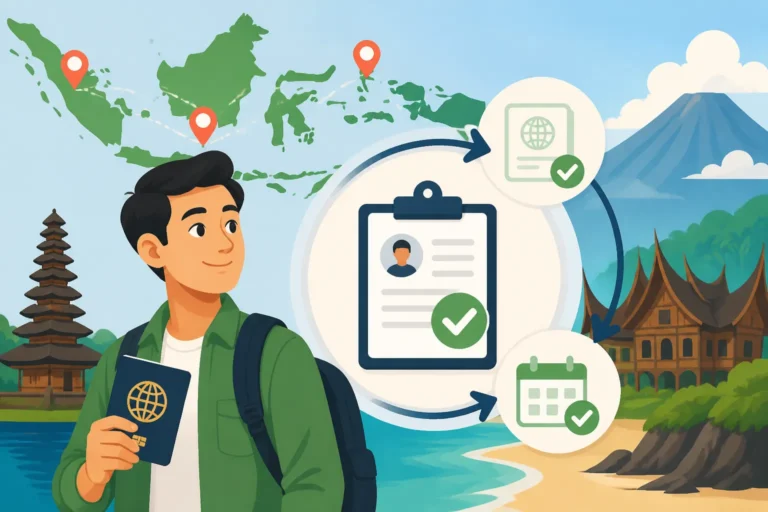
The administrative landscape in Indonesia has shifted dramatically over the last couple of years, moving from a paper-heavy, "visit the embassy" grind to a largely digital-first approach. While this is a massive improvement, it has introduced a new set of digital hurdles. The current system relies heavily on the Molina (Motivasi Layanan Imigrasi) portal, which serves as the central hub for almost all visa applications. If you are coming for a short stay or a long-term career, this is where your journey begins.
The e-Visa Revolution and the Molina System
The introduction of the e-Visa system was intended to cut out the middleman, but as any veteran expat will tell you, the website has its moods. In 2026, the system is more robust than it was five years ago, allowing you to apply for everything from a 30-day Visit Visa to a multi-year Golden Visa from your laptop. However, the requirement for precision is absolute. One typo on your passport number or a slightly blurry scan of your bank statement can lead to an instant rejection with no refund of the processing fee.
When using the Molina system, you need to ensure your internet connection is stable and your documents are perfectly formatted. If you are struggling with translating your home country’s birth certificates or marriage licenses into the required formats, services like RushTranslate can be a lifesaver for ensuring your paperwork meets the rigorous standards of the Ministry of Law and Human Rights. I’ve seen applications denied simply because a stamp was slightly illegible on a scan, so do not cut corners here.
Understanding Sponsor Responsibilities
Every long-term resident in Indonesia needs a sponsor. Whether it’s a PT PMA (Foreign Owned Company) for workers, an Indonesian spouse for those married to locals, or a designated travel agency for certain tourist visas, the sponsor is legally responsible for your behavior and your departure. This isn't just a formality; if you overstay or break the law, your sponsor is the one immigration will call first.
Choosing your sponsor is the most critical decision you will make. For those on a work permit, your employer handles the heavy lifting, but for retirees or investors, you often have to rely on a "Biro Jasa" (visa agency). Always vet these agencies through expat forums and community groups. A bad agent might take your money and "forget" to file your extensions, leaving you in a legal nightmare that could end in deportation.
Visa on Arrival vs Pre arranged B211A
For many, the first entry into Indonesia is via the Visa on Arrival (VoA). It’s convenient, costing around IDR 500,000, and it can be extended once for another 30 days. But it is strictly for tourism. If you plan to stay longer or think you might want to look for work (without actually working yet), the B211A "Social" visa is a better bet. It allows for a 60-day initial stay and can be extended multiple times without leaving the country.
The B211A is the "Swiss Army Knife" of Indonesian visas. It’s often used by those who are testing the waters before committing to a full KITAS. You can use platforms like iVisa to handle the initial application if the local government portal feels too daunting. Just remember that switching from a B211A to a residency permit usually requires an "onshore" conversion process which, while possible in 2026, still requires a mountain of paperwork and a visit to your local Kantor Imigrasi (Immigration Office).
The ITAS Explained: Your Ticket to Temporary Residency
The ITAS (Izin Tinggal Terbatas), commonly referred to by its physical card name "KITAS," is what transforms you from a visitor into a resident. It’s a multi-entry permit that allows you to open bank accounts, get a local driver’s license, and stop paying the "tourist price" at certain hospitals. But a KITAS isn't a one-size-fits-all document; it is strictly tied to the purpose of your stay.
Working KITAS and the RPTKA Hurdle
If you are moving for a job, you will be on a Working KITAS. The backbone of this permit is the RPTKA (Expatriate Placement Plan). The Indonesian government is very protective of the local labor market, so your employer must prove that your role cannot be easily filled by an Indonesian citizen. This is a slow, bureaucratic process that involves the Ministry of Manpower.
Once the RPTKA is approved, your employer pays a mandatory DPKK fee (Skill & Development Fund) of USD 100 per month, which goes toward training local workers. Only after this payment is made can your actual visa be issued. For a deeper dive into the specific documents needed for this, check out KITAS Explained: Working, Dependent, and Investor Temporary Stay Permits. I’ve seen many new arrivals get frustrated by how long this takes—expect a 4-to-8 week wait before you can legally sit at your desk.
Investor KITAS for Business Owners
For those wanting to start their own business, the Investor KITAS is the gold standard. It comes in two flavors: the Index 313 (1 year) and Index 314 (2 years). The biggest perk of the Investor KITAS is that the DPKK fee is waived, and it generally requires less interaction with the Ministry of Manpower. However, the financial entry bar is high.
To qualify, you must be a shareholder in a PT PMA with a significant minimum capital investment. As of 2026, the regulations around the Investor KITAS: Minimum Capital Injection and Director vs Commissioner Roles have become stricter to ensure that "investors" are actually bringing capital into the country rather than just bypassing work permit rules. It’s a great option if you have the funds, but don't try to fake it; immigration audits are becoming increasingly common.
Dependent and Family KITAS
If you are the "trailing spouse" or a child of a KITAS holder, you will be on a Dependent KITAS. This allows you to live in Indonesia but—and this is a huge "but"—it does not allow you to work. I have seen many expat spouses get into trouble for starting small "home businesses" or teaching private yoga classes on a dependent visa. It is illegal and can lead to the cancellation of the primary holder’s visa as well.
For those married to an Indonesian citizen, the Spouse Sponsored KITAS: Marrying an Indonesian Citizen and Work Rights offers a much better deal. After two years of marriage, this can be converted into a permanent residency permit (KITAP). Under the most recent 2026 guidelines, spouse-sponsored holders have a slightly easier path to obtaining a work permit (IMTA) if they wish to work for a local company, though the process is still separate from the visa itself.
Specialized Long Term Visas: The Golden and Second Home Options
In an effort to attract high-net-worth individuals and remote talent, Indonesia has launched several "elite" visa categories. These are designed for people who want the stability of long-term residency without the hassle of yearly renewals or corporate sponsorship.
The Golden Visa Investment Tiers
The Golden Visa (E28C) is Indonesia’s play for the global "investor class." If you have the capital, this is the most seamless way to live in the archipelago. It offers stay permits of 5 to 10 years, depending on the level of investment. For individuals, this usually involves placing a significant sum into Indonesian government bonds, shares in public companies, or a savings account in a state-owned bank.
The benefits of the Golden Visa (E28C) Guide: Investment Thresholds and Long-Term Residency are substantial. You get priority lanes at airport immigration, exemption from certain reporting requirements, and a general "VIP" status within the system. It’s an expensive ticket, but if you are planning to make Indonesia your permanent base for a decade, the time and stress saved on renewals are often worth the price of admission.
Second Home Visa and the Deposit Requirement
The Second Home Visa was met with a lot of controversy when it first launched, primarily because it replaced the old Retirement Visa for many people. To qualify, you must show proof of funds in a dedicated Indonesian bank account amounting to at least IDR 2 billion (roughly USD 130,000). This money must remain in the account for the duration of your stay.
This visa is ideal for wealthy retirees or those with significant passive income who don't want to deal with a corporate sponsor. However, the Second Home Visa: Navigating the IDR 2 Billion Deposit Requirement is a steep hill to climb for many. If you go this route, ensure your health insurance is world-class, as the government expects Second Home holders to be fully self-sufficient. A policy from Cigna Global is often the preferred choice here to meet the comprehensive coverage requirements.
Remote Worker Visa for Digital Nomads
After years of "will they, won't they," the E33G Remote Worker Visa is finally a reality in 2026. This is specifically for those employed by companies outside of Indonesia or freelancers with a steady global client base. It solves the "Canggu problem" where thousands were working illegally on tourist visas.
The requirements are clear: you must prove an annual income of at least USD 60,000 and show that your employer is based abroad. This visa allows you to stay for up to a year and is renewable. It’s the perfect middle ground for someone who wants to enjoy the Bali lifestyle without the fear of a "razia" (immigration raid) at their favorite co-working space. For the nitty-gritty on income verification, see the guide on Remote Worker Visa (E33G): Digital Nomad Requirements and Limitations.
Moving Toward Permanency: The KITAP Pathway
If you’ve lived in Indonesia for several years and have decided this is truly home, the KITAP (Izin Tinggal Tetap) is the ultimate goal. It is a permanent stay permit that lasts for five years and is then renewed automatically for life, provided your status doesn't change.
Eligibility for Permanent Stay
You can’t just apply for a KITAP on day one. Generally, you need to have held a KITAS for several consecutive years (usually three to four, depending on the category) before you are eligible to upgrade. The most common paths to a KITAP are through marriage to an Indonesian or through a long-term corporate directorship.
The application process for the KITAP (Permanent Stay): Eligibility, 5-Year Validity, and How to Upgrade is famously rigorous. It involves an interview at the regional immigration office where they will verify the "authenticity" of your stay. If it’s a marriage-based KITAP, expect them to ask for photos, proof of a shared home, and potentially even talk to your neighbors. It sounds invasive, but it’s their way of filtering out "contract marriages."
The 5 Year Renewal vs Lifetime Validity
One of the best things about the KITAP is that after the first five-year period, the "renewal" is mostly a formality. You no longer have to worry about the annual stress of your visa expiring. However, you still have a MERP (Multiple Exit Re-entry Permit) that needs to be managed if you travel frequently.
The freedom a KITAP provides is unparalleled. You can often act as your own sponsor for certain things, and it is the closest you can get to being a citizen without actually giving up your home passport. Given that Indonesia does not allow dual citizenship, the KITAP is the finish line for 99% of expats.
Transitioning from Spouse or Work KITAS
The transition from a temporary to a permanent permit requires a clean track record. Any "Surat Peringatan" (warning letters) from immigration or history of overstays can jeopardize your application. I always recommend starting the transition at least four months before your current KITAS expires.
During this transition, your sponsor’s commitment is more important than ever. If you are switching from a work KITAS to a KITAP, your company must be willing to commit to you for the long haul. Many companies are hesitant to do this because it makes it harder for them to "cancel" you if the employment ends. It’s a negotiation, so bring your "A" game to the HR office.
Legal Compliance and Daily Life with a Permit
Holding the visa is only half the battle. To live legally in Indonesia, you need a suite of local documents that many expats overlook until they try to buy a scooter or open a bank account.
Domicile Letters and Civil Registry
The first thing you need after your KITAS is issued is a "Surat Domisili." This is a letter from your local village head (Kepala Desa or Lurah) confirming that you actually live where you say you live. It sounds like a relic from a bygone era, but without it, you cannot progress to the next stage. Learn Surat Domisili (Domicile Letter): How to Get it from the Village Head before you move, as the process varies wildly between a high-rise in Jakarta and a villa in Bali.
Once you have your domicile letter, you must register with the Catatan Sipil (Civil Registry) to get your SKTT (Temporary Resident Card). This card is often more useful in daily life than your actual KITAS. If you stay on a KITAP, this becomes a KTP-WNA (Foreigner’s ID Card), which looks almost exactly like the ID cards locals carry. For a breakdown of why this matters, see The Civil Registry (Catatan Sipil): SKTT and KTP WNA Explained.
Managing Address Changes and Reporting
Immigration in Indonesia likes to know where you are. If you move house—even if it’s just to the next neighborhood—you are legally required to report that change to your local immigration office within 30 days. Failure to do so is a common reason for fines and "administrative complications" during your next renewal.
The process involves getting a new domicile letter and then having your KITAS updated in the immigration system. It’s a tedious afternoon of paperwork, but it’s much cheaper than the alternative. You can find the steps for this in the guide on Immigration Compliance: Address Changes, EPOs, overstays, and Reporting.
Exit Permits (EPO and ERP) Processes
When you finally decide to leave Indonesia for good, or if you are switching employers, you must go through the EPO (Exit Permit Only) process. This officially "closes" your visa. You cannot just fly away and never come back; if you don't do an EPO, your visa remains "active" in the system, and your sponsor could be held liable for you indefinitely.
An EPO gives you exactly seven days to leave the country. If you are already outside Indonesia and realize you won't be coming back to your old job, you can apply for an ERP (Exit Re-entry Permit) "Not Returning," which handles the cancellation remotely. Just don't leave this until the last minute—it's the final piece of the puzzle to ensure you can return to Indonesia as a tourist in the future without issues.
Common Pitfalls and How to Avoid Deportation
The Indonesian immigration authorities are generally fair, but they are incredibly strict about the rules. Ignorance is never accepted as an excuse. Here is how to stay on the right side of the law.
Overstaying and the Million Rupiah Fine
As of 2026, the fine for overstaying your visa is IDR 1,000,000 per day. If you overstay by a few days, you can usually just pay the fine at the airport before you board your flight. However, if you overstay by more than 60 days, you are looking at detention, deportation, and a spot on the "Blacklist" (Cekal), which prevents you from re-entering Indonesia for at least six months to several years.
I’ve seen people lose track of their dates because they thought the "60 days" meant two months (it doesn't—if a month has 31 days, you lose a day). Always count your days manually. If you find yourself in this situation, read Overstaying Your Visa in Indonesia: IDR 1,000,000 Daily Fines and Deportation Risk to understand your options before you head to the airport.
Working Outside Your Permit Scope
This is the most common reason for deportation in Bali and Jakarta. If your KITAS says you are a "Marketing Manager," you cannot be seen selling jewelry at a market or teaching a surf lesson. Social media is the primary tool immigration uses to find violators. If you post a "Work with me!" caption on Instagram while on a tourist or dependent visa, you are basically inviting immigration to your door.
Even volunteer work can be a gray area. If you want to help out at a local charity, make sure they have the proper permits to host foreign volunteers. The rule of thumb is: if it looks like work, smells like work, or provides any benefit (even non-monetary), don't do it unless it’s explicitly allowed by your visa.
Vetting Visa Agents and Agencies
There are thousands of "visa agents" in Indonesia, ranging from professional legal firms to guys on WhatsApp with a laptop. A good agent is worth their weight in gold; a bad one can get you deported. Never give your passport to an agent who doesn't have a physical office you can visit.
Check for "Biro Jasa" certification. Ask for references from other expats. If an agent tells you they can "bypass" a rule or get you a visa without the required documents for an extra fee, run away. This is often a scam, and when the system catches the fraudulent document, it’s you—not the agent—who will be held responsible.
Financial and Practical Preparation
Before you even apply, you need to have your finances and records in order. Indonesian immigration wants to see that you are an asset to the country, not a financial burden.
| Visa Type | Primary Purpose | Key Financial Requirement (Approx) | Duration |
|---|---|---|---|
| B211A Visit | Tourism / Business Meetings | USD 2,000 in bank | 60 – 180 Days |
| Working KITAS | Employment | Employer pays USD 1,200/year (DPKK) | 1 Year (Renewable) |
| Investor KITAS | Business Ownership | Shared Capital IDR 10 Billion+ | 1 – 2 Years |
| Remote Worker (E33G) | Digital Nomads | USD 60,000 annual income | 1 Year |
| Second Home | Long-term Residency | IDR 2 Billion in State Bank | 5 – 10 Years |
| Golden Visa | High-level Investment | USD 350,000+ in Bonds/Property | 5 – 10 Years |
Practical Tips for Smooth Immigration Visits
If you have to visit the "Kantor Imigrasi" for your photo and fingerprints, preparation is key. This is a formal government office, so dress the part. No singlets, no flip-flops, and no ripped jeans. I’ve seen people turned away at the door for wearing "beach attire." Think business casual.
Arrive early. Most offices use a queue system that fills up by 9:00 AM. Bring a black ink pen, all your original documents (not just copies), and a lot of patience. The staff are generally very polite if you are polite to them. A "Selamat Pagi" (Good Morning) and a smile go a long way in navigating the bureaucracy.
Finally, keep a digital folder of every visa scan, every stamp, and every receipt. The Indonesian system is becoming more integrated, but having your own backup will save you if a record ever gets lost in the digital ether. Living in Indonesia is an incredible adventure, and once you get the paperwork out of the way, the rewards are well worth the effort.
Disclaimer
This guide is for informational purposes only and does not constitute legal advice. Visa regulations in Indonesia are subject to frequent changes by the Directorate General of Immigration. Always verify current requirements with an official government representative or a licensed legal professional before making financial or travel commitments.