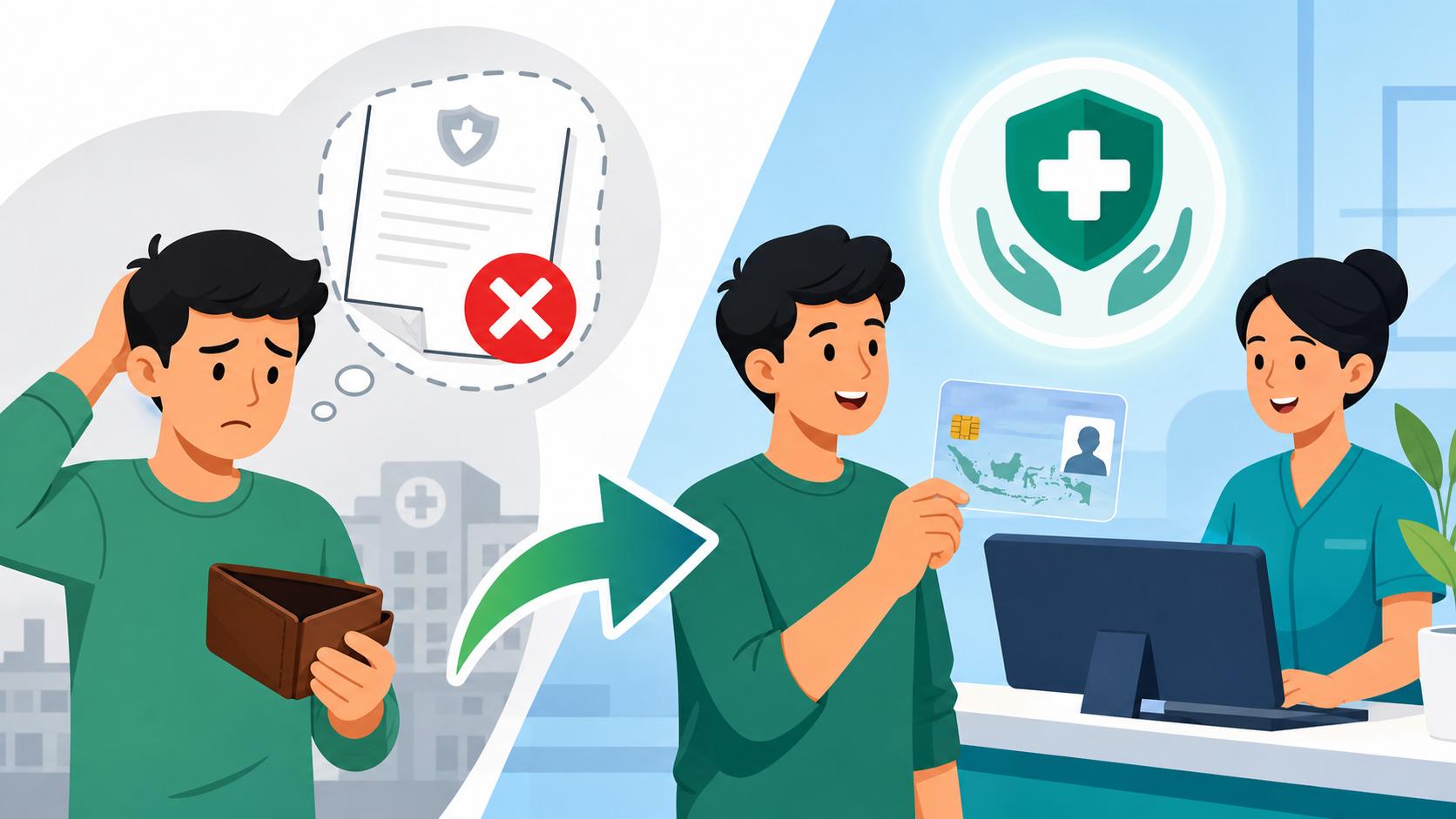
Lost Your Insurance Proof? Using Your NIK/KTP for Medical Access
There is nothing quite as gut-wrenching as standing at a hospital reception desk in Jakarta or Bali, feverish and shaking, only to realize your physical insurance card is nowhere to be found. I remember the cold sweat I broke into when I first misplaced my BPJS card during a nasty bout of "Bali Belly"; I was convinced I would be denied care or forced to pay a king's ransom out of pocket. This guide solves that specific panic by explaining exactly how your NIK and KTP/SKTT serve as your golden ticket to medical access in Indonesia, even when your paperwork goes missing.
The Administrative Shift Toward the NIK
For years, the Indonesian healthcare system relied on a dizzying array of physical cards. You had a card for your employer's private plan, a card for BPJS Kesehatan, and perhaps a separate folder for your hospital records. However, the government has been aggressively moving toward a "Single Identity Number" system. This 16-digit number, known as the Nomor Induk Kependudukan (NIK), is now the primary key for almost every administrative interaction in the country, including your health coverage.
As an expat, you might think the NIK is only for Indonesian citizens, but that is a common misconception that causes unnecessary stress. If you are here on a KITAS or KITAP, you are part of the national population database. Your NIK is the thread that connects your immigration status to your social security. When you understand how to wield this number, the fear of losing a plastic card evaporates.
In my experience, the staff at major facilities like those mentioned in the Siloam Hospitals Overview: What Expats Should Know About the Network are well-versed in this digital integration. They are often more interested in your NIK than the physical card itself because the NIK allows them to pull your real-time eligibility status from the central BPJS database.
Understanding the Difference Between KTP WNA and SKTT
To use your NIK for medical access, you first need to know where to find it. Depending on your residency status, your NIK will be printed on one of two documents. For those on a KITAP (Permanent Stay Permit), you will hold a KTP WNA (Kartu Tanda Penduduk Warga Negara Asing). This looks almost identical to a local Indonesian ID card but clearly states your foreign nationality. It is a powerful document that many banks and hospitals view with the same authority as a local ID.
For the majority of expats on a KITAS (Temporary Stay Permit), your NIK is found on your SKTT (Surat Keterangan Tempat Tinggal). This is a green or white piece of paper issued by the Disdukcapil (Civil Registry). While it feels less "official" than a plastic card, the 16-digit NIK printed on it is what the hospital system needs. I always tell newcomers to take a high-resolution photo of their SKTT and keep it in a "Favorites" album on their phone. This simple act has saved me more times than I can count when Finding Medical Care in Indonesia: Clinics, Hospitals, and International Facilities.
If you are still confused about which document you should have, it is worth reviewing The Civil Registry (Catatan Sipil): SKTT and KTP WNA Explained to ensure your local registration is actually complete. Without that NIK being registered in the local system, your BPJS coverage remains a "ghost" in the machine.
Accessing BPJS Kesehatan Without a Physical Card
The transition to the NIK as a health identifier is most evident within the BPJS system. The government has officially mandated that the NIK is a valid substitute for the JKN (Jaminan Kesehatan Nasional) card. When you arrive at a primary clinic (Faskes 1) or an emergency room, the registration desk will ask for your card. You can simply state, "Saya tidak bawa kartu, bisa pakai NIK?" (I don't have my card, can I use my NIK?).
The administrator will enter your 16-digit NIK into their system, usually via an application called VClaim or the BPJS health portal. Within seconds, your photo, membership class, and "active" status will appear on their screen. This is a lifesaver, but it only works if your employer has stayed current on payments. You can read more about how these contributions are managed in our guide on BPJS Kesehatan for Expats: Registration, Costs, and the New KRIS System.
I have found that even in smaller regional hospitals, this system is surprisingly robust. However, if the hospital's internet is down—which does happen in more remote parts of the country—having a digital copy of your NIK is your secondary defense. It provides the proof of identity required to start the triage process while the administrative team resolves the system issues.
Using the Mobile JKN App as a Digital Backup
If you want to be truly "expat-pro," you should not rely solely on a photo of your ID. The Mobile JKN application is the official digital arm of the Indonesian healthcare system. Once you register with your NIK and phone number, the app displays a "Digital KIS" (Kartu Indonesia Sehat). This digital card features a barcode that hospital scanners can read directly.
Beyond just showing a digital card, the app allows you to check if your insurance is actually active. There is nothing worse than arriving at the Emergency Rooms (UGD) in Indonesia: Triage, Payment Upfront, and Documentation only to find out your HR department forgot to pay the monthly premium. By checking the app regularly, you stay ahead of the bureaucracy.
The app also allows you to book appointments at your registered Faskes (Primary Clinic), which cuts down on the hours spent sitting in plastic chairs. For a deeper dive into the app's features, see Using Your BPJS Card (Kartu JKN): How to Register and Book at Local Faskes. It really is the best way to bypass the "lost card" anxiety entirely.
| Access Method | Requirement | Reliability | Best For |
|---|---|---|---|
| Physical Card | Must carry at all times | High (unless lost) | Traditional clinics |
| NIK / KTP WNA | 16-digit number | High (system dependent) | Hospital ERs & Admissions |
| Mobile JKN App | Smartphone & Data | Very High | Booking & Verification |
| Passport Copy | Physical or Digital | Moderate | Initial ID verification only |
When the NIK Isn't Enough: Private Insurance Realities
While the NIK works wonders for the public BPJS system, private international insurance works differently. If you are using a premium provider like Cigna Global, the hospital won't find you in the national NIK database. Private insurers maintain their own proprietary systems and "Direct Billing" networks.
If you lose your private insurance card, the NIK won't help you there. Instead, you will need your policy number and a passport copy. Most high-end hospitals in Jakarta will contact your insurer's 24-hour hotline to verify a "Letter of Guarantee" (LOG). For many of us living here long-term, we use Cigna Global as a top-up to our mandatory BPJS, ensuring that if we need a private room or international evacuation, we aren't limited by the standard ward system.
Having both—a NIK-ready BPJS account and a digital copy of your Cigna Global policy—is the ultimate safety net. It allows you to use the local system for minor issues while keeping the heavy-duty private coverage ready for serious emergencies. This dual-coverage strategy is common among veteran residents who want to avoid the limitations of the new KRIS system, which you can learn about in Transitioning to KRIS: What Standard Inpatient Classes Mean for Expats.
Managing Post-Care and Medications
Once you have successfully used your NIK to get treated, the next hurdle is often the pharmacy. If you are using BPJS, the medications are usually provided by the hospital's internal pharmacy. However, they often provide local generic equivalents which might not always align with what you are used to back home.
In cases where the hospital pharmacy is out of stock or you prefer specific international brands for your recovery, many expats turn to iHerb. It is a reliable way to source high-quality supplements and over-the-counter supportive care that might be hard to find in a local Apotek. Just be sure you understand the import limits to avoid your recovery being delayed by customs.
When I was recovering from a respiratory infection in smoky Jakarta, the hospital gave me the basics, but I relied on iHerb for specific vitamins and probiotics to get my gut health back on track after a heavy round of antibiotics. Navigating the local pharmacy scene can be tricky, so check out our Apotek Guide: Prescription Workflow, Refills, and Communicating with Pharmacists to understand how to handle your prescriptions once you leave the hospital.
Troubleshooting NIK Discrepancies
Sometimes, you might provide your NIK only for the hospital to say, "Data tidak ditemukan" (Data not found). This usually happens for one of three reasons:
- Your NIK was recently updated (e.g., you moved from a KITAS to a KITAP).
- There is a typo in the BPJS database (very common with foreign names).
- Your NIK has not been "synchronized" between the Civil Registry and the Health Ministry.
If this happens, you cannot fix it at the hospital. You or your HR representative will need to contact BPJS via their WhatsApp "PANDAWA" service or visit a local BPJS office to link your NIK to your membership number manually. It is a tedious bit of admin, but once it is done, the NIK becomes your permanent identifier. For those moving between cities, our guide on Updating Your Address on Your KITAS When Moving from Jakarta to Bali covers the steps needed to keep your regional data current, which is vital for your Faskes registration.
Summary of Immediate Steps if You Lose Your Card
If you are sick right now and cannot find your card, do not panic. Follow these steps:
- Locate your NIK on your KTP WNA or SKTT (or a photo of it).
- Download the Mobile JKN app and try to log in; your digital card is there.
- If you have private insurance, find the digital PDF of your policy on your email.
- Go to the hospital with your Passport and NIK.
- Ask the registration desk to look you up via "Nomor NIK."
In most modern Indonesian hospitals, this is a standard operating procedure. The days of being denied care because of a lost piece of plastic are largely over, provided your residency paperwork is in order. If you are still in the process of setting up your life here, make sure you prioritize How to Enroll in BPJS Kesehatan After Getting Your KITAS (Step-by-Step) so that your NIK is active before you actually need it.
Disclaimer
This guide is for informational purposes only and is based on personal experience and current administrative practices in Indonesia as of 2026. Healthcare regulations and digital systems can change frequently. Always consult with your HR department, an official immigration agent, or a legal professional to ensure your specific residency and insurance status are compliant with the latest Indonesian laws. This content does not constitute legal or medical advice.