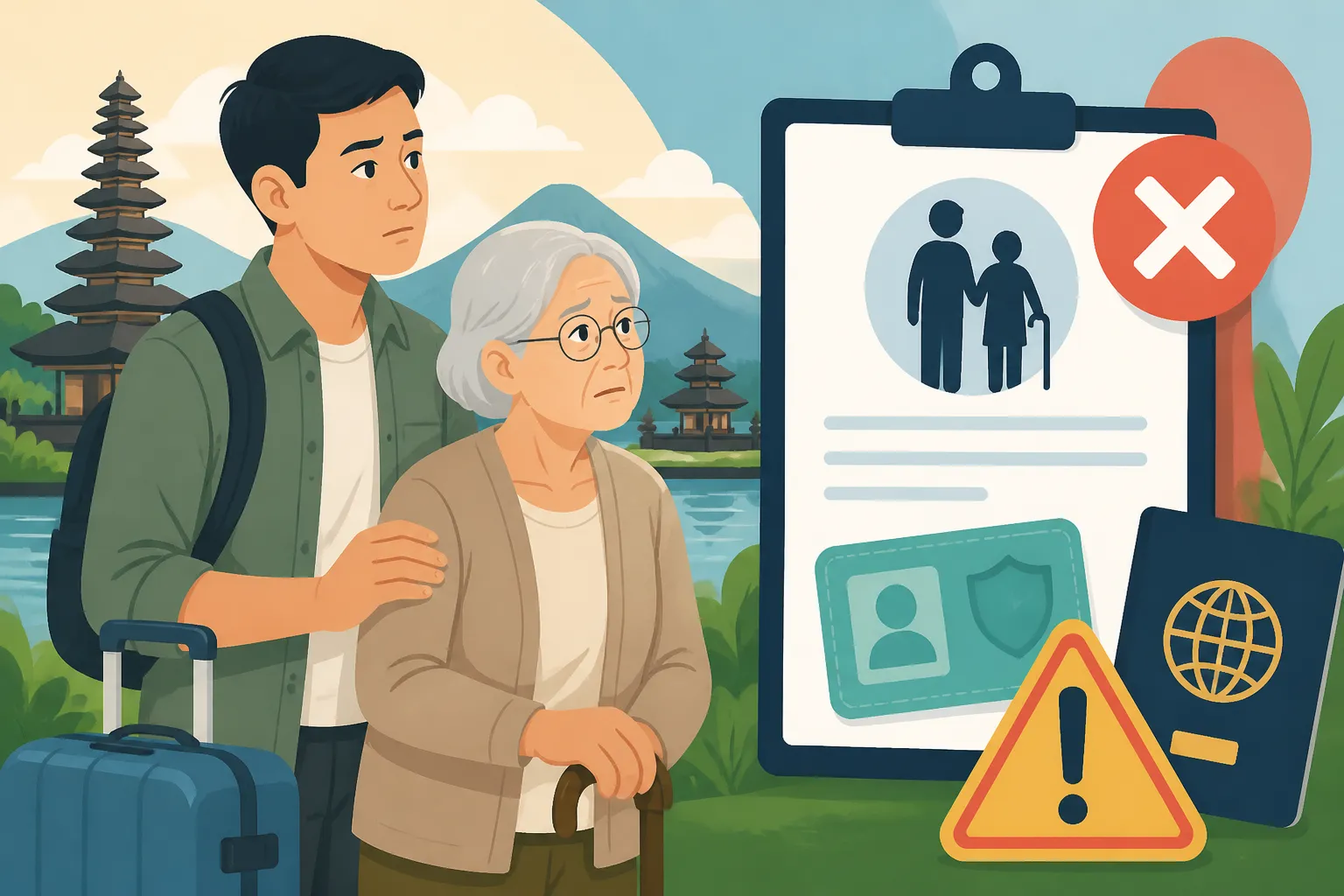
Bringing an Elderly Parent to Indonesia: Dependent Visa Challenges
Wanting to bring your aging parents to the tropics sounds like a dream until you see the "Under 18" clause on the standard dependent visa forms. I personally spent months chasing shadows at the South Jakarta immigration office before realizing the system simply isn't built for multi-generational expat living in the way Westerners often expect. This guide breaks down why the standard dependent route often fails for parents and explores the specific legal alternatives and logistical realities of moving seniors to Indonesia.
The Reality Check: Is There a Parent Dependent Visa?
The biggest shock for most expats is realizing that "Family" in the eyes of Indonesian Immigration is defined very narrowly. When you hold a work KITAS, the C317 Dependent Visa is designed almost exclusively for your legal spouse and your children under the age of 18 (or 21 in some rare, strictly unmarried cases). Unlike some countries that offer "parental dependency" based on financial support, Indonesia generally views parents as independent entities once they reach adulthood.
I remember the frustration of trying to prove my father was financially dependent on me, only to be told by a polite officer that "he is still a father, not a child." This cultural distinction is baked into the law. If your parent is under 55, they essentially cannot be your "dependent" unless you are an Indonesian citizen sponsoring a parent (a completely different category). For expats, if your parent wants to live here, we have to look outside the dependent visa box.
The immediate hurdle this creates is one of sponsorship. Your employer, who likely sponsors your KITAS Explained: Working, Dependent, and Investor Temporary Stay Permits, is rarely willing or legally able to sponsor an elderly non-worker. This leaves the responsibility entirely on you to find a category that fits their age and financial profile. Most newcomers start by looking at Family Visas in Indonesia: Spouse, Dependent, and Marriage to an Indonesian, only to find that the "parent" clause is missing for foreign workers.
Alternative Pathways: The Retirement KITAS
If your parent is 55 or older, the most realistic path is not a dependent visa, but an independent Retirement KITAS: Age Limits, Financial Proof, and Mandatory Maid Hiring. This is officially known as the E33E (formerly C319) visa. It is a temporary stay permit that allows seniors to live in Indonesia without the need for a local job. In fact, one of the primary conditions is that they are strictly forbidden from seeking local employment or running a business.
The financial requirements for this are significant. Your parent will need to show a pension or income of at least USD 3,000 per month, or a substantial lump sum in a bank account. They must also commit to living in a managed property (like a villa or a high-end apartment) and, interestingly, they are legally required to hire an Indonesian domestic helper. This requirement is actually a blessing in disguise, as it ensures your elderly parent has local assistance for daily tasks, which is vital when navigating the heat and local language.
For those who find the retirement route too expensive or complex, some look into the Second Home Visa: Navigating the IDR 2 Billion Deposit Requirement. This is a newer category aimed at high-net-worth individuals. While it offers a 5 to 10-year stay, the IDR 2 billion (approx. USD 130,000) deposit must be placed in an Indonesian state-owned bank. For most families just wanting Grandma to see her grandkids, the Retirement KITAS remains the most common "workaround" for the lack of a parent-dependent visa. You can check the latest eligibility requirements on iVisa to see which entry permits are currently available for seniors from your specific home country.
Document Preparation and Legalization Hurdles
Once you settle on a visa category, the "paperwork mountain" begins. Indonesia is a highly bureaucratic country that lives and breathes on stamped, legalized, and translated documents. To bring a parent, you will need birth certificates that prove your relationship, marriage certificates (if they are bringing a spouse), and pension statements.
Since 2022, Indonesia has joined the Apostille Convention, which has simplified things slightly. However, you still need to ensure every document is translated into Bahasa Indonesia by a certified translator. For critical immigration documents, using a service like RushTranslate is often necessary to ensure the wording matches the specific legal requirements of the Directorate General of Taxes and Immigration.
Don't underestimate the time it takes to get these documents ready. I’ve seen families get to the final stage of an application only to have it rejected because a birth certificate was a "copy" rather than an "original with an apostille." If you are managing this from abroad, it’s worth checking RushTranslate for their expedited services, as local Indonesian "sworn translators" can sometimes have a backlog of several weeks.
| Visa Type | Age Requirement | Work Rights | Key Requirement |
|---|---|---|---|
| C317 Dependent | Under 18 (Children) | None | Sponsored by your employer/KITAS |
| E33E Retirement | 55+ | Strictly Forbidden | USD 3,000/mo income or deposit |
| B211A Visit | Any | None | Must exit/renew every 60-180 days |
| Second Home | Any | None | IDR 2 Billion bank deposit |
Healthcare Realities for Seniors in Indonesia
This is where the "I've been there" empathy kicks in: Healthcare for seniors in Indonesia is a high-stakes game. While major cities like Jakarta and Bali have world-class private hospitals, the public system is not something most expats choose for their elderly parents. Furthermore, BPJS (the national health insurance) has specific enrollment windows and limitations for expats that might not cover pre-existing chronic conditions common in older age.
Most international schools and corporations do not include parents in their family health plans. This means you will need to secure a robust, independent international health policy. I highly recommend looking at Cigna Global because they specialize in expat coverage that includes medical evacuation. In a country where specialized cardiac or neurological care can be inconsistent outside of Jakarta, having a "Medevac" clause to Singapore or Bangkok is not just a luxury—it’s a life-saving necessity.
Before they fly out, read up on Healthcare in Indonesia for Foreign Residents: Complete System Overview (2027) to understand how the referral system works. You should also look into Long-Term Care: Hiring In-Home Nurses for Aging Residents in Indonesia. In Indonesia, we call these "Suster Lansia" (elderly nurses). They are incredibly affordable compared to Western standards and can provide 24/7 live-in care, which is often a better alternative to a traditional nursing home, which are rare and culturally stigmatized here.
Navigating the Social and Cultural Transition
Moving an 80-year-old from a quiet suburb in Europe or the US to the chaotic streets of Jakarta or the humid hills of Ubud is a massive shock. The infrastructure is not always elder-friendly; sidewalks are often non-existent or broken, and the "Macet" (traffic) can make a simple doctor’s visit an all-day ordeal. You need to plan for their mobility. Most expat families hire a dedicated driver for their parents to ensure they aren't trapped at home.
Culturally, Indonesians revere the elderly. Your parents will likely be treated with immense respect and warmth, often being referred to as "Oma" or "Opa" by complete strangers. This social warmth can alleviate the "Expat Burnout" that many seniors feel when they can't communicate fluently. However, you should still look for communities where they can thrive. Bali has several "Senior Social Clubs," and in Jakarta, the various business chambers often have coffee mornings where older expats congregate.
If your parent struggles with the language, getting them a basic course or even just a list of "survival" phrases is helpful. I found that my mother felt much more confident once she could at least say "Pedas" (spicy) and "Kiri/Kanan" (left/right) to the driver. For more on managing the daily logistics, check out Everyday Etiquette: Religion, Culture, Garbage, and Community Norms to help them avoid unintentional faux pas in the neighborhood.
Logistics of the "Visit Visa" Loophole
Many families who cannot meet the USD 3,000 monthly income requirement for the Retirement KITAS resort to the "Visit Visa" (B211A) loop. This allows a senior to stay for 60 days, with the ability to extend twice for a total of 180 days. After six months, they must leave the country and re-apply. While this is a common tactic, it is exhausting for an elderly person.
The constant trips to immigration for finger-printing and the "border runs" to Singapore can take a toll on their health. Furthermore, staying on a visit visa means they are forever a "tourist" in the eyes of the law. They won't be able to easily open a local bank account, sign a long-term lease in their own name, or get a local driving license. If you go this route, ensure all their documents are handled by a reputable agent to minimize their time spent in government waiting rooms. You can use iVisa to handle the initial B211A paperwork to save them the hassle of visiting an Indonesian embassy in their home country.
Final Steps: A Checklist for Success
Bringing a parent is a marathon, not a sprint. Before you book that one-way ticket, ensure you have checked the following:
- Proof of Relationship: Is your birth certificate apostilled and translated by RushTranslate?
- Financial Floor: Does the parent have a verifiable pension of USD 3,000 or the required deposit?
- Medical Safety: Have you secured Cigna Global or similar high-limit international insurance?
- Housing: Does the rental contract allow for an elderly "long-term guest" or is the Retirement KITAS holder the primary lessee?
- Domestic Support: Have you interviewed a "Suster" or helper who has experience with seniors?
Navigating the Immigration Compliance: Address Changes, EPOs, Overstays, and Reporting rules is much harder with a senior in tow. Be meticulous, be patient, and always have a "Plan B" (like a return ticket or a medical evacuation fund) ready. Indonesia can be a paradise for seniors with its slow pace of life and affordable help, but only if the legal foundation is rock solid.
Disclaimer
The information provided in this article is for informational purposes only and does not constitute legal, financial, or immigration advice. Indonesian visa regulations are subject to frequent change without notice. Always consult with a licensed immigration professional or the official Indonesian Directorate General of Immigration before making travel or residency arrangements for yourself or family members. Global healthcare and insurance needs should be discussed with a qualified insurance broker to ensure adequate coverage for specific medical conditions.