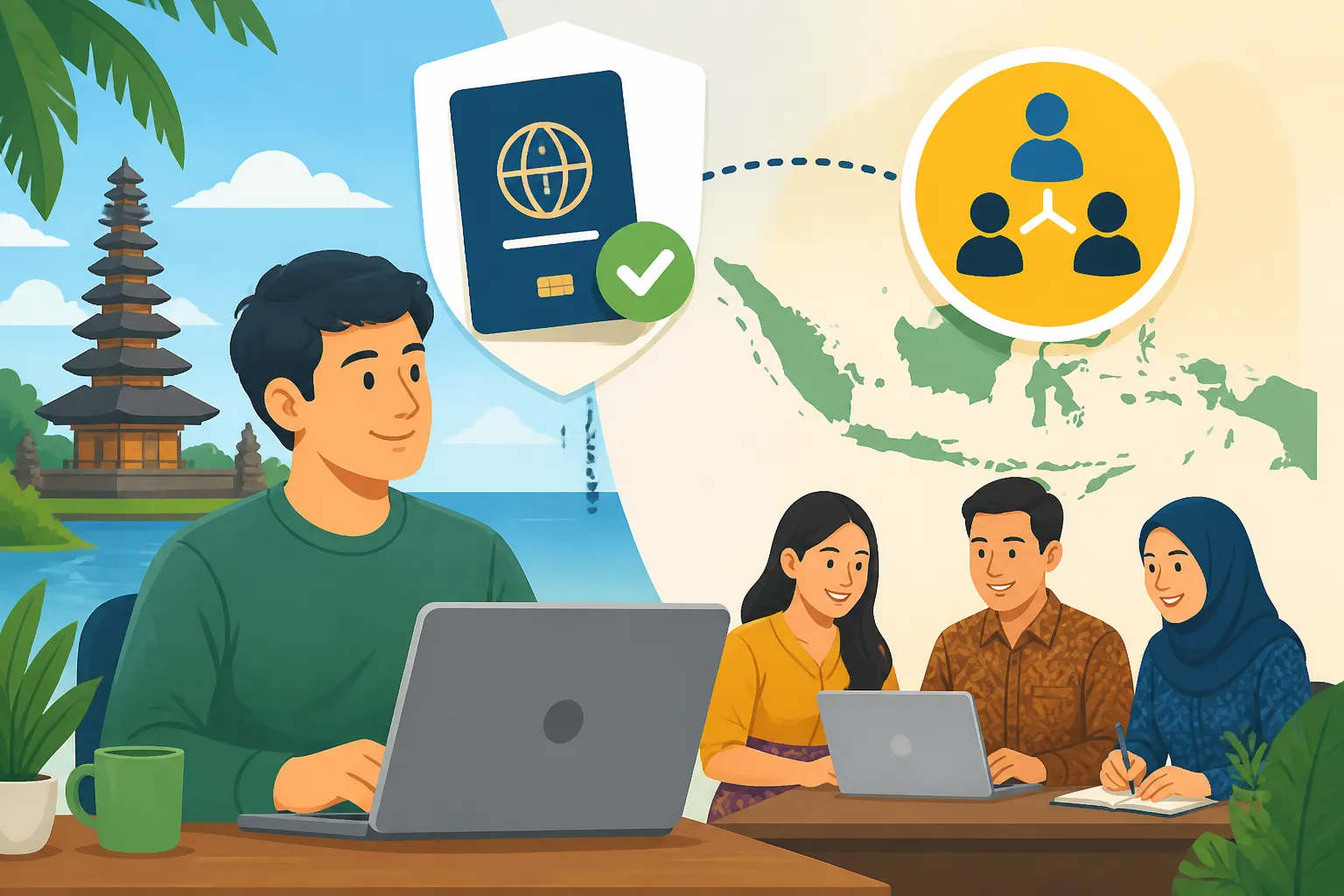
Remote Worker Visa (E33G): Can I Hire Local Indonesian Staff?
The biggest headache for digital nomads in Indonesia isn't the occasional power outage or the erratic Wi-Fi; it is the terrifyingly vague line between "working remotely" and "running a local business." I remember sitting in a Canggu cafe three years ago, desperately wanting to hire a local videographer to help with my content, but I spent the whole afternoon paralyzed by the fear that one wrong payment would lead to a "red stamp" in my passport. This guide solves the confusion around the Remote Worker Visa (E33G) and whether you can legally hire local Indonesian staff without risking deportation.
Understanding the Legal Boundaries of the E33G Remote Worker Visa
The E33G visa is a brilliant addition to Indonesia’s immigration landscape, specifically designed for those of us who earn our living from companies or clients based entirely outside of Indonesia. It allows you to live the dream in places like Bali or Jakarta for up to a year, provided you can show an annual income of at least $60,000. However, the legal "hook" of this visa is that your economic activity must remain external.
The core intent of the Indonesian government with this specific permit is to attract high-spending residents who do not compete with the local workforce. When you start talking about hiring staff, you are crossing from being a "consumer" of Indonesian services into being an "operator" within the Indonesian economy. This is where the legal gray area turns dark very quickly.
To stay compliant, you must understand that the Remote Worker Visa (E33G): Digital Nomad Requirements and Limitations strictly forbid you from engaging in local commercial activities. This means you cannot sell products to Indonesians, and you cannot provide services to Indonesian companies. By extension, the act of "hiring" is a corporate function that the E33G was never designed to support.
Can You Legally Hire Local Indonesian Staff on an E33G Visa
The short, realistic answer is no—you cannot hire local Indonesian staff as an employer if you are on an E33G visa. To be a legal employer in Indonesia, you generally need to be a registered legal entity, such as a PT PMA (Foreign Owned Company). As an E33G holder, you are here as an individual "remote worker," not as a business owner with the right to establish a local payroll.
When you hire a local Indonesian, you are entering into an employment relationship that is governed by Indonesian Labor Law. This requires the payment of specific taxes (PPh 21) and mandatory social security contributions. Since you do not have a local company structure, you have no way to legally register these employees or pay their BPJS Ketenagakerjaan: Calculating JKK, JKM, JHT, and Pension Contributions through the official government portals.
If you attempt to hire someone "under the table," you are putting both yourself and the local worker at risk. Indonesian immigration (Imigrasi) is increasingly vigilant about foreigners who appear to be running unlicensed offices. If you are caught with a team of locals working in your villa, immigration will likely view this as "operating a business without a permit," which is a fast track to an Exit Permit Only (EPO) and a potential blacklist.
Personal Services vs Business Employees
It is vital to distinguish between hiring "staff" for your business and hiring "help" for your personal life. Indonesia has a long-standing tradition of expats employing domestic staff, and this is generally accepted, even for those on remote worker visas.
You can certainly hire a housekeeper (Pembantu), a gardener, or a driver. These are considered personal services that help you maintain your residence. In these cases, you aren't "operating a business"; you are simply a resident consuming local services. If you need help navigating the cultural nuances of this, you might find my advice on Hiring a Domestic Helper (Pembantu): Salaries, THR, and Live-In Arrangements particularly useful for setting expectations.
The trouble starts when your "assistant" begins performing tasks that contribute to your remote income—such as managing your business emails, editing your commercial videos, or handling your social media for a foreign company. If the work is professional and business-oriented, immigration views the local worker as an employee of a business that hasn't been legally registered in Indonesia.
The Risks of Local Commercial Interaction
If you are using iVisa to process your E33G, you’ll notice the documentation focuses heavily on your foreign employment. This is because any hint of local commercial interaction can disqualify you. Hiring local staff is seen as a "local economic nexus."
Beyond the immigration risk, there is the tax risk. If you are seen as an employer, the Indonesian Tax Office (Ditjen Pajak) may argue that you have created a "Permanent Establishment" (Bentuk Usaha Tetap) in Indonesia. This could lead to your entire global income being taxed locally at progressive rates. To avoid this, most veterans stick to Remote Worker Visa E33G: Proving $60,000 Annual Income and $2,000 Bank Balance requirements and keep their professional life entirely on their laptops.
For your own peace of mind, especially regarding health and liability, ensure you have robust coverage. While you can't easily enroll local staff in BPJS without a company, you should at least ensure your own health is protected by a provider like Cigna Global, which is well-versed in the needs of international remote workers who may find themselves in complex legal or medical situations abroad.
Comparing Your Options for Staffing in Indonesia
If your goal is to build a team and scale a business while living in the tropics, the E33G is likely the wrong "tool" for the job. You should instead look at the PT PMA structure, which is the only way to legally hire and manage a local team.
| Feature | Remote Worker Visa (E33G) | Investor KITAS (PT PMA) |
|---|---|---|
| Legal Right to Hire Locals | No (Personal help only) | Yes (Full employment rights) |
| Local Business Activity | Strictly Prohibited | Allowed (Within sector) |
| Minimum Income/Capital | $60,000 USD Annual Income | IDR 10 Billion Capital |
| Sponsorship Required | No (Self-sponsored/Remote) | Yes (By your own PT PMA) |
| Tax Residency | Likely after 183 days | Immediate upon ITAS |
If you find that the E33G is too restrictive, you might consider Starting a PT PMA: Investor Visas, Directorships, and Immigration Rules as your next step. It requires more capital up-front, but it gives you the "green light" to hire as many local staff as your business needs.
Alternatives to Direct Hiring for E33G Holders
If you are determined to stay on the E33G but desperately need help, there are two common (though slightly complex) workarounds that expats use to stay within the lines of the law.
First, you can use a global "Employer of Record" (EOR) service. There are international companies with legal entities in Indonesia that can "hire" the local staff on your behalf. You pay the EOR service in your home currency, and they handle the Indonesian payroll, taxes, and BPJS. This keeps your hands clean of "local hiring" while giving you the support you need.
Second, you can work with established Indonesian agencies. Instead of hiring an individual, you contract an Indonesian agency (like a creative studio or a virtual assistant firm) to provide a service. In this scenario, you are a "client" of an Indonesian business, which is perfectly legal. Just make sure all your contracts are translated accurately; I always recommend using RushTranslate for any official documents to ensure there are no "lost in translation" moments that could be misinterpreted by the authorities.
Navigating the Current Regulatory Landscape
The Indonesian government is currently very focused on the "Golden Visa" and "Remote Worker" initiatives, but they are also tightening the screws on Immigration Compliance: Address Changes, EPOs, Overstays, and Reporting. They want your tourist dollars and your high-earning remote presence, but they are protective of the local job market.
If you are moving from a tourist visa to this permit, be sure to check the latest on Switching from a Tourist Visa to an E33G Remote Worker Visa to ensure your transition is seamless. Remember, the E33G is a privilege designed for a specific lifestyle. Don't ruin it by trying to play "company director" without the proper license.
In summary, use your E33G to enjoy the incredible lifestyle Indonesia offers. Hire a housekeeper to keep your villa clean and a driver to navigate the "macet" (traffic), but keep your professional team offshore or managed through a legitimate third-party agency. It's the only way to sleep soundly at night without worrying about a knock on the door from the local immigration office.
Disclaimer
The information provided in this guide is for informational purposes only and does not constitute legal, financial, or tax advice. Immigration regulations in Indonesia are subject to frequent change. Always consult with a certified immigration agent or legal professional before making decisions regarding your visa status or employment practices.