Best Ways to Send IDR to USD/EUR: Avoiding Hidden Conversion Fees
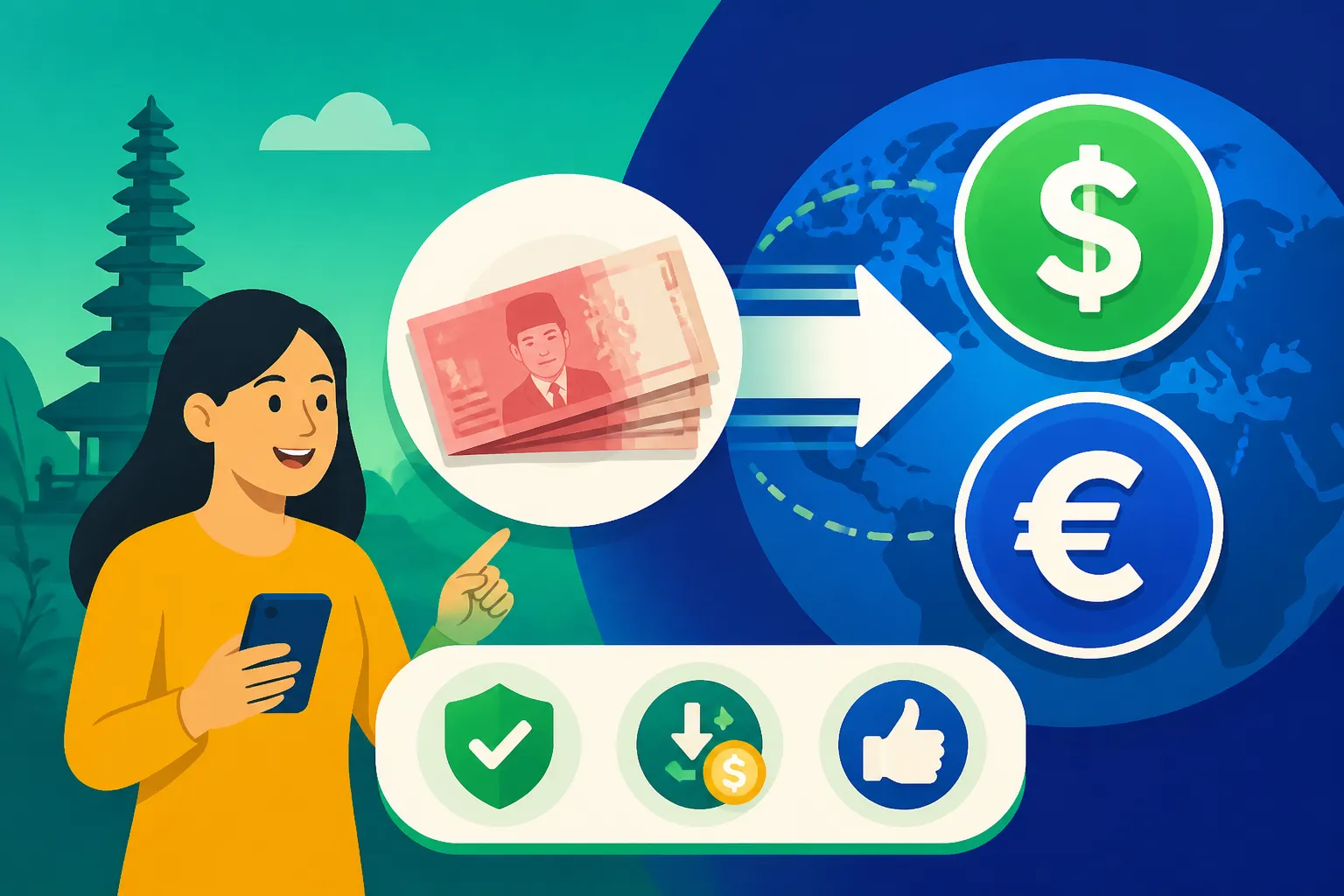
Trying to send your hard-earned Rupiah back home often feels like navigating a maze where the walls keep moving and someone is picking your pocket at every turn. I vividly remember standing in a sweltering Jakarta bank branch for three hours, clutching a stack of paperwork, only to realize the "zero fee" transfer I was promised actually cost me $200 in hidden exchange rate markups. This guide breaks down exactly how to bypass those predatory bank rates and move your money from Indonesia to the West without losing a fortune.
The Hidden Trap of Indonesian Bank Remittances
When you first arrive and start Receiving Salary in Indonesia: Payroll Deductions and Net Income Calculations, your focus is likely on surviving the commute and finding a decent apartment. But the moment you need to send funds back to a USD or EUR account, the reality of the Indonesian banking system hits. Most local banks, including the big players like BCA, Mandiri, and BNI, advertise "low" or "flat" telegraphic transfer (TT) fees. Usually, this is around $20 to $30. What they don't tell you—and what is often buried in a tiny font on a digital screen—is the exchange rate "spread."
The spread is the difference between the mid-market rate (the one you see on Google) and the rate the bank actually gives you. In Indonesia, this spread can be as high as 3% to 5%. If you are sending 100 million IDR home, a 3% spread means you are effectively paying 3 million IDR just for the privilege of the conversion. That is on top of the flat fee. I have seen expats lose thousands of dollars over a year simply because they defaulted to using their local mobile banking app for every transfer.
Furthermore, you have the "Correspondent Bank Fee." Because Indonesian Rupiah is not a major global currency, your money often has to stop at an intermediary bank in Singapore or New York before it hits its final destination. Each of these "stops" can deduct another $15 to $25 from your principal amount. By the time your money arrives in Europe or the US, it has been nibbled away by three different entities. To manage these costs, you need to understand Managing IDR Volatility: Strategies for Expats Paid in Local Currency to time your transfers when the Rupiah is strong against the Greenback or the Euro.
Best Digital Platforms for Sending IDR to USD/EUR
Thankfully, we are no longer tethered to physical bank branches. Several digital-first platforms have revolutionized the way we move money out of the archipelago. The most reliable and transparent tool I have found over my years here is Wise. Unlike traditional banks, Wise uses the real mid-market exchange rate and charges a single, upfront fee that is clearly displayed before you hit "send."
When you use Wise, you aren't actually sending Rupiah across the ocean. Instead, you send a local IDR transfer to their Indonesian account. Then, they pay out your USD or EUR from their respective local accounts in the US or Europe. This bypasses the expensive SWIFT network entirely. It is usually the fastest method; I’ve had transfers hit my UK account in under twenty minutes, whereas a bank-to-bank TT can take three to five business days.
For those who are more tech-savvy or already involved in the digital asset space, Binance offers an alternative via Peer-to-Peer (P2P) trading. You can use your Indonesian bank account to buy a stablecoin like USDT and then sell that USDT for USD or EUR to be deposited into your home account. While this can sometimes net you a rate even better than the mid-market, it requires a solid understanding of Cryptocurrencies in Indonesia: Tax Regulations and Trading Accounts to ensure you aren't running afoul of local laws. It’s a bit more "wild west," but for moving money quickly during bank holidays, it’s a lifesaver.
| Method | Estimated Fee (on 50M IDR) | Transfer Speed | Best For |
|---|---|---|---|
| Traditional Bank (TT) | 1.5M – 2.5M IDR (incl. spread) | 3-5 Days | Very large sums (> $50k) |
| Wise | 450k – 600k IDR | Instant to 24 Hours | Monthly savings & bills |
| Binance P2P | Variable (often < 1%) | 30 Minutes | Tech-savvy users |
| Interactive Brokers | Minimum (Wholesale rates) | 2-3 Days | Investors & high-net-worth |
Strategic Moves for Expats Moving Large Sums
If you are a high-earning director or someone who has just sold a business and needs to move significant capital, even Wise might start to feel expensive as their percentage-based fee scales up. In this scenario, you need to look at "wholesale" options. This is where Interactive Brokers becomes an essential part of an expat’s financial toolkit. By opening an international brokerage account, you can often perform currency conversions at the professional level—rates usually reserved for hedge funds.
The process involves sending your IDR (or more commonly, converting to USD first through a competitive local broker) and then using the Interactive Brokers platform to swap currencies at nearly zero spread. It is more complex than a simple app transfer, but the savings on a $100,000 transfer can be enough to pay for a month’s rent in Kemang. However, be aware that when moving these amounts, Indonesian regulators (Bank Indonesia) require "Proof of Purpose." If you send more than $100,000 (or equivalent) per month, you must provide documents like an invoice, a property contract, or a tax statement. This is why keeping your Taxes in Indonesia for Expats: NPWP, PPh 21, and the 183-Day Rule in order is so critical; without a clean tax record, the bank can freeze your outgoing transfer indefinitely.
Another layer of protection involves your digital security. When you are managing these high-value transfers, especially if you are accessing your home country’s bank accounts from an Indonesian IP address, you risk being flagged for suspicious activity. I have had my US bank account locked because I tried to log in from a cafe in Bali. Using NordVPN to maintain a stable, "home-based" IP address is a standard veteran move. It ensures that your bank’s security algorithms don't freak out while you're trying to move money, and it adds an essential layer of encryption when you're using public Wi-Fi to check your International Money Transfers: Using Wise, SWIFT, and Local Bank Remittances status.
Navigating Indonesian Regulations and Final Transfers
One thing no one tells you until it’s too late is that sending money out becomes significantly harder the moment you lose your residency status. If you are in the process of Deactivating BPJS Kesehatan When Leaving Indonesia Permanently and wrapping up your affairs, you should make your bulk transfers before your KITAS is cancelled. Once you move to an "Exit Permit Only" (EPO) status, your ability to use local banking apps often becomes restricted, and you may find yourself forced to use the physical teller window where the rates are at their worst.
Always ensure that your Registering for an NPWP (Tax ID): How Expats Link NIK to Tax Records in 2027 data matches your bank records perfectly. In the last year, the Indonesian government has moved toward a "Single Identity" system. If the name on your Wise account, your Indonesian bank, and your NPWP has even a one-letter discrepancy—like a missing middle name—your transfer will likely be rejected by the clearing house. This results in your money being stuck in "purgatory" for weeks, and when it is finally returned to your account, you will have lost a chunk of it to "return fees."
Before you make that final big push of funds, double-check your limits. Most Indonesian banks have a daily limit for "Online" or "App" transfers that is quite low (often around 25 million to 50 million IDR). If you need to send more, you may need to visit the branch once to "white-list" your foreign recipient or increase your daily limit. Doing this while you still have a valid KITAS and a friendly relationship with your local account officer makes the process infinitely smoother. If you're struggling with the local bureaucracy, it might be worth checking Health and Wellness in Bali: Yoga, Holistic Clinics, Diet, and Retreats—not for the money, but for the stress relief you’ll definitely need after dealing with Indonesian bank paperwork.
Final Checklist for Your Outbound Transfer
To ensure you aren't being taken for a ride, follow this workflow every time you send money:
- Check the Google Mid-Market Rate: This is your benchmark. Anything more than 0.5% away from this is a bad deal.
- Compare Wise vs. Your Bank: Open your bank app and Wise side-by-side. Look at the final amount that will arrive in your home account, not just the "fee."
- Check for Correspondent Fees: If using a bank, ask if they can use "OUR" or "SHA" billing. "OUR" means you pay all fees upfront so your family or your home bank receives the exact amount intended.
- Verify the Recipient Details: Double-check the IBAN or Routing Number. Indonesian banks are notoriously slow at reversing errors.
- Secure Your Connection: Turn on NordVPN before logging into any financial portal to prevent account freezes and data theft.
Moving money out of Indonesia doesn't have to be a recurring trauma. By stepping away from the traditional bank counter and utilizing platforms like Wise or Interactive Brokers, you can keep more of your salary where it belongs: in your pocket. Just remember to stay compliant with Filing the Annual Tax Return (Formulir 1770): Deadlines and Required Documents so that your "Proof of Funds" is never questioned by the authorities.
Disclaimer
The information provided in this guide is for informational purposes only and does not constitute financial, legal, or tax advice. Exchange rates, platform fees, and Indonesian financial regulations are subject to frequent change. Always conduct your own due diligence and consult with a qualified professional before making significant financial transactions.