ATM Fees in Indonesia: Using Alto, Prima, and ATM Bersama Networks
You’re standing in a stuffy glass booth in Jakarta’s SCBD or perhaps a humid corner of Canggu, staring at a screen that offers you a choice between "Withdrawal with Conversion" and "Without Conversion." I remember my first month in Jakarta, sweating at a BCA terminal while three people behind me waited, wondering if those little logos at the bottom—Alto, Prima, ATM Bersama—meant I was about to be charged a small fortune in hidden network fees. This guide demystifies the Indonesian ATM landscape, ensuring your hard-earned Rupiah stays in your pocket rather than feeding the bank’s bottom line.
Decoding the Indonesian ATM Landscape
Navigating the financial infrastructure of Indonesia is a rite of passage for every expat. Unlike some Western countries where one or two networks dominate, Indonesia has a robust, interconnected web of local networks that keep the cash flowing across seventeen thousand islands. For a newcomer, the sheer variety of ATM machines—from the bright blue of BCA to the deep red of Mandiri—can be overwhelming.
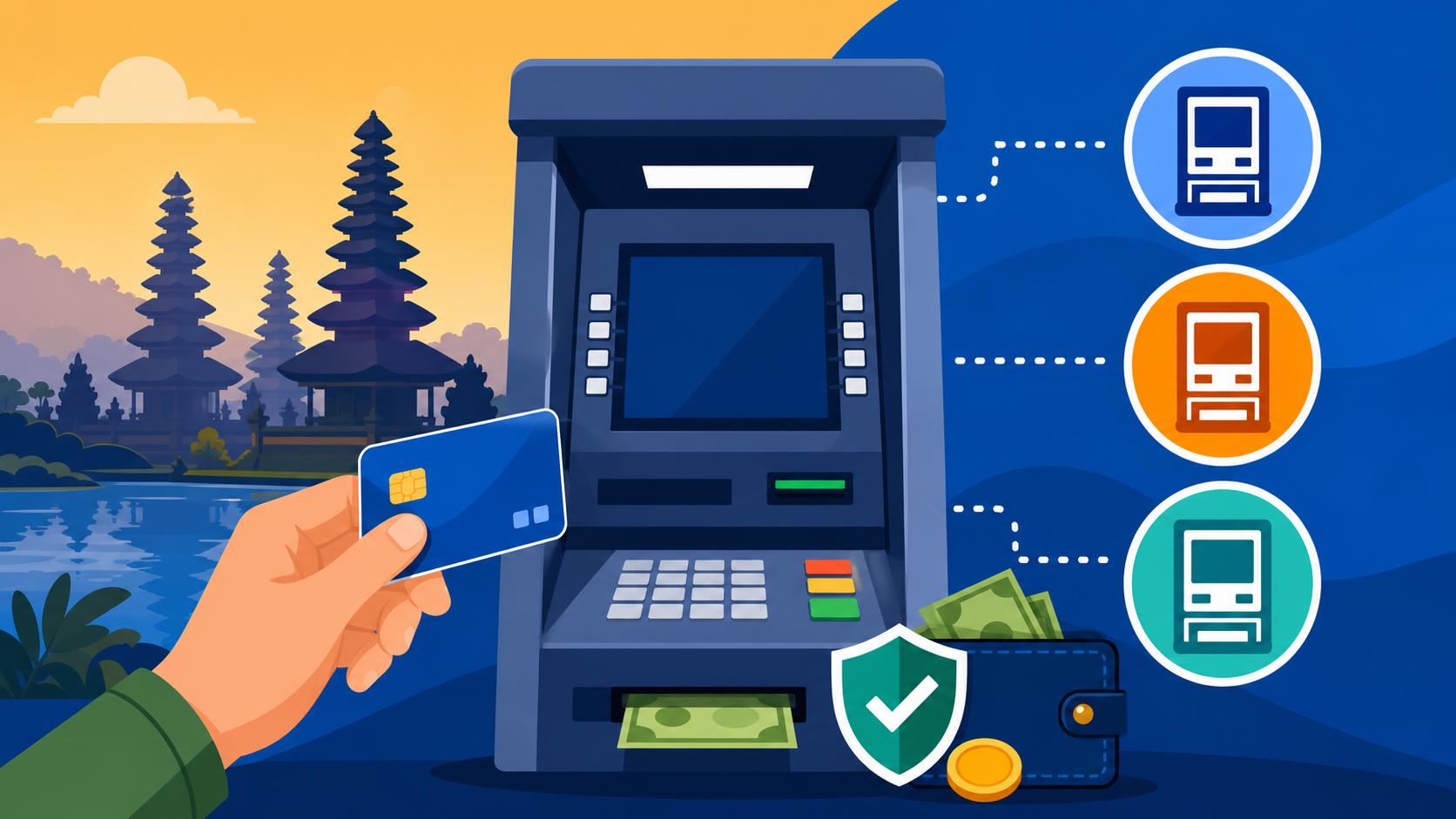
The first thing you need to realize is that Money in Indonesia for Foreign Residents: Banking, Tax, and Financial Setup (2027) is heavily reliant on cash for day-to-day transactions at local markets (pasar) or smaller warungs, even as digital payments rise. Most ATMs in Indonesia are part of several domestic networks simultaneously. This interoperability is great for convenience but can be a minefield for fees if you aren't careful. You will frequently see the logos for ATM Bersama, Prima, and Alto plastered on the bottom of the machines. These are the bridges that allow a Mandiri cardholder to use a BNI machine, or a Permata cardholder to withdraw from a CIMB Niaga terminal.
Understanding ATM Networks: Alto, Prima, and ATM Bersama
To master your finances here, you have to understand who these players are. Think of these networks as the "rails" your transaction travels on. Each has its own reach and fee structure, and knowing which ones your local bank supports can save you thousands of Rupiah over a year.
ATM Bersama: The Giant of the Archipelago
ATM Bersama is the oldest and most extensive network in Indonesia. Managed by Artajasa, it connects over 90 different banks, including the massive state-owned entities (BUMN) like Mandiri, BNI, and BRI. If you find yourself in a remote part of Sumatra or a small village in North Sulawesi, chances are the only ATM available will be an ATM Bersama-linked machine.
When you use an ATM Bersama machine with a card from a member bank, the transaction is usually seamless. However, if you are using an international card, ATM Bersama acts as the gateway to the global networks like Visa or Mastercard. It is worth noting that Opening a Bank Account in Indonesia: Document Checklists (KITAS, NPWP, Passport) usually results in you receiving a card that is default-enabled for ATM Bersama, allowing you to check balances or transfer funds to other local banks directly at the terminal.
Prima: The Convenience King
Owned by PT Rintis Sejahtera, the Prima network is the primary competitor to ATM Bersama. Its biggest "claim to fame" is its deep integration with BCA (Bank Central Asia), which is arguably the most popular private bank for expats due to its excellent mobile app. Prima focuses heavily on transaction speed and reliability.
If you see the Prima logo, it means you can likely use your card for more than just cash. You can pay utilities, top up your GoPay or OVO balance, and even pay for train tickets. For expats, Prima-linked ATMs are often found in high-end malls and office buildings. If you are trying to keep your Financial Checklist for Your First 30 Days in Indonesia on track, identifying the nearest Prima-enabled machine is a top priority for smooth daily operations.
Alto: The Niche Player
Alto (Asosiasi Lintas Pembayaran) is the third major domestic network. While it has a smaller footprint than the other two, it still connects several significant private banks and is increasingly moving into digital payment processing. You will often see the Alto logo alongside Prima and ATM Bersama on the same machine, indicating that the terminal is "tri-network" compatible. This redundancy is a uniquely Indonesian solution to ensure that even if one network has a technical glitch, your transaction can still be routed through another.
Breaking Down the Costs: Fees for Local and International Cards
Fees are where the "expat tax" often hides in plain sight. In Indonesia, ATM fees are split into two categories: interbank fees for local cards and access fees for international cards.
Local Interbank Fees
If you have a local Indonesian bank account, using your own bank's ATM is almost always free. However, if you take your BCA card to a Mandiri ATM, you will typically be charged a fee. As of 2026, the standard interbank withdrawal fee through networks like Prima or ATM Bersama is around IDR 6,500 to IDR 7,500 per transaction. Balance inquiries usually cost around IDR 4,000, and transfers to other banks cost IDR 6,500.
While these amounts seem small—less than fifty cents—they add up if you are frequently withdrawing small amounts. This is especially relevant when Receiving Salary in Indonesia: Payroll Deductions and Net Income Calculations results in your funds being deposited into a specific bank that might not have a branch near your home.
International Card Fees and the DCC Trap
For those using cards from back home, the fees can be significantly higher. Many Indonesian banks now charge a "local access fee" of IDR 50,000 to IDR 100,000 per withdrawal for foreign cards. This is on top of whatever your home bank charges you.
The biggest danger, however, is Dynamic Currency Conversion (DCC). When the ATM asks, "Would you like to be charged in your home currency?" always choose NO. Choosing "Yes" allows the Indonesian bank to set the exchange rate, which is often 5% to 10% worse than the mid-market rate. To avoid this, many expats use Wise to hold Rupiah directly or to benefit from much lower conversion fees when pulling from a foreign balance. Using Wise in conjunction with a local ATM allows you to see exactly what you are paying without the "guesswork" of bank-inflated rates.
Comparison of ATM Network Fees and Limits
To help you visualize the differences, here is a breakdown of what you can expect when using various machines across Indonesia.
| Feature | ATM Bersama | Prima | Alto | International (Visa/MC) |
|---|---|---|---|---|
| Typical Withdrawal Fee | IDR 7,500 (Local Interbank) | IDR 6,500 (Local Interbank) | IDR 6,500 (Local Interbank) | IDR 50k – 100k + DCC |
| Balance Inquiry Fee | IDR 4,000 | IDR 4,000 | IDR 4,000 | Often Free (but check home bank) |
| Max Withdrawal (50k notes) | IDR 1,250,000 | IDR 1,500,000 | IDR 1,000,000 | Varies by Bank (usually lower) |
| Max Withdrawal (100k notes) | IDR 2,500,000 | IDR 3,000,000 | IDR 2,000,000 | Up to IDR 3,000,000 |
| Prevalence | Nationwide (High) | Malls/Cities (High) | Urban Centers (Medium) | Tourist Hubs (High) |
Strategic Tips for Minimizing Fees
After years of living here, I’ve learned that a little bit of planning goes a long way. You don't want to be the person paying IDR 100,000 in fees just to get cash for a IDR 20,000 taxi ride.
Choosing the Right Bank and Machine
If you are a resident, I highly recommend opening an account with one of the "Big Four": BCA, Mandiri, BNI, or BRI. These banks have the largest ATM networks, meaning you will rarely need to use an interbank network and incur a fee. Furthermore, pay attention to the sticker on the ATM. ATMs in Indonesia dispense either IDR 50,000 notes or IDR 100,000 notes. If you are withdrawing a large amount, always look for a "100,000" machine. A "50,000" machine has a much lower physical limit on the number of bills it can spit out, forcing you to make multiple transactions (and pay multiple fees) to get the same amount of cash.
Digital Banking and E-Wallets
One of the best ways to avoid ATM fees altogether is to stop using cash where possible. Digital Banking and E-Wallets: How to Register for GoPay, OVO, and Dana has changed the game. You can top up these wallets directly from your Indonesian bank app for a nominal fee (usually IDR 1,000) and then pay for groceries, coffee, and even cinema tickets using a QR code. This is part of the Using Your BPJS Card (Kartu JKN): How to Register and Book at Local Faskes mindset—integrating into the local digital ecosystem to save both time and money.
If you are a more sophisticated investor or freelancer, you might even find yourself using platforms like Binance to move assets into the country or Interactive Brokers to manage your global portfolio. While these aren't "ATM" solutions, they are part of a broader strategy to minimize the need for high-fee physical cash withdrawals.
Safety and Security at Indonesian ATMs
Beyond fees, you need to be vigilant about security. ATM skimming is a real issue, particularly in high-traffic tourist areas like Kuta, Seminyak, or Labuan Bajo.
Avoiding Skimming Scams
Avoiding Skimming Scams: Safe ATM Practices in Bali Tourist Areas is a topic we discuss frequently in the expat community. Always check the card slot for anything loose or unusual. Cover your hand when entering your PIN—scammers often use tiny pinhole cameras hidden above the keypad.
I personally only use ATMs that are located inside a bank branch with a security guard (Satpam) present. Not only are these machines less likely to be tampered with, but if the machine swallows your card (a common occurrence during power flickers), you can walk right into the branch and resolve it immediately. Using a NordVPN connection when checking your bank balance on the bank’s mobile app while on public Wi-Fi at a cafe near the ATM is also a smart move to prevent credential theft.
Location and Timing
Avoid using standalone ATMs in dark or isolated areas. Not just for physical safety, but because these machines are often the least maintained and most prone to technical errors. Also, be aware that many ATMs "run out of cash" during long holiday weekends like Lebaran (Idul Fitri) or Christmas. If you see a long line at an ATM Bersama machine on a Friday afternoon before a long weekend, join it—you might not get another chance until Tuesday.
Practical Scenarios and Common Frustrations
Even with the best planning, things go wrong. I once had a machine in Yogyakarta deduct IDR 2,500,000 from my account but fail to dispense the cash. It was a stressful three-week battle of paperwork to get it back.
The Swallowed Card Nightmare
If an ATM swallows your card, do not leave the machine immediately. Wait a few minutes to ensure it doesn't spit it back out after a delayed reboot. If it’s during bank hours, alert the Satpam. If it’s after hours, call the bank’s official call center immediately to block the card. This is why having your bank's 24-hour hotline saved in your phone is essential.
The Power of QRIS
The best "fee avoidance" strategy is the ubiquitous QRIS (Quick Response Code Indonesian Standard). Almost every merchant, from the high-end boutiques in Grand Indonesia to the satay seller on the street, now accepts QRIS. By Using QRIS: The Cashless Payment System Revolutionizing Indonesian Commerce, you bypass the ATM networks entirely. You simply scan, pay the exact amount, and go. It’s faster, safer, and completely fee-free for the consumer.
In summary, while the ATM networks like Alto, Prima, and ATM Bersama provide a vital service, they are tools that should be used strategically. By understanding the fee structures, avoiding DCC, and embracing the local digital payment revolution, you can navigate Indonesia’s financial waters like a pro.
Disclaimer
The information provided in this article is for informational purposes only and does not constitute financial, legal, or investment advice. While we strive to keep the data current, ATM fees, bank policies, and network regulations in Indonesia are subject to frequent changes. Always verify the latest terms and conditions with your specific banking institution.