Spotting Rental Scams in Bali: Unregistered Owners and Fake Subleases
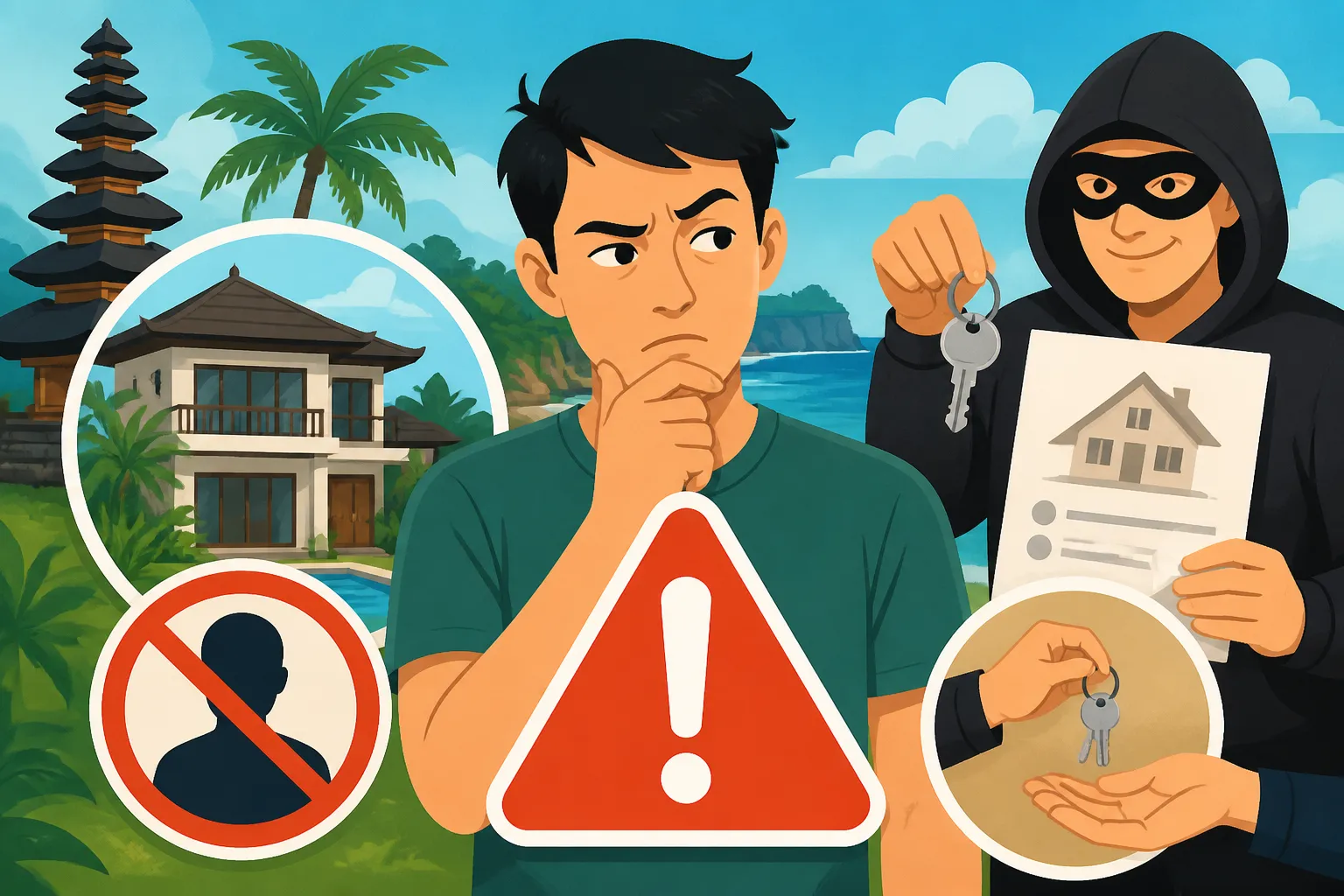
Finding a dream villa in Bali often turns into a nightmare when you realize the person you just sent a massive deposit to doesn't actually own the property. I’ve personally sat in a cafe in Berawa, watching a distraught newcomer realize their "landlord" had vanished the moment the bank transfer hit, leaving them with no house and no recourse. This guide breaks down exactly how to identify and avoid the sophisticated rental scams currently targeting expats and digital nomads in Bali.
The Anatomy of a Bali Rental Scam
The digital landscape of Bali's real estate market is a double-edged sword. While it’s easier than ever to browse listings from your home country, it’s equally easy for scammers to create a facade of legitimacy. Most scams begin on social media platforms or unverified listing sites where the barrier to entry is non-existent. These individuals aren't just "dishonest"—they are often professional syndicates operating with high-quality stolen assets.
Fake Facebook Profiles and WhatsApp Impersonation
Facebook groups like "Bali Housing" or "Canggu Community" are the primary hunting grounds for rental scammers. They often create elaborate profiles that look like a friendly local or a well-established expat. They post high-end villas at prices that seem just a bit too good to be true—but not so low that they immediately trigger suspicion. When you comment or message them, they quickly move the conversation to WhatsApp, which is the standard for communication in Indonesia but also provides them with an encrypted, untraceable way to send "contracts" and bank details.
One common tactic involves the scammer hacking a legitimate local’s Facebook account. This gives them immediate social proof; you see a profile with years of history, local friends, and photos of Bali life. They will use this stolen identity to build rapport, sharing stories about their "family villa" and why they need to rent it out quickly. They may even send you a photo of a KTP (Indonesian ID card), which is almost certainly stolen from someone else. Before you start your search, ensure you have a stable connection using an eSIM from a provider like Airalo so you can research these profiles in real-time while you’re out visiting properties.
The Ghost Property Phenomenon
A ghost property is a listing for a villa that either doesn’t exist, isn't for rent, or is currently occupied by someone else who has no idea it's being advertised. Scammers will visit legitimate booking sites like Agoda to find beautiful photos of a villa, then copy the descriptions word-for-word. They might even go to the physical location and take photos over the fence to show "recent" updates.
The danger here is that they may even arrange a "showing." I’ve seen cases where a scammer rents a villa on a short-term basis for two nights, then spends those two days showing the property to ten different prospective "long-term" tenants. They collect ten deposits and disappear before the actual owner returns. This is why verifying the owner’s identity against the property documents is the only way to be sure the person holding the keys actually has the right to give them to you.
Bait and Switch Tactics on Popular Platforms
Sometimes, the property is real, but the listing is a "bait." You see a stunning 3-bedroom villa in Bali Neighborhoods: Seminyak, Canggu, Sanur, Ubud, and the Bukit for a great price. When you inquire, the "owner" tells you that the specific villa was just taken, but they have another one nearby that is "even better." They pressure you to put down a holding deposit immediately because "five other people are looking at it right now."
The secondary property is almost always of significantly lower quality, has legal issues, or is located in a high-noise area. By the time you realize the discrepancy, you’ve already paid a non-refundable deposit. Always insist on seeing the exact unit you are renting. If you’re currently staying in temporary accommodation booked through Agoda, take advantage of that flexibility to walk the neighborhood and see if the villa’s location matches the listing's claims.
Unregistered Owners and the Legal Red Flags
In Indonesia, owning land and renting it out requires specific documentation. Many scams succeed because foreigners aren't familiar with what a legal property document looks like. If an owner is "unregistered," it means they may not have the legal right to lease the property, or the property itself is built on land not zoned for residential or commercial rental use.
The Importance of the IMB or PBG Certificate
The IMB (Izin Mendirikan Bangunan), now transitioning to the PBG (Persetujuan Bangunan Gedung), is the building permit. It specifies what the building can be used for. If you are looking at a villa but the owner cannot produce a copy of the IMB/PBG, you are entering a high-risk zone. The government has been increasingly strict about zoning, and houses built without these permits can be subject to demolition or power disconnection.
Furthermore, the IMB/PBG will list the owner's name. If the person claiming to be the owner has a different name than the one on the permit, you need to see a notarized power of attorney (Surat Kuasa) or a valid sales contract. Without this, you have no legal protection if the real owner shows up and demands you leave. Understanding these documents is a core part of Understanding Indonesian Lease Agreements: Notarized Contracts and Stamp Duty, which every long-term resident should read.
Understanding the Banjar and Local Village Oversight
In Bali, the Banjar (local community council) is the ultimate authority on what happens in a neighborhood. Every legitimate rental should be known to the Banjar. If you are suspicious of a landlord, one of the most effective "expat pro-tips" is to visit the local Banjar office or speak to the Kepala Desa (Village Head).
They will know who owns the land and whether it is a legitimate rental property. If the landlord seems nervous about you mentioning the Banjar or tries to prevent you from getting a Surat Domisili (Domicile Letter): How to Get it from the Village Head, it’s a massive red flag. This letter is required for many administrative tasks in Indonesia, and a legitimate landlord will have no issue helping you obtain it.
Verified Ownership via the Certificate of Land Ownership
The Sertifikat Hak Milik (SHM) is the highest form of land ownership in Indonesia, available only to Indonesian citizens. Most villas you rent will be owned by an Indonesian under an SHM. As a renter, you should ask for a copy of this certificate. You aren't just looking at the name; you’re checking if the land is currently under dispute or if it’s being used as collateral for a bank loan that is in default.
If you are considering Buying Property as a Foreigner: Hak Pakai, Hak Milik Nominees, and Risks, you’ll know that the paper trail is everything. The same applies to renting. A scammer will often give excuses like "the certificate is at the bank" or "my lawyer has the original." While they might not give you the original, they should always be able to provide a clear photocopy or a scan for your lawyer or notary to verify.
The Hidden Trap of Illegal Subleases
Illegal subleasing is perhaps the most common way expats lose money in Bali. This occurs when a tenant (often another expat) rents a villa for a long period—say, 5 years—and then tries to "re-lease" it to you for a year. If their original contract doesn't explicitly allow this, you could be evicted by the actual owner at any time, and your "landlord" will have already left the country with your money.
Why the Master Lease Must Explicitly Allow Subletting
In Indonesian law, the right to sublease is not automatic. The "Master Lease" (the contract between the owner and the primary tenant) must have a specific clause that says "allowed to sublease" (boleh disewakan kembali). I’ve seen many cases where the primary tenant is in financial trouble and decides to "flip" their lease to a newcomer without telling the owner.
When you are negotiating a sublease, you must demand to see the original Master Lease. Don't take their word for it. Look for the stamp duty (Materai) and the signatures of both the owner and the tenant. If the primary tenant refuses to show you this document, they are likely hiding the fact that they are violating their agreement with the owner. This is a critical step in Renting in Indonesia: The 1-Year Upfront Rule, Contracts, and Avoiding Scams.
The Danger of Short-Term Sublets on Yearly Contracts
Bali has a unique rental culture where landlords typically demand Why Landlords Demand 1-to-3 Years Rent Upfront and How to Negotiate. Scammers take advantage of this by offering "monthly" stays in a villa that is strictly a yearly rental. They take your monthly payment, but they haven't paid the owner the yearly lump sum.
A few weeks into your stay, the real owner or their representative might show up to lock the gates because the rent hasn't been paid. Because you don't have a direct contract with the owner, the police will usually side with them, and you will be forced to leave. This is why "too good to be true" monthly rates in prime areas like Canggu or Uluwatu should be treated with extreme caution.
Verification Steps with the Original Landlord
The only way to safely sublease is to have a three-way meeting or at least a confirmed communication with the original property owner. You want the owner to acknowledge in writing that they are aware of the sublease and that the primary tenant is in good standing.
If the person you are dealing with says, "Oh, the owner is an old lady in Java, she doesn't want to be bothered," be very suspicious. Every owner has a representative or a Pemilik contact. If you can't verify the sublease with the person who actually owns the land, do not transfer any money. Building a relationship with the owner is part of Connecting with the Local Community: Participating in Gotong Royong, which helps secure your long-term standing in the village.
Comparison of Legitimate vs. Scammed Rental Scenarios
| Feature | Legitimate Rental | Potential Scam |
|---|---|---|
| Documentation | Provides IMB/PBG and SHM copies immediately. | Excuses about documents being "at the bank" or "with a lawyer." |
| Payment | Bank transfer to an account matching the owner's name. | Requests for Western Union, Crypto, or a "friend's" account. |
| Physical Access | Allows multiple walk-throughs and meeting the staff. | Only one showing allowed, or "owner" is currently out of town. |
| Contract | Notarized with a clear Materai (stamp duty). | Simple Word document or just a "WhatsApp agreement." |
| Social Proof | Known by the Banjar and neighboring villas. | No one in the neighborhood knows the "landlord." |
Common Red Flags During the Negotiation Phase
Scammers rely on psychological pressure to bypass your common sense. They know that Bali’s rental market is competitive and that newcomers are often anxious to secure a place to live so they can start their new life.
The "Urgent Deposit" Pressure Tactic
If you hear the phrase, "I have someone else coming in an hour with cash, but I like you, so if you pay the deposit now, it’s yours," walk away. This is the classic "fear of missing out" (FOMO) tactic used by scammers to prevent you from doing your due diligence. A legitimate landlord will usually give you 24–48 hours to review a contract after a viewing.
In a market as hot as Bali’s, things do move fast, but no legitimate business person will refuse you a few hours to verify land certificates. If you feel pressured, remember that it's better to stay an extra week in an Agoda hotel than to lose $5,000 to a scammer.
Refusal to Meet in Person or Show the Property
In the age of digital nomads, many people try to rent villas before they even arrive in Indonesia. Scammers love this. They will send "video tours" (often stolen from YouTube or real estate agents) and offer a discount for "early booking."
Never, under any circumstances, rent a long-term villa in Bali without seeing it in person or having a trusted friend/agent visit it for you. There are many things a video won't show: the construction site next door, the smell of the nearby trash dump, or the fact that the "private pool" is actually shared with four other units. If they say you can't see it because "it's currently occupied," wait until the guest leaves. If they still refuse, it’s because they don't have the keys.
Payment Requests via Suspicious Methods or Third Parties
In Indonesia, the name on the bank account should always match the name on the property documents or the company name of the management agency. If you are told to transfer money to a "personal assistant," a "cousin," or via an international wire service that doesn't show the recipient's name, stop.
Scammers also frequently ask for payments in Cryptocurrency or through obscure apps. While some expats use these, a professional rental should always be payable via a standard Indonesian bank transfer. Once you've moved in and need to furnish your place, you'll find that using Shopee for household goods is a much more secure way to spend your money.
Practical Steps to Protect Yourself
Protecting yourself requires a mix of digital savvy and "boots on the ground" investigation. Don't be afraid to be "difficult"—a legitimate owner who is used to dealing with foreigners will understand your need for security.
Conducting a Reverse Image Search and Digital Due Diligence
Before you even message a landlord, take their listing photos and run them through Google Lens or a reverse image search. If the "private villa in Canggu" also appears as a "luxury rental in Phuket" or an "Airbnb in Tulum," you’ve caught a scammer.
Check the WhatsApp number. If it’s a business account, does it have a history? If it’s a personal account, does the profile picture look like a stock photo? Use apps like GetContact to see how other people have saved that phone number. If you see tags like "Scammer Villa" or "Fake Landlord," you have your answer. Staying connected with a local SIM or an eSIM from Airalo allows you to do this research instantly during a viewing.
Using Notaries and Legal Representatives for Long-Term Leases
If you are signing a lease for more than a year, or if the rent is substantial, hire a local notary (Notaris). In Indonesia, a notary is a government-appointed official who verifies the legality of the documents and the identity of the parties. They are much cheaper than a lawyer and provide a necessary layer of protection.
The notary will check the land certificate at the National Land Agency (BPN) to ensure it’s not blocked or disputed. This is a standard part of Safety 101: Petty Theft, ATM Skimming, and Home Security in Indonesia—protecting your financial assets is the first step to personal safety.
Leveraging the Community for Vetting
The expat community in Bali is surprisingly small and very vocal. If you’re unsure about a management company or an owner, ask in the Facebook groups—but do it smartly. Instead of saying "Is this villa real?", post the name of the owner or agency and ask for "references."
Often, someone will chime in with their experience. You can also check if the villa is listed on reputable platforms. If it’s on Agoda or a major management site like Bukit Vista or Bali Treasure Properties, it’s much more likely to be legitimate. Even if you want to rent directly to save on fees, use these platforms to verify that the property actually exists and is being managed professionally.
What to Do if You Have Been Scammed
If the worst happens and you realize you’ve been scammed, you must act immediately. The chances of getting your money back are low, but not zero, and your actions can prevent the scammer from hitting their next target.
Reporting to the Police and Obtaining a Berita Acara
Go to the nearest police station (Polsek) and file a report. You will need to bring all your evidence: WhatsApp screenshots, bank transfer receipts, and the fake contract. You are looking to get a Berita Acara Pemeriksaan (BAP), which is an official police report.
While the local police may not always have the resources to track down a digital scammer, this document is essential for any insurance claims or if you need to prove your situation to your bank. It’s also a required step if you ever face issues with Surat Domisili (Domicile Letter): How to Get it from the Village Head later because you don't have a valid lease.
Contacting Your Bank and Payment Processors
As soon as you suspect a scam, call your bank’s fraud department. If you did a domestic transfer within Indonesia, the receiving bank can sometimes freeze the account if there is a police report. Scammers usually withdraw the cash immediately, but speed is of the essence.
If you used a credit card or a platform like PayPal (though rare for Bali rentals), initiate a chargeback immediately. Be prepared to provide the police report and all correspondence. This is another reason why you should avoid paying with cash or untraceable methods. Once you are settled, you can buy a security camera or extra locks for your actual home via Shopee to ensure your physical safety.
Warning the Community to Prevent Future Victims
Once you have secured your own situation, share your story. Post the scammer’s phone number, the fake bank account details, and the photos they used in the community groups. Scammers often reuse the same assets for months.
By speaking out, you make the "Bali" keyword toxic for that specific scammer. This collective vigilance is part of Connecting with the Local Community: Participating in Gotong Royong, where everyone looks out for one another. It’s the only way to keep the island’s rental market safe for everyone. Be mindful of the Dealing with Neighborhood Noise: Mosques, Roosters, and Construction Etiquette too, as staying in a neighborhood while you sort out a scam can be stressful, and you'll want to maintain good relations with those around you.
Disclaimer
This guide is based on personal expat experiences and current market trends in Indonesia as of 2026. I am not a qualified legal professional or a licensed real estate agent in Indonesia. Regulations and common scam tactics can change rapidly. Always consult with a local notary or a registered legal consultant before signing long-term contracts or transferring large sums of money. Any actions taken based on this information are at your own risk.