Avoiding Skimming Scams: Safe ATM Practices in Bali Tourist Areas
You are finally settling into the Bali rhythm—the morning surf, the scent of incense on the breeze, and the endless search for the perfect nasi campur. But then it happens: you check your phone and see three unauthorized withdrawals from an ATM in Kuta while you were asleep in Ubud. I remember standing in a grocery store line in Seminyak, my card declined for a simple bottle of water, only to realize my entire monthly budget had been drained by a skimmer. This guide is here to ensure that never happens to you, providing the hard-won secrets to keeping your cash safe in Indonesia's most popular tourist hubs.
The Anatomy of an ATM Scam in Bali
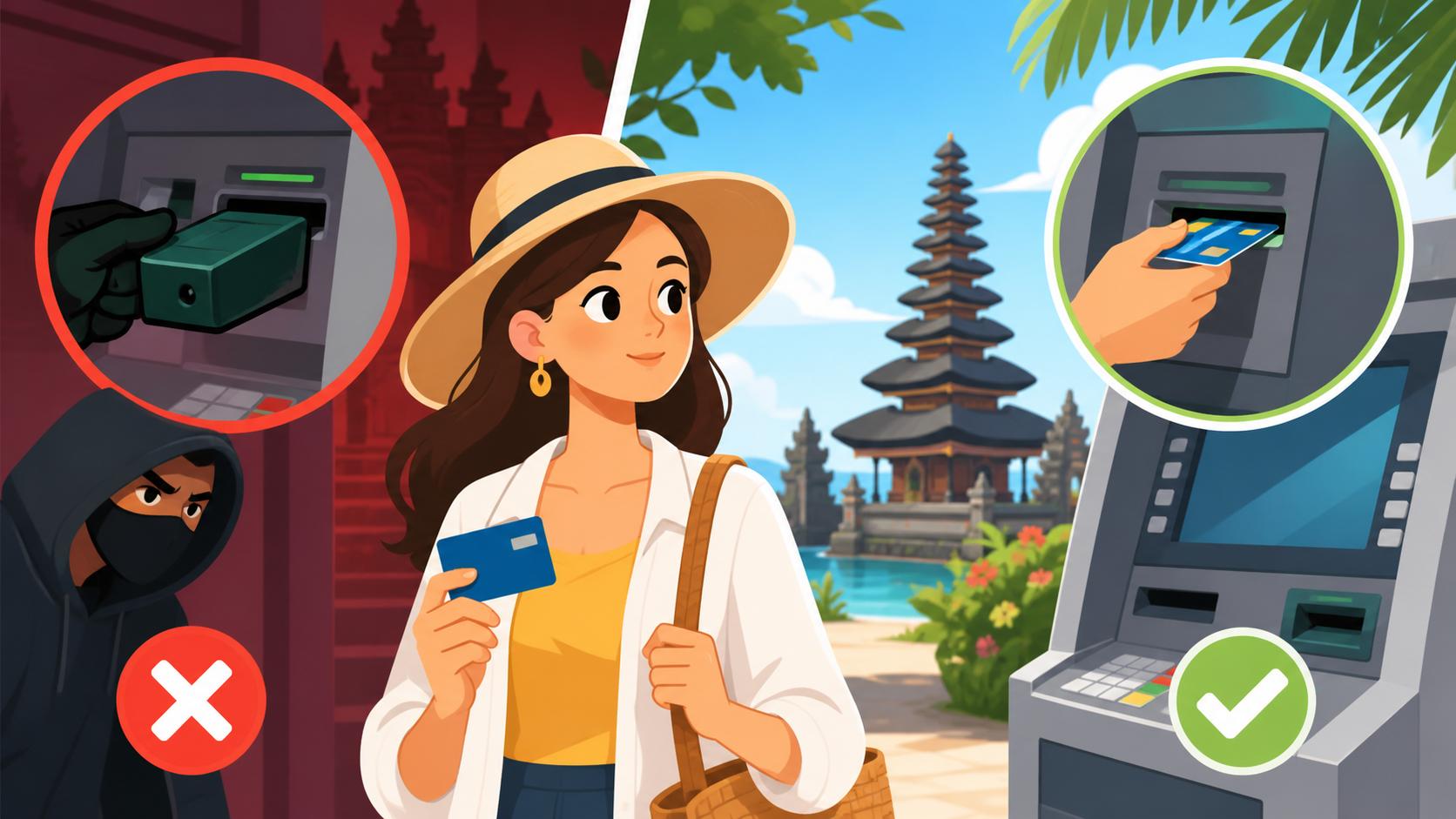
The first thing you need to understand is that skimming in Bali is not a primitive crime; it is a sophisticated operation. Scammers often target "dark" ATMs—those tucked away in the back of convenience stores or stand-alone booths on quiet streets. These locations allow them to install and retrieve devices without being caught on security footage or noticed by bank staff. They rely on the fact that tourists are often distracted by the heat, the traffic, or the excitement of their holiday, leading them to overlook small physical discrepancies in the machine.
The psychology of the scam often exploits your need for convenience. You are on your way to a beach club, you realize you need cash for the entrance fee, and you see a lone ATM booth. It looks official enough, but it hasn't been serviced by a major bank in weeks. This is the "honey pot" for skimmers. They know that once you insert your card and enter your PIN, they have everything they need to clone your data. Understanding this landscape is the first step in Money in Indonesia for Foreign Residents: Banking, Tax, and Financial Setup (2027) and protecting your hard-earned assets.
Furthermore, many of these scams involve a "shim" rather than a "skimmer." While a skimmer is a bulky device placed over the card slot, a shim is a paper-thin piece of circuit board inserted into the card reader itself. It is virtually invisible to the naked eye. This is why relying on physical inspection alone isn't enough. You need a multi-layered defense strategy that involves both physical awareness and digital tools like Wise to manage your daily spending limits and freeze cards instantly if something feels off.
Identifying High-Risk ATM Locations
The general rule of thumb in Bali is that if an ATM is not physically attached to a bank branch with a security guard standing nearby, the risk level increases significantly. Independent ATM operators, often found in smaller "minimarts" or circle-Ks, are the most frequent targets. These machines are rarely inspected for physical tampering. If you are in the process of Opening a Bank Account in Indonesia: Document Checklists (KITAS, NPWP, Passport), you should prioritize using the official ATMs of the bank where you hold your account.
Large shopping malls like Beachwalk in Kuta or Living World in Denpasar are generally safer, as they have high foot traffic and constant security presence. However, even there, you should be vigilant. The safest possible option is an ATM located inside a bank vestibule during business hours. In these environments, scammers have almost zero opportunity to install hardware. If you are a long-term resident, you should also be aware of the Top Banks for Expats: Comparing BCA, Mandiri, BNI, and Digital Banks (Jenius) to find the ones with the most advanced anti-skimming technology on their machines.
| ATM Location Type | Risk Level | Security Features | Recommendation |
|---|---|---|---|
| Bank Branch (Indoor) | Very Low | Guards, CCTV, Frequent Audits | Always use this first |
| Major Shopping Mall | Low | Mall Security, High Visibility | Safe for daytime use |
| Minimarts / Convenience Stores | High | Low Visibility, No On-site Techs | Use only in emergencies |
| Stand-alone Booths (Street) | Very High | Isolated, Easy to Tamper | Avoid at all costs |
The Physical Signs of Tampering
Before you even touch your card to the machine, you need to perform what I call the "Expat Wiggle." Grab the plastic shroud around the card slot and give it a firm tug. If it feels loose, has sticky residue around the edges, or moves at all, walk away immediately. Real ATM components are built to be incredibly sturdy and should not have any "give." Scammers often use 3D-printed parts that are glued on top of the original reader, and these will almost always fail the wiggle test.
Next, look up. Most skimming operations require a tiny "pinhole" camera to record your fingers as you type your PIN. These cameras are often hidden in a fake plastic strip directly above the keypad or disguised as a fire alarm or a leaflet holder. This is why the most effective physical habit you can develop is to cover your hand with your wallet or your other hand while typing. Even if they have your card data, it is useless without that four or six-digit code. Always refer back to your Financial Checklist for Your First 30 Days in Indonesia to ensure these habits become second nature.
Tech-Savvy Practices to Outsmart Scammers
We have tools that make traditional skimming much harder for criminals to profit from. One of the biggest game-changers has been the rise of cardless withdrawals. Most major Indonesian banks, including BCA and Mandiri, now allow you to generate a temporary code on your mobile banking app. You then type this code into the ATM instead of inserting your physical card. If you don't insert a card, there is no data to skim. This is a crucial part of Digital Banking and E-Wallets: How to Register for GoPay, OVO, and Dana that every expat should master.
Another essential tool is the use of a specialized travel card like Wise. Instead of carrying your primary bank card with your life savings, you can transfer only what you need for the day into your digital wallet. If that card is skimmed, the loss is capped at a few hundred dollars rather than your entire account. Furthermore, Wise allows you to "freeze" the card instantly from your phone the moment you walk away from the ATM, adding an extra layer of peace of mind.
While you are managing your finances on the go, security extends to your internet connection. Never log into your banking app using a public Wi-Fi network at a cafe in Canggu without a secure connection. I always use NordVPN to encrypt my traffic, ensuring that even if the Wi-Fi is compromised, my login credentials remain private. For those who are more active in the investment space, keeping your long-term assets in a brokerage like Interactive Brokers ensures that your primary wealth is decoupled from your day-to-day spending cards in Bali.
Utilizing QRIS and E-Wallets
The most effective way to avoid ATM scams is to stop using ATMs altogether. Indonesia has seen a massive surge in the adoption of QRIS (Quick Response Code Indonesian Standard). From high-end restaurants to the smallest roadside "warung," almost everyone accepts QRIS payments. By Using QRIS: The Cashless Payment System Revolutionizing Indonesian Commerce, you bypass the need for physical cash and the risks associated with it. You simply scan a code with your banking app, and the money is transferred instantly.
For digital nomads and those who prefer a more modern approach, keeping a balance in a Binance wallet can also serve as a strategic backup. While not yet a mainstream payment method for your morning coffee, having crypto assets that can be off-ramped to local e-wallets like GoPay or OVO provides a safety net if your physical cards are stolen or compromised. This diversification is a key part of modern Safety 101: Petty Theft, ATM Skimming, and Home Security in Indonesia.
Managing ATM Fees and Transaction Limits
If you must use an ATM, be strategic about your withdrawal amounts. Every transaction usually incurs a fee, which you can learn about in our guide on ATM Fees in Indonesia: Using Alto, Prima, and ATM Bersama Networks. To minimize the number of times you expose your card to a machine, it is often better to withdraw the maximum allowed amount (usually 2.5 million to 3 million IDR) in a single session at a secure bank branch.
Keep in mind that Cash Rules Everything: When You Absolutely Need Rupiah Banknotes, particularly when dealing with local ceremonies, parking attendants, or traditional markets. However, for everything else, stick to your digital tools. If you are worried about your spending, you can set "daily limits" on your local bank account app. I set my withdrawal limit to the bare minimum required for my lifestyle, so even in a worst-case scenario, the damage a scammer can do is severely limited.
What to Do If Your Card Is Compromised
Despite your best efforts, sometimes the scammers win. If you notice a suspicious transaction, the first 60 minutes are critical. Do not wait to see if it was a "mistake." Open your banking app and immediately lock or freeze your card. If you are using a local bank, call their 24-hour hotline. For BCA, it’s 1500888; for Mandiri, it’s 14000. These lines usually have English-speaking operators, but be prepared for a bit of a wait during peak hours.
Once the card is blocked, you will need to file a formal dispute. This is where your documentation becomes vital. Keep your ATM receipts and, if possible, take a photo of the ATM booth where you think the compromise occurred. In Indonesia, the burden of proof often feels like it's on the customer, so having evidence that you were nowhere near the location of the fraudulent withdrawal is helpful. You might also need to provide a police report (Surat Tanda Penerimaan Laporan) if the amount is significant.
The Role of Local Authorities and Police Reports
Reporting a crime in Bali can be a bureaucratic marathon. If you need a police report for insurance purposes or to satisfy your bank's requirements, head to the nearest "Polsek" (local police station). Be prepared to spend a few hours there. It is helpful to have a local friend or a translator with you, as the paperwork will be in Bahasa Indonesia. While the police are generally helpful, they rarely have the resources to track down ATM scammers, so view this process as an administrative necessity rather than a path to catching the culprits.
If you find yourself in a situation where you are short on cash because of a scam, don't forget the importance of Tipping Culture in Indonesia: Gojek Drivers, Waitstaff, and Spa Therapists. If you have been a regular at a local spot, the staff are often incredibly empathetic and might even help you navigate local services while you wait for a replacement card to arrive. It's in these moments that the community aspect of living in Bali really shines through.
Replacing Your Card While in Bali
Getting a replacement card from your home country while you are in Indonesia can take anywhere from five days to three weeks. Services like DHL or FedEx are your best bet, but you will likely have to pay import duties. This is another reason why I always travel with at least three different financial "pipelines." One local bank card, one Wise card, and a backup credit card kept in a safe at my villa.
If you have a local account, getting a new card is much easier. You can usually walk into a branch with your passport and KITAS/KITAP and walk out with a new card in thirty minutes. If you are still on a tourist visa, this process is much harder, which is why we emphasize the importance of Opening a Bank Account in Indonesia: Document Checklists (KITAS, NPWP, Passport) for anyone staying longer than a month.
Safety Summary Table for Bali Expats
To keep your finances secure, follow this quick reference guide whenever you are out and about in the tourist hubs.
| Action | Why it Matters | Tools Needed |
|---|---|---|
| The Wiggle Test | Detects physical skimmers | Your hand |
| Cover the Keypad | Blocks hidden cameras | Your wallet or other hand |
| Use Cardless | Bypasses the card reader entirely | Mobile Banking App |
| Use a VPN | Prevents data interception | NordVPN |
| Daily Spending Limits | Caps the potential loss | Wise or Local Bank App |
| Use QRIS | Avoids ATMs altogether | Any Indonesian Bank App |
Money and Finance Disclaimer
The information provided in this article is for educational and informational purposes only and does not constitute professional financial, legal, or investment advice. While we strive to keep the information up-to-date, banking regulations and scam tactics in Indonesia change frequently. Always consult with a qualified professional or your banking institution before making significant financial decisions or setting up international accounts. We are not responsible for any financial losses incurred through the use of the methods described.