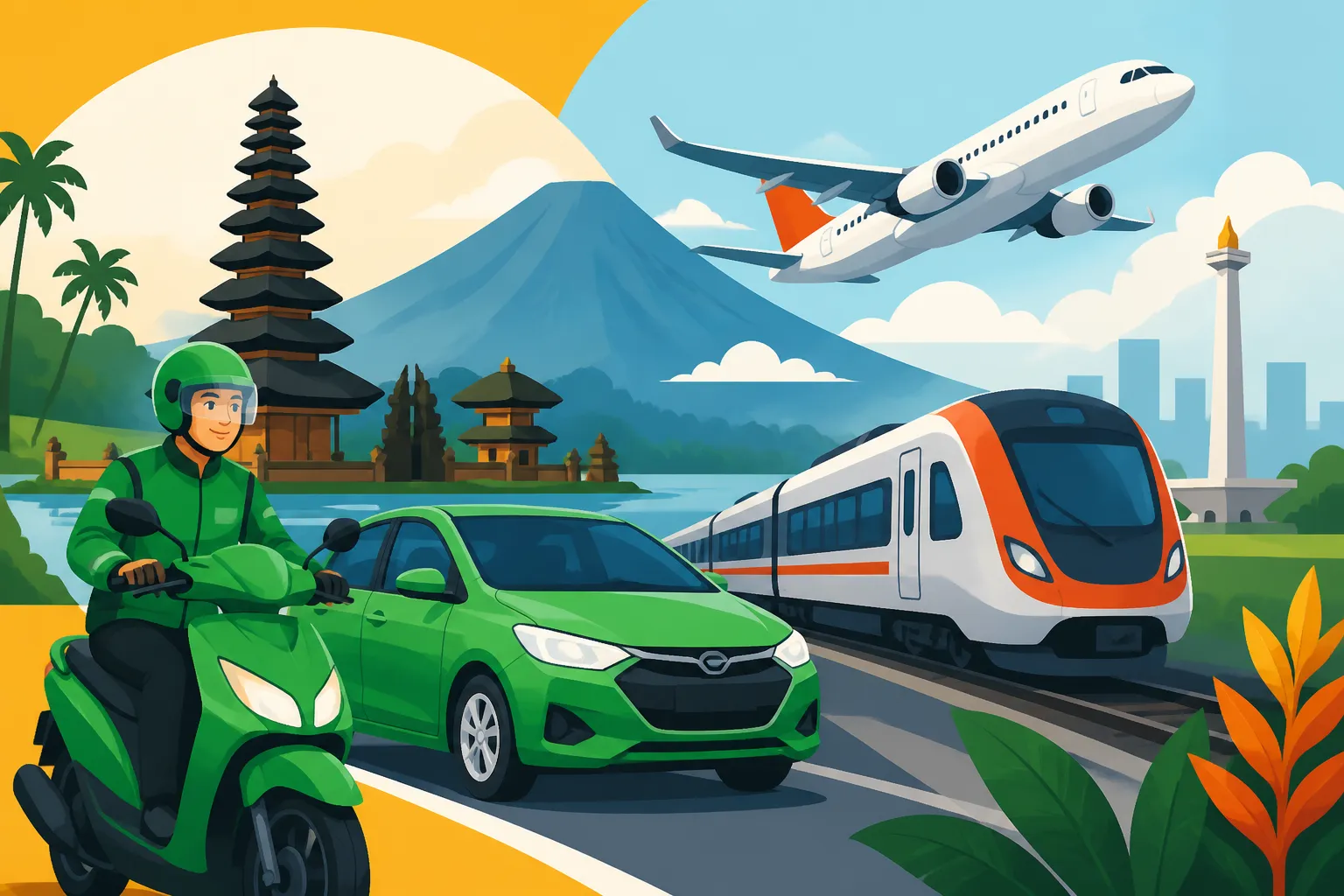
Transportation in Indonesia: Gojek, Grab, Trains, and Domestic Flights
One of the most overwhelming moments for any new resident in Indonesia is standing on a street corner in Jakarta, watching thousands of motorcycles weave through gridlocked traffic like a school of fish. I remember feeling completely paralyzed during my first week in the city, unsure if I would ever master the chaos. This guide breaks down every transportation option to help you move with confidence through the archipelago.
The Rise of Super-Apps: Navigating Gojek and Grab
The arrival of ride-hailing apps completely transformed the expat experience in Indonesia. Gone are the days of arguing with unmetered taxi drivers or trying to explain a complex destination in broken Bahasa Indonesia to a confused ojek (motorcycle taxi) driver on the corner. Today, Gojek and Grab are the twin pillars of urban mobility. These platforms are not just for transport; they are integrated into the very fabric of daily life. For a newcomer, downloading these apps is as essential as securing your KITAS.
When you first open these apps, the sheer number of services can be dizzying. For transportation, you will primarily use GoRide/GrabBike or GoCar/GrabCar. The motorcycle option is the ultimate "macet" (traffic jam) buster. If you have an appointment in the SCBD or Kuningan areas of Jakarta, a car might take 90 minutes for a 5-kilometer trip, whereas a bike can often do it in 15. I personally learned the hard way that trying to maintain a "professional" appearance in a car often leads to being late, whereas a motorcycle taxi gets you there on time, albeit with a bit of "helmet hair."
Beyond just getting from A to B, these apps handle the logistics of your entire household. You can use them for Navigating Gojek and Grab: Food Delivery, Transport, and Package Courier services, which is incredibly helpful when you need to move documents or small items across the city without leaving your office. The integration of payment systems like GoPay and OVO makes the experience cashless and seamless. To ensure you stay connected to these apps the moment you land, using a digital SIM from a provider like Airalo can save you the headache of hunting for a physical kiosk while stuck in airport arrivals.
Choosing Between GoCar and GrabCar
While both services offer standard and "XL" (6-seater) options, there are subtle differences in their ecosystems. Grab often has a wider reach in regional areas outside of Java, while Gojek remains the hometown hero with a deeply loyal user base in Jakarta. When booking a car, you will notice "Bluebird" as an option within the Gojek app. This is a massive advantage. Bluebird is the gold standard for traditional taxis in Indonesia, known for their reliability and professional drivers. If you book a Bluebird through the Gojek app, you get the fixed-price benefit of ride-sharing with the quality assurance of a veteran taxi fleet.
In my experience, if you are traveling with family or heavy luggage, always opt for the "XL" versions. Standard cars in Indonesia are often small MPVs like the Toyota Avanza, and if the driver has a large subwoofer or cleaning supplies in the trunk, your suitcases might not fit. Furthermore, during heavy tropical rainstorms, the demand for cars spikes instantly. Having both apps installed allows you to price-match and, more importantly, "driver-match" to see who can pick you up faster when the streets start to flood.
Another factor to consider is the "Plus" or "Premium" tiers. These typically guarantee a newer vehicle and a driver with high ratings. For business meetings where you need to arrive looking fresh and composed, the extra few thousand Rupiah is a worthy investment. I’ve often used the travel time in a GrabCar Premium to finish emails, as the drivers are generally more conservative with their horn usage and provide a smoother ride than the standard fleet.
The Ojek Experience: Faster Travel on Two Wheels
The "ojek" is the lifeblood of Indonesian transport. Before the apps, these were informal neighborhood riders. Now, they are a professionalized army in green jackets. Riding on the back of a motorcycle is an art form you will quickly learn. You must learn to sit "with" the bike, leaning slightly as the driver weaves between side mirrors. It is common practice for the driver to provide a helmet, though many long-term expats prefer to buy their own for hygiene reasons. You can easily find high-quality helmets on Shopee and have them delivered to your apartment within a day.
Safety is a common concern for newcomers. While the apps track every ride and offer emergency buttons, the reality of Jakarta or Bali traffic is inherently risky. Always ensure your helmet strap is clicked. If you are uncomfortable with the driver's speed, a simple "Pelan-pelan, Pak" (Slowly, Sir) usually does the trick. Most drivers are incredibly skilled at navigating the narrow "gang" (alleys) that cars simply cannot enter, which is often the secret to bypassing the main road gridlock.
One of the best tips for using motorcycle taxis is to carry a small "buff" or face mask. The pollution and dust on the main arteries can be intense, especially during the dry season. I’ve found that Commuting in Jakarta: Surviving the MRT, TransJakarta, and Macet (Traffic) is much more bearable when you are prepared with the right gear. After a few weeks, the thrill of zipping past a line of frustrated luxury cars while on the back of a 125cc scooter becomes strangely satisfying.
Beyond Transport: Food and Logistics Integration
The "Super-App" moniker isn't an exaggeration. During my first year, I used GoFood almost every night while I was still figuring out the local grocery stores. The ability to track your driver as they pick up your "Sate Ayam" and deliver it to your doorstep is a luxury that becomes a habit very quickly. The apps also offer "GoSend" or "GrabExpress," which are life-savers for expats. If you forget your keys at a friend's house or need to send a signed contract to a notary, you can hire a rider specifically for the delivery.
There is also a social etiquette to these apps. It is customary to tip your driver, especially during bad weather or late at night. A tip of 5,000 to 10,000 IDR (less than a dollar) is deeply appreciated and goes a long way for the driver's daily earnings. You can tip directly through the app after the ride is completed. This small gesture is part of the Everyday Etiquette: Religion, Culture, Garbage, and Community Norms that helps you integrate into the local community and build rapport with the service providers you rely on every day.
Finally, keep an eye on the "Subscription" or "Voucher" sections of the apps. If you are a frequent traveler, you can buy packs of discounted ride vouchers that significantly reduce your monthly transport budget. I usually top up my GoPay balance via my local bank app at the start of the month to ensure I never have to worry about carrying physical cash for my daily commutes.
Traveling by Rail: The Kereta Api Experience
The Indonesian railway system, managed by PT KAI, has undergone a massive modernization program over the last decade. If you haven't taken a train in Java recently, you are in for a pleasant surprise. The stations are clean, the booking system is digital, and the trains generally run on time—a stark contrast to the unpredictable nature of the roads. For many expats, taking the train from Jakarta to destinations like Yogyakarta, Surabaya, or Bandung is far more relaxing than flying or driving.
Booking tickets is best done through the "KAI Access" app or via third-party platforms like Agoda, which often integrates transport bookings with hotel stays. You will need your passport number for the booking, as security at the stations is strict. Upon arrival at the station, you simply scan your barcode at a kiosk to print your boarding pass. It’s a level of efficiency that I wish existed in every other government department.
The scenery from a Javanese train is nothing short of spectacular. As you leave the concrete jungle of Jakarta, you are treated to endless vistas of emerald-green rice paddies, volcanic peaks, and bustling rural villages. It is a side of the country you simply don't see from 30,000 feet. I always recommend the morning departures to maximize the view, as the tropical sun sets early, and once it’s dark, there isn't much to see out the window.
Understanding Classes: Executive, Business, and Economy
When booking, you will see three main classes: Eksekutif (Executive), Bisnis (Business), and Ekonomi (Economy). Executive class is the way to go for long-haul trips. The seats are plush, they recline significantly, and there is ample legroom even for taller expats. Each seat has a power outlet, which is crucial if you plan to work during the 8-hour journey to Yogyakarta. The air conditioning in Executive class can be notoriously cold, so always bring a light jacket or a "sarong" to stay comfortable.
Economy class has also improved significantly. The "Economy Premium" trains feature 2+2 seating and are quite comfortable for shorter journeys. However, the basic Economy (Ekonomi C) still uses bench-style seating where you may be facing other passengers. While it’s the cheapest way to travel, it can be a bit cramped for a long trip. I once took an 11-hour Economy ride to East Java to "save money," and I regretted it by hour three. The extra cost for Executive is almost always worth the physical comfort.
Onboard dining is another highlight. There is a "Kereta Makan" (Dining Car) where you can sit and eat, or you can order from your seat using the app or by flagging down the attendants. The menu usually includes Indonesian staples like Nasi Goreng and Bakso. While it’s not fine dining, there’s something quintessentially Indonesian about eating hot noodles while watching the volcanoes of Central Java pass by.
The High-Speed Whoosh: Jakarta to Bandung
The newest jewel in Indonesia’s transport crown is the "Whoosh" high-speed rail. Connecting Jakarta (Halim Station) to Bandung (Padalarang or Tegalluar), it has reduced a trip that could take three to five hours in traffic to just 45 minutes. It is a game-changer for those who live in the capital but want to escape to the cooler climates of Bandung for the weekend. The train reaches speeds of 350 km/h, and the ride is incredibly smooth—you can even balance a coin on its edge.
There are First Class, Business Class, and Premium Economy seats on the Whoosh. Even the Premium Economy is vastly superior to standard intercity trains. However, a key detail to remember is that the stations are located on the outskirts of the cities. From Halim, you can take the LRT, and from Padalarang, there is a dedicated "feeder train" that takes you into the heart of Bandung city. This multi-modal approach is the future of Indonesian transit.
The booking process for Whoosh is slightly different and can be done through its own dedicated app or website. Because it’s a popular weekend activity, tickets sell out fast, especially during "Tanggal Merah" (public holidays). I recommend booking at least a week in advance if you plan to travel on a Friday afternoon or Sunday evening. It’s a fantastic way to show visiting friends a different, more modern side of Indonesia.
Commuter Lines and LRT: Urban Mobility in Jakarta
For daily travel within the Greater Jakarta area (Jabodetabek), the KRL Commuter Line is the most efficient option. It connects the suburbs like Bogor, Depok, and Bekasi to the city center. It is incredibly cheap, often costing less than 10,000 IDR for a long journey. However, it is not for the faint of heart during rush hour. The "sardine-can" experience is real, and if you are sensitive to crowds, you might prefer to wait until the mid-day lull.
The MRT (Mass Rapid Transit) is the pride of Jakarta. It currently runs from Lebak Bulus in the south to Bundaran HI in the center. It is world-class: clean, air-conditioned, and perfectly on time. It has significantly increased the property value in areas like Cipete and Fatmawati. If you can find an apartment near an MRT station, your quality of life in Jakarta will improve exponentially. You can use a multi-trip card or even scan a QR code from the "MRT-J" app to enter.
The LRT (Light Rail Transit) is the newest addition, serving the eastern and southern suburbs. It integrates with the MRT and the Whoosh station at Halim. Navigating these systems requires a "Flazz" (BCA) or "e-money" (Mandiri) card, which you can top up at any Indomaret or Alfamart. Understanding how these links work is a major part of Healthcare in Indonesia for Foreign Residents: Complete System Overview (2027) as it allows you to reach major hospitals like RSUPN Dr. Cipto Mangunkusumo or Medistra without being at the mercy of road traffic.
Island Hopping: Mastering Domestic Flights
With over 17,000 islands, flying is often the only practical way to travel between major regions. The domestic aviation market in Indonesia is one of the busiest in the world. Whether you are heading to the beaches of Bali, the jungles of Kalimantan, or the diving spots in Labuan Bajo, you will likely spend a significant amount of time in Terminal 2 or 3 of Soekarno-Hatta International Airport.
The domestic flight landscape is divided between full-service carriers and Low-Cost Carriers (LCCs). Choosing the right airline depends on your budget and your tolerance for delays. While Indonesia’s aviation safety record has improved dramatically, it is still wise to stick with the major established groups. One thing to keep in mind is the "Waktu Indonesia" (Indonesian Time) phenomenon; delays are common, particularly in the afternoon when tropical thunderstorms can disrupt schedules.
When planning your trips, remember that the "peak season" in Indonesia revolves around Lebaran (Eid al-Fitr) and the Christmas/New Year period. During these times, flight prices can triple, and availability disappears months in advance. Use apps like Agoda to track prices and book early. To stay connected during your travels, an Airalo eSIM is a great way to avoid the often-flaky airport Wi-Fi while you are waiting for a connection.
Major Carriers vs. Low-Cost Airlines
Garuda Indonesia is the national flag carrier and the only full-service airline. It offers a generous baggage allowance, onboard meals, and generally flies out of the modern Terminal 3 in Jakarta. While it is more expensive, the peace of mind and the comfort are often worth it, especially for flights longer than two hours. Batik Air, part of the Lion Group, positions itself as a "bridge" between LCC and full-service, offering more legroom and sometimes snacks.
On the LCC side, Lion Air is the giant. They have the most extensive network, reaching even the smallest provincial airports. However, they are known for strict baggage rules and frequent schedule changes. Citilink (the budget arm of Garuda) and AirAsia are generally more popular with expats for their better customer service and punctuality. I’ve found that Citilink is often the "sweet spot" for flights between Jakarta and Bali—reliable enough for a weekend trip without the Garuda price tag.
Always pay attention to baggage allowances when booking. Most LCCs do not include checked luggage in the base fare. Buying your baggage allowance online at the time of booking is much cheaper than paying the "excess baggage" fees at the check-in counter. I’ve seen many tourists get caught out at the gate in Denpasar, paying more for their suitcase than they did for their seat.
Navigating Indonesian Airports: Tips for the Weary Expat
Soekarno-Hatta (CGK) in Jakarta is a sprawling complex. Terminal 3 is beautiful and easy to navigate, but Terminals 1 and 2 can feel a bit dated and chaotic. Always check which terminal your flight departs from, as a "terminal transfer" in Jakarta traffic can take 20 to 30 minutes even with the skytrain. If you have a morning flight, I highly recommend staying at an airport hotel the night before to avoid the early morning stress.
In Bali, Ngurah Rai International Airport (DPS) is much more compact but can be incredibly busy. The domestic and international terminals are within walking distance of each other. A pro-tip for Bali: the traffic around the airport can be legendary. If you are staying in Canggu or Uluwatu, give yourself at least two to three hours to reach the airport during the late afternoon.
When you arrive at a new airport, ignore the aggressive "freelance" drivers at the arrivals gate. Always look for the official taxi queue (Bluebird is best) or use your Gojek/Grab app to book a ride from the designated "Pick-up Point." In many airports, like Labuan Bajo or certain cities in Sumatra, there are local "transport cooperatives" that might prevent Grab/Gojek from picking up directly at the curb. You may have to walk a few hundred meters outside the airport gates to meet your app driver.
Baggage Policies and Hidden Fees
One of the most frustrating aspects of domestic travel is the "VAT" and "Airport Tax" which are now usually included in the ticket price but sometimes appear as additions in third-party bookings. Always check the final price before clicking "pay." Furthermore, if you are carrying sports equipment like surfboards or diving gear, check the airline's specific policy. Some carriers, like Garuda and Citilink, often have seasonal promotions for free sporting equipment, while Lion Air will charge you by the kilo.
Another "hidden" cost can be the transit time. If you are flying to a remote location like Raja Ampat, you might have an overnight layover in Makassar or Sorong. Factoring in the cost of a transit hotel and meals is essential for your Healthcare Budgeting: BPJS Caps, Out-of-Pocket Costs, and Private Copays strategy, as you want to keep your emergency funds intact for medical needs rather than spending them on unplanned travel delays.
Lastly, always have a digital and physical copy of your KITAS or passport. While the "SatuSehat" app used to be mandatory for health checks, requirements have eased. However, security personnel will always check your ID against your boarding pass multiple times before you even reach the gate. Being organized saves you from the "sweaty panic" of digging through your bag while a line of people waits behind you.
Driving Yourself: Licenses and Road Realities
For many expats, especially those living in Bali or the suburbs of Jakarta, the desire for independence leads them to get behind the wheel. However, driving in Indonesia is a high-stakes game of spatial awareness and cultural understanding. The "rules of the road" are often more like suggestions, and the hierarchy of the road is determined by size: trucks yield to no one, and motorcycles are like water, flowing into every available gap.
If you choose to drive, you must do so legally. This means having the correct Indonesian license (SIM). Many expats rely on an International Driving Permit (IDP), but these are only valid for a limited time and must be accompanied by your home country license. If you are on a KITAS, the best move is to get a local SIM A (for cars) or SIM C (for motorcycles). The process for Converting a Foreign Driving License to an Indonesian SIM A or SIM C has become more streamlined but still requires a visit to the "Satpas" (Police Licensing Center).
Insurance is another critical factor. Most rental cars come with basic insurance, but the "deductible" can be high. If you own a vehicle, ensuring you have "Comprehensive" (All Risk) insurance is vital. In the event of an accident involving a local resident, the unwritten rule is that the "wealthier" party (often the expat) is expected to contribute to repairs or medical costs, regardless of who was technically at fault. Having a good insurance agent can help mediate these stressful situations.
Obtaining an Indonesian Driving License
The journey to getting your SIM usually involves a morning at the police station, a simple medical check (eyes and blood pressure), and sometimes a theory/practical test. I highly recommend using a "Biro Jasa" (service agency) to help navigate the paperwork, especially if your Bahasa Indonesia is not yet fluent. They can ensure your documents are in order and help you move through the various windows at the Satpas more efficiently.
You will need your original passport, KITAS, a copy of your blood type, and a few photos. The license is typically valid for five years (linked to your KITAS validity) and can be used as a primary form of ID within Indonesia. This is incredibly helpful for domestic flights and hotel check-ins, allowing you to leave your passport safely at home. For those in Bali, the rules are often stricter due to the high volume of tourists, so ensure you understand the Driving Legally: International Driving Permits (IDP) Validity in Bali requirements to avoid being fined at a police checkpoint.
One thing to note: as of 2025/2026, Indonesian driver's licenses are increasingly recognized across ASEAN countries. This adds a layer of value to your SIM, making it easier to rent a car during a weekend trip to Thailand or Malaysia. Just remember that in Indonesia, we drive on the left side of the road—though you will often see motorcycles coming at you from every direction regardless of the lane.
The Chaos of Indonesian Traffic (Macet)
"Macet" is not just a word; it is a lifestyle. In Jakarta, the traffic can be so dense that you might move only one kilometer in 30 minutes. The city has implemented an "Odd-Even" (Ganjil-Genap) system on major roads to combat this. This means only cars with license plates ending in an odd number can drive on certain roads on odd-numbered dates, and vice versa. Expats often buy two cars or alternate with ride-hailing services to navigate this rule.
In Bali, the traffic is less about volume and more about infrastructure. The roads are narrow, and a single "upacara" (religious ceremony) can close a main artery for hours. This is where patience becomes your most valuable asset. Honking is common but rarely aggressive; it’s more of a "I’m here" signal. Learning to navigate these quirks is part of the Everyday Etiquette: Religion, Culture, Garbage, and Community Norms you’ll need to master.
I’ve found that using Waze or Google Maps is mandatory. These apps are surprisingly accurate at predicting "macet" and suggesting "jalan tikus" (mouse paths)—the narrow alleys that bypass the main gridlock. However, be careful; sometimes these paths lead to bridges that are too narrow for a car, leaving you in the embarrassing position of having to reverse out while a dozen motorcyclists wait for you.
Renting vs. Buying a Vehicle
For short-term stays (under a year), renting is definitely the way to go. You can rent a decent scooter in Bali for about 1.5 to 2 million IDR per month, which includes maintenance. For cars, monthly rentals can range from 5 million to 15 million IDR depending on the model. The advantage is that the rental agency handles the "Pajak" (annual tax) and repairs. If the AC stops working—a common tropical malady—you just swap the car for a new one.
If you are here for the long haul, buying might make financial sense. However, as a foreigner, you cannot technically own a vehicle in your name unless you have a KITAS. The registration (STNK) and ownership book (BPKB) will be tied to your ID. When buying used, ensure the "Buku Servis" is up to date, as the humidity and dust can be hard on engines. You can find many listings on Shopee or Facebook Marketplace, but always bring a trusted mechanic to inspect the vehicle before paying.
For those choosing the two-wheeled life, please prioritize safety. Bali has a high rate of scooter accidents involving foreigners. Before you jump on a N-Max, make sure you are comfortable with the weight of the bike and the slickness of the roads after a rainstorm. I always recommend Renting a Scooter in Bali: Avoiding Fines, Helmet Laws, and Police Checks as a starting point for anyone new to the island to avoid the common pitfalls of the "holiday" mindset.
Comparison of Transport Modes in Indonesia
| Mode | Cost | Speed in Traffic | Comfort Level | Best For |
|---|---|---|---|---|
| GoRide/GrabBike | Low | Very High | Low | Solo travelers, beating "macet" |
| Bluebird/GoCar | Medium | Low | High | Families, rainy weather, meetings |
| MRT (Jakarta) | Very Low | High | High | Commuting south to central Jakarta |
| Intercity Train | Medium | High | High | Traveling across Java (e.g., Jakarta to Jogja) |
| Domestic Flight | High | Very High | Medium | Island hopping (e.g., Bali to Labuan Bajo) |
| Whoosh (HSR) | Medium-High | Very High | Very High | Jakarta to Bandung trips |
Public Ferries and Sea Travel
As an archipelagic nation, the sea is the original highway of Indonesia. While flying is faster, traveling by sea is an adventure that offers a glimpse into the vastness of the country. For many expats, sea travel is usually limited to short-distance speedboats between Bali and the Gili Islands or Lombok. However, for the truly adventurous, the PELNI ships offer routes that span the entire length of the country, from Medan to Merauke.
Safety standards for sea travel vary wildly. The large PELNI ships are generally stable and safe, but small local speedboats can sometimes be overloaded or lack sufficient life jackets. Always check the weather forecast before a crossing. During the "Barat" (West) monsoon season, waves in the Bali Strait or the Java Sea can become dangerous, and ferry services are often suspended.
If you are planning a boat trip, remember to pack motion sickness tablets. Even the most seasoned sailors can be humbled by the swells of the Indian Ocean. I also recommend booking through reputable companies for the Bali-Gili routes. While the "cheap" boats at the harbor might save you 100,000 IDR, the safety and comfort of the established operators like Blue Water Express or Eka Jaya are worth the premium.
PELNI: The Giant of the Seas
PELNI is the state-owned shipping line. Their ships are massive, carrying thousands of passengers and tons of cargo. For an expat, booking a 1st or 2nd-class cabin on a PELNI ship is a bucket-list experience. You get a private room with a bed and a bathroom, and meals are included. It’s not a luxury cruise—think of it more as a floating dormitory—but it’s an incredible way to see remote islands like the Bandas or the Raja Ampat archipelago without the high cost of a liveaboard.
Booking PELNI tickets can be done online or at their offices. The schedules are more of a "guide" than a certainty; ships can be delayed by days due to loading requirements or weather. If you have a fixed schedule, PELNI is not for you. But if you have time and a spirit of adventure, watching the sunrise over the Makassar Strait from the deck of a PELNI liner is a memory you won't soon forget.
One tip: the "Economy" class on PELNI is a vast open deck with thousands of mattresses. It is an intense cultural experience but offers zero privacy. If you are traveling as a foreigner, the 1st-class cabins are highly recommended for security and comfort. Always keep your valuables with you, and use a sturdy lock on your luggage.
Speedboats and Local Ferries (ASDP)
The ASDP ferries (the large "roll-on/roll-off" boats) connect the main islands. The crossing from Ketapang (Java) to Gilimanuk (Bali) runs 24/7 and takes about 45 minutes. It is the primary artery for food and supplies entering Bali. You can simply drive your car or scooter onto the ferry, pay the fee with an e-money card, and head up to the passenger deck. It’s a seamless and very cheap process.
Speedboats are the standard for tourist routes. The trip from Padang Bai in Bali to the Gili Islands takes about 1.5 to 2 hours. These boats can be quite bumpy, as they "slam" over the waves at high speeds. If you have back issues, try to sit at the rear of the boat where the impact is less severe. Many of these operators also offer pickup services from your hotel in Kuta or Seminyak, which you can often book via Agoda or directly through their websites.
For those staying in the Thousand Islands (Kepulauan Seribu) off the coast of Jakarta, speedboats depart from Marina Ancol. It’s a great weekend escape from the city. The water quality improves dramatically as you get further from the mainland. Just remember to bring your own sunscreen and bug spray, as prices on the smaller islands can be significantly marked up.
Intercity Buses and Private Travel
Before the trains were modernized, the intercity bus was the king of the road. Even today, for routes not served by rail—such as those across Sumatra or to the remote parts of Bali—the bus is a vital option. The industry has seen a "luxury" revolution recently, with "Sleeper Buses" becoming a popular way to travel long distances in comfort.
Private "Travel" (shuttles) are another common option. These are typically Toyota HiAce vans that run point-to-point between cities like Jakarta and Bandung or Surabaya and Malang. They are faster than the large buses because they can take the toll roads and offer "door-to-door" service in some cases. It’s a middle-ground between a private car and a public bus.
When booking a long-distance bus, always look for "Executive" or "Super Executive" classes. These offer reclining seats with leg rests, on-board toilets, and sometimes even a snack box. Brands like Rosalia Indah, Gunung Harta, and Primajasa have loyal followings for their safety and service standards. You can use apps like RedBus or Traveloka to compare routes and book your seat in advance.
Executive Buses: The Luxury Sleeper Trend
The sleeper bus is a revelation. Instead of a seat, you get a fully reclining pod with a pillow, a blanket, and your own entertainment screen. It’s essentially a "Business Class" airplane seat on wheels. For a trip from Jakarta to Yogyakarta, you can board at 8 PM, sleep through the night, and arrive refreshed at 6 AM. It saves you the cost of a hotel night and is often more comfortable than the train.
Safety is the main concern with buses, as drivers are sometimes under pressure to meet tight deadlines. Stick to the reputable companies mentioned above, as they usually have speed limiters and two drivers for long-haul routes. I’ve found that the newer toll roads (Trans-Java Toll) have made bus travel much smoother and faster than it used to be.
One cultural note: buses will often stop at a "Rumah Makan" (large roadside restaurant) in the middle of the night. Even if you aren't hungry, it’s a good time to stretch your legs and use a proper restroom. The food at these stops is usually a pre-set "buffet" style included in your ticket price—just show your coupon to the staff.
Travel (Shuttles): Point-to-Point Convenience
The "Travel" shuttle is the expat's favorite for the Jakarta-Bandung route. Companies like DayTrans, Cititrans, and Jackal Holidays have departure points in SCBD, Senayan, and Kuningan. They are punctual, air-conditioned, and use the toll roads. You can book a specific seat (I recommend the one next to the driver for the most legroom).
The main downside of the shuttle is the luggage space. If you are moving house or have several large suitcases, a HiAce van will not have enough room. You might be asked to buy an extra seat for your bags. For a simple weekend trip with a backpack, however, it is the most efficient way to travel. I’ve often used the Wi-Fi on these shuttles to stay productive during the two-hour trip to Bandung.
In more remote areas, the "Travel" might be a regular car (like an Avanza) that picks up several passengers along a route. This is common in Sumatra and Sulawesi. It’s a bit more "intimate" than a bus, and you’ll likely end up chatting with your fellow passengers—a great way to practice your Bahasa Indonesia. Just be prepared for some spirited driving!
Logistics and Safety for the Foreign Resident
Navigating Indonesian transport is as much about mindset as it is about mechanics. You must accept that things will not always go according to plan. A sudden downpour can turn a 20-minute trip into a 2-hour odyssey. A religious procession can close the only road to the airport. Building a "buffer" into your schedule is the single most important piece of advice I can give.
Safety is also about being proactive. Whether you are using a Gojek or a private car, always share your live location with a friend or spouse. Most apps have this feature built-in. If you are driving yourself, keep your doors locked and your windows up in heavy traffic to prevent opportunistic petty theft. While Indonesia is generally very safe, "macet" provides a window for "snatch-and-grab" incidents, particularly with mobile phones.
Finally, keep your Emergency Numbers in Indonesia: 118/119 for Ambulance and What to Expect saved in your phone. In the event of a transport-related accident, knowing who to call can make a critical difference. Most major hospitals in Jakarta and Bali have their own private ambulance services which are often faster than the public 119 system.
Payment Ecosystems: QRIS and Cash
While Indonesia is rapidly moving toward a cashless society, having some "Uang Tunai" (cash) is still necessary for smaller transport needs. If you are taking an angkot (local micro-bus) or paying for parking (which is everywhere), you will need small 2,000 or 5,000 IDR notes. Most "Parkir" attendants are informal but essential—they help you back out into busy traffic, and the small fee is a standard part of the driving culture.
For everything else, QRIS (Quick Response Code Indonesian Standard) is the king. You can use your local bank app (like BCA Mobile or Livin' by Mandiri) or your e-wallet (GoPay, OVO) to scan a QR code almost anywhere—even at some small ferry terminals or bus kiosks. It has made traveling so much easier for expats who don't want to carry a thick wallet of Rupiah.
If you are still waiting for your local bank account to be opened, some e-wallets can be linked to international cards, but it can be finicky. This is why many newcomers find Opening a Bank Account in Indonesia: Document Checklists (KITAS, NPWP, Passport) to be a top priority within their first month. Having a local debit card makes topping up your transport apps and paying for tolls a breeze.
Managing Travel During Holidays
The "Mudik" season—the mass exodus of people from cities to their hometowns during Lebaran—is the most challenging time to travel. Millions of people are on the move simultaneously. Toll roads become parking lots, and tickets for trains and flights are sold out months in advance. If you don't need to travel during this time, I highly recommend staying put in Jakarta. The city becomes strangely quiet and empty, which is a rare treat.
During Nyepi (the Day of Silence) in Bali, the entire island shuts down, including the airport and all ferry terminals. No one is allowed on the streets, and even lights must be kept to a minimum. This is a unique aspect of Understanding the Balinese Calendar: Nyepi (Day of Silence) Rules for Expats that you must plan for. Ensure you have enough supplies at home, as there is absolutely no transportation available for 24 hours.
By understanding these rhythms and tools, you can turn the logistical challenge of Indonesian transportation into a manageable, and even enjoyable, part of your life. Whether you are zipping through Jakarta on a Gojek or watching the sunrise from a PELNI ship, every journey is a chance to see more of this incredible country.
Disclaimer
The information provided in this guide is for informational purposes only and does not constitute legal or professional advice. Transportation regulations, app features, and safety protocols in Indonesia are subject to change. Always verify current requirements with official government sources or registered service providers before making travel arrangements. Regardless of the transport mode chosen, individual travelers are responsible for their own safety and compliance with local laws.