Driving in Indonesia: Getting a SIM A/C License and Traffic Realities
The sheer sensory overload of an Indonesian intersection—a swirling vortex of thousands of motorbikes, colorful public minivans, and luxury SUVs—can make even the most seasoned driver’s heart race. I remember my first week in Jakarta, staring at the gridlock and wondering if I’d ever have the courage to touch a steering wheel here. This guide breaks down the administrative maze and the cultural nuances of driving in Indonesia so you can navigate the roads with confidence and legality.
Understanding the Indonesian Driving Landscape: More Than Just Chaos
If you are coming from a country with strict lane discipline and predictable driver behavior, the first thing you need to do is unlearn everything you know. Driving in Indonesia is a communal exercise in fluidity. It is less about following a rigid set of rules and more about understanding the rhythm of the road. People will merge without looking, motorbikes will fill every square inch of available space, and the horn is used as a polite "I am here" rather than an expression of rage.
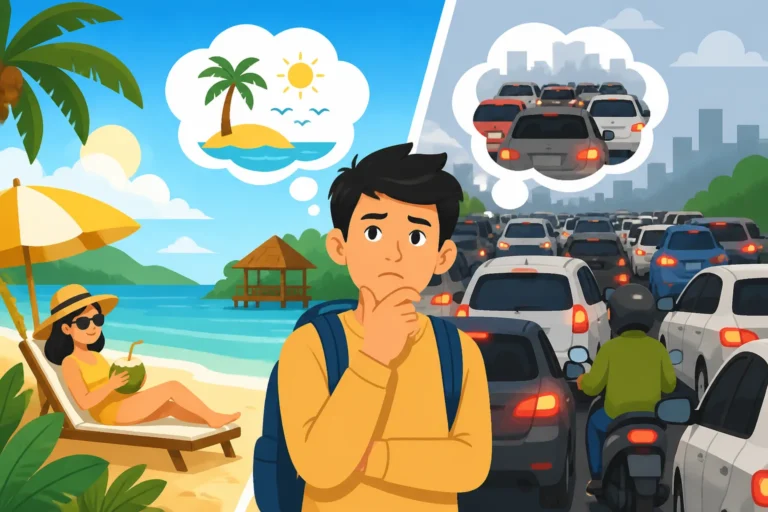
In cities like Jakarta and Surabaya, the primary challenge is the "macet," or traffic jam. You might find yourself moving only three kilometers in an hour. During these times, having a reliable data connection via Airalo is essential for keeping your navigation apps like Google Maps or Waze updated with real-time traffic data and alternative routes. Without these tools, you are essentially flying blind in a concrete maze.
Outside the major urban hubs, the challenges shift. In Bali or Yogyakarta, roads become significantly narrower. A two-way street might barely be wide enough for two small cars to pass each other, requiring one driver to pull over into a driveway to let the other through. This is where the local "gotong royong" (mutual cooperation) spirit manifests on the road. You will find that most drivers are surprisingly patient, even in situations that would cause a breakdown in Western traffic.
The Philosophy of the Flow
There is an unspoken social contract on Indonesian roads. The largest vehicle usually has the right of way, but the smallest vehicles (the motorbikes) are the most agile. As a car driver, you are expected to be the "big brother," constantly watching out for the "little brothers" on two wheels who will inevitably zip across your front bumper. It is not about who is legally right; it’s about keeping the flow moving.
I’ve spent years observing how "Pak Ogah"—the unofficial traffic directors who stand at U-turns and intersections—manage the chaos. They aren't police, just local residents who help clear a path for a few small coins. Learning to work with these individuals is part of the local driving etiquette. They provide a service that the official infrastructure often can’t, and a small tip of a few thousand Rupiah goes a long way in ensuring you are let into a busy lane.
Regional Differences: Jakarta vs. Bali vs. Rural
Driving in Jakarta is a high-stakes game of endurance and technical skill. You have to navigate the "Odd-Even" (Ganjil-Genap) rule, where only cars with certain license plate endings can enter specific zones on specific days. This requires meticulous planning. In contrast, driving in Bali is more about navigating terrain and tourists. The roads are often shared with religious processions and ceremonies that can bring traffic to a standstill for thirty minutes without warning.
In rural areas, the "road" might suddenly turn into a dirt path or be blocked by a herd of cows or drying cloves on a tarp. Here, your speed should drop significantly. Local villagers often use the road as an extension of their living space. You must remain hyper-aware of children playing or elderly residents crossing slowly. It’s a slower pace of life, and your driving should reflect that.
Decoding the Indonesian Driver's License: SIM A vs. SIM C
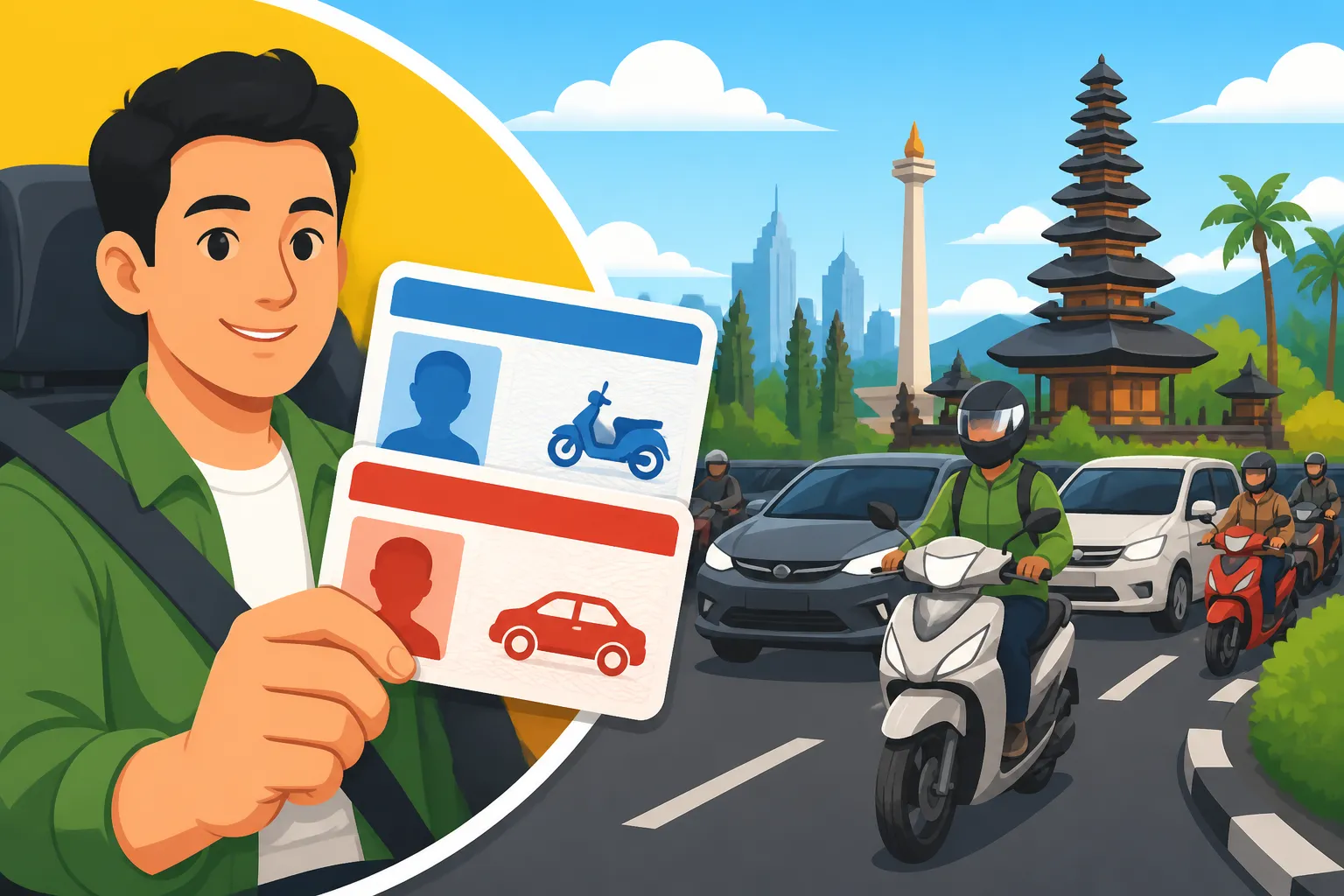
To drive legally in Indonesia as a resident, you need a Surat Izin Mengemudi (SIM). For most expats, there are two primary categories you need to care about: SIM A and SIM C. Unlike many countries where one license covers almost everything, Indonesia is very specific about the type of vehicle you are permitted to operate.
If you plan on driving a standard passenger car, you must obtain a SIM A. If you are tempted by the convenience of a scooter—which is often the only way to get around places like Canggu or Uluwatu efficiently—you need a SIM C. It is a common mistake for foreigners to assume their car license at home allows them to ride a 150cc NMax scooter. It does not. If you are caught by a "razia" (police checkpoint) without the correct category, you will face fines or vehicle impoundment.
The eligibility for these licenses usually requires a KITAS (Limited Stay Permit) or a KITAP (Permanent Stay Permit). In 2026, the integration of the NIK (National Identity Number) into the driving license system has made the process more streamlined but also more strictly monitored. You cannot simply "buy" a license as easily as some outdated blogs might suggest; the system is increasingly digital and tied to your immigration status.
SIM A for Cars: The Requirements
To get your SIM A, you need to be at least 17 years old and possess a valid passport and residency permit. The police will require a "Surat Keterangan Sehat" (Health Certificate) and a psychological evaluation (Tes Psikologi). These are usually available at small clinics located right next to the SATPAS (Satuan Penyelenggara Administrasi SIM) offices.
The health check is rudimentary—usually just an eye exam and a blood pressure check—but it is a mandatory step in the bureaucracy. For more information on the documentation needed for your stay, you might want to look into Visas and Permits in Indonesia: The Complete Expat Guide (2027) to ensure your underlying residency is in order before approaching the police department.
SIM C for Motorcycles: Crucial for Bali
The motorcycle license, SIM C, has recently been subdivided into three categories based on engine capacity (C, C1, and C2). Most expat scooters fall under the standard SIM C (up to 250cc). The practical exam for SIM C is notoriously tricky, involving a series of tight turns and "figure-eight" maneuvers on a narrow track.
I remember failing my first attempt because I put my foot down during a sharp U-turn. It’s a test of balance more than speed. If you are staying in Bali, you should check out Renting a Scooter in Bali: Avoiding Fines, Helmet Laws, and Police Checks to understand why having this specific license is so important for your insurance coverage and local compliance.
The 2026 Digital Update: Smart SIM
Indonesia has fully transitioned to the "Smart SIM." This card isn't just a license; it also functions as an e-money card that you can top up to pay for tolls or parking. This is incredibly convenient for expats. When you are shopping for accessories for your new vehicle on Shopee, make sure to get a cardholder that attaches to your keychain so you never forget your SIM when switching between cars and bikes.
The Smart SIM also records traffic violations electronically. In the past, you might have been able to talk your way out of a ticket, but with the "Electronic Traffic Law Enforcement" (ETLE) cameras now ubiquitous in major cities, your SIM data is linked to your vehicle’s registration. Fines are sent via WhatsApp or mail, and failure to pay can lead to your license being blocked during renewal.
The Step-by-Step Guide to Getting Your Local SIM License
The process of getting a license can take anywhere from a few hours to a full day, depending on the crowd. It is best to arrive at the SATPAS office as early as possible—usually by 7:30 AM. Dress appropriately; this is a government office, so avoid flip-flops, shorts, or sleeveless shirts, or you may be denied entry.
The journey begins at the registration desk where you present your documents. You will be given a folder and sent to various stations: first for the health check, then for the psychology test, and finally to the payment window. Once the fees are paid, you move to the "Theory Room." In many major cities, there are now English-language options for the digital theory test, though the translations can sometimes be a bit "creative."
After passing the theory, you head to the field for the practical exam. If you are applying for a car license, you will demonstrate basic maneuvers like parallel parking, reversing in a straight line, and stopping/starting on an incline. If you pass, you proceed to the final step: the photo and fingerprinting booth. Within thirty minutes of the photo being taken, your brand-new SIM card is usually printed and ready.
Visiting the SATPAS Police Office
Each city has its own SATPAS. In Jakarta, the main office is in Daan Mogot, which is massive and can be overwhelming. In Bali, the Denpasar office is the hub for most residents. Navigating these offices requires patience and a basic grasp of Bahasa Indonesia. If your language skills are still developing, bringing a local friend or a driver can make the day significantly smoother.
For a deeper dive into the specifics of these visits, I recommend reading Getting SIM A and C: Age Requirements, Medical Checks, and SATPAS Police Visits. It covers the exact fees you should expect to pay officially, helping you avoid overpaying to "helpers" who hang around the entrance.
The Theory and Practical Exams
The theory exam consists of about 30 questions on a touchscreen computer. You’ll need to answer at least 70% correctly. The questions cover road signs, right-of-way, and emergency procedures. Some are common sense, while others are specific to Indonesian law, such as the rules regarding "convoys" or the specific distances required for signaling before a turn.
The practical exam is where most people get nervous. For the car test, you usually use a manual transmission vehicle provided by the police. If you only know how to drive an automatic, you should practice with a manual beforehand or check if your local SATPAS has an "Automatic Only" option, which is becoming more common but is not yet universal.
Fees and Processing Times
The official fee for a new SIM A is typically around IDR 120,000, and for SIM C, it’s IDR 100,000. However, you must also factor in the cost of the health certificate (IDR 25,000–50,000) and the psychology test (IDR 50,000–75,000). While the total is quite affordable, the "time cost" is the real investment.
If you don’t have a full day to spare, there are "agents" or "biro jasa" who can facilitate the process for a higher fee. They can’t bypass the photo or fingerprints, but they can often help you move through the queues faster. Just ensure you are using a reputable agency to avoid getting a counterfeit card, which is a serious criminal offense.
Foreign License Conversion and the International Driving Permit (IDP)
If you are only in Indonesia for a short stint or haven't yet secured your residency permits, you cannot get a local SIM. In this case, you must rely on your foreign license in conjunction with an International Driving Permit (IDP). It is a major misconception that a foreign license alone is enough. Without the IDP, you are driving illegally.
The IDP must be issued in your home country before you arrive. It essentially acts as a translation and verification of your home license. Police at checkpoints will ask for both. If you are planning a road trip and booking accommodations through Agoda, always ensure you have these documents packed, as you are much more likely to be stopped by police when driving a rental car or bike in tourist areas.
The Validity of Your Home Country License
Starting in 2025 and fully implemented in 2026, there has been a significant shift in regional policy. Under the ASEAN Mutual Recognition Agreement, domestic driving licenses from ASEAN member states (including Singapore, Malaysia, Thailand, and the Philippines) are now valid in Indonesia without an IDP. This is a game-changer for regional expats.
However, if your license is from the US, UK, Australia, or Europe, the IDP remains mandatory. You can read more about these updates in Indonesian Driver's Licenses Are Now Valid Across ASEAN (2025/2026 Rules). This article explains the technicalities of the reciprocity and which specific license classes are covered.
Using Agencies to Streamline the Process
For many expats, the prospect of spending a day at a police station is unappealing. There are many reputable agencies, especially in Bali and Jakarta, that specialize in license conversions for KITAS holders. They handle the paperwork, schedule your "VIP" appointment for photos, and ensure all your documents are legalized.
The cost for these services can range from IDR 1,000,000 to IDR 3,000,000, but for many, the time saved is well worth the expense. For a comparison of your options, check out Converting a Foreign Driving License to an Indonesian SIM A or SIM C. It’s also important to know the limitations of these permits, which you can find in Driving Legally: International Driving Permits (IDP) Validity in Bali.
| Document Type | Eligibility | Validity Period | Recommended For |
|---|---|---|---|
| Local SIM (A/C) | KITAS/KITAP Holders | 5 Years | Long-term Residents |
| IDP + Foreign License | Tourists/Social Visas | Duration of IDP | Short-term Visitors |
| ASEAN License | ASEAN Citizens | As per home license | Regional Expats |
| Smart SIM | Residents | 5 Years | Those needing e-money/toll features |
Essential Rules of the Road and Traffic Realities
In Indonesia, you drive on the left side of the road. This can be an adjustment for those from North America or Europe. Beyond the side of the road, the most important "rule" is spatial awareness. You are responsible for everything that happens in the 180 degrees in front of you. If you hit someone from behind, it is almost always considered your fault, regardless of how suddenly they stopped.
Traffic lights are generally followed in big cities, but in smaller towns, they are often treated as "suggestions" during late hours. One unique rule is that you are often allowed to turn left at a red light unless a sign specifically says "Belok Kiri Jalan Terus" (Keep going left) or "Belok Kiri Ikuti Lampu" (Follow the light for left turns). When in doubt, watch what the locals are doing.
The Role of the "Pak Ogah"
As mentioned earlier, the "Pak Ogah" is a staple of Indonesian roads. These men stand at gaps in the central median or at busy intersections where there is no traffic light. They use hand signals and sometimes whistles to stop traffic and let you out. While technically unofficial, they perform a vital function.
When you use their help, it is customary to pass a small coin (IDR 1,000 or 2,000) out the window. You don’t need to stop; just a quick hand-off as you drive past. It’s a small price to pay for avoiding a fifteen-minute wait to turn into a busy stream of traffic.
Navigating the "Odd-Even" Rule
Jakarta’s "Ganjil-Genap" system is a major hurdle. It applies during morning and evening rush hours on most main arteries. If today’s date is the 21st (an odd number), only cars with license plates ending in 1, 3, 5, 7, or 9 are allowed. If you violate this, the ETLE cameras will catch you, and the fine is substantial.
Most navigation apps now have a setting where you can input your license plate number, and they will automatically route you around restricted zones. Always double-check this setting before you leave your driveway. If you are new to the city, check Jakarta Public Transport: MRT, LRT, and Commuter Line Guide for Expats as an alternative for days when your car isn't allowed on the road.
Vehicle Ownership, Insurance, and Maintenance for Expats
Buying a car in Indonesia as an expat is possible if you have a KITAS. The vehicle's registration (STNK) and the ownership book (BPKB) can be in your name. However, many expats choose to lease or rent long-term to avoid the hassle of depreciation and the complex process of selling the vehicle when they eventually leave.
If you decide to buy, be prepared for high taxes on imported vehicles. Most expats stick to locally assembled brands like Toyota, Honda, or Mitsubishi because parts are cheap and every "bengkel" (repair shop) knows how to fix them. For those looking to purchase, Buying and Registering a Car or Scooter in Indonesia on a KITAS provides a comprehensive checklist of the taxes and paperwork involved.
Insurance Realities: Comprehensive vs. TLO
Insurance is not mandatory for private vehicles in Indonesia, but for an expat, it is essential. There are two types: "All Risk" (Comprehensive) and "Total Loss Only" (TLO). TLO only pays out if the car is stolen or damaged beyond 75% of its value. For most, the "All Risk" policy is the better choice, as it covers minor dents and scratches—which are almost guaranteed in Indonesian traffic.
Always check if your policy includes "Third Party Liability" (TPL). In the event of an accident involving a local resident, having an insurance company handle the negotiations and compensation can save you from a very stressful and potentially expensive personal confrontation.
Annual Taxes and the "Samsat"
Every year, you must pay the "Pajak Kendaraan Bermotor" (Motor Vehicle Tax). You take your STNK and BPKB to a Samsat office or a "Samsat Drive-Thru." Much of this can be done via mobile apps like "Signal," but as an expat, you may still need to visit in person the first time to verify your documents. Failure to pay means your vehicle is not "road legal," and police will check for the annual sticker during razias. Detailed steps can be found in Annual Vehicle Taxes (Pajak Kendaraan): How to Pay at Samsat.
Navigating Accidents, Police Interactions, and Safety
Accidents happen. If you are involved in a minor fender bender, the first rule is to stay calm. Do not start shouting. In Indonesian culture, maintaining "cool head" (kepala dingin) is the best way to resolve a conflict. Often, both parties will pull over, assess the damage, and agree on a cash settlement right there.
If the accident is more serious, you must call the police. However, be aware that as a foreigner, there is often an underlying assumption that you have more money, and you may be pressured to pay more than a local would. This is where having a dashcam—which you can easily find on Shopee—is a lifesaver. Video evidence is hard to argue with and can protect you from false claims.
Police Stops and Roadside Checks
Police checkpoints are common, especially in Bali. They are usually looking for three things: a valid license, a valid STNK (registration), and a helmet (for motorcyclists). If you have all three, the interaction will be brief. Always be polite and respectful.
If you are missing a document, the officer may issue a "Tilang" (ticket) and confiscate your license until you pay the fine at a court or bank. Some officers might hint at a "faster" way to solve the problem (uang damai). While common in the past, the government is cracking down on this, and it is always safer and more ethical to ask for the official ticket.
Safety Gear and the "Sopan" Factor
In Bali, there is a tendency for tourists to ride scooters in bikinis or without helmets. Not only is this dangerous, but it is also deeply disrespectful to the local culture. It’s called "tidak sopan" (impolite). In 2026, Bali police have become much stricter, and you will be fined or stopped for improper attire or lack of a helmet. Always wear a helmet, and keep a "jas hujan" (raincoat) under your seat for the inevitable tropical downpours.
Practical Tips for Stress-Free Commuting
One of the best decisions I ever made was knowing when not to drive. On days when I have important meetings or if I'm heading into the heart of Jakarta's SCBD during rush hour, I hire a driver or use a ride-hailing app. It allows me to work from the backseat rather than losing my sanity in traffic.
If you are a family with children, Managing a Full-Time Driver: Providing Meals, Overtime, and Responsibilities is a must-read. Having a dedicated driver is surprisingly affordable and acts as a massive stress-reducer. They handle the maintenance, the parking, and the navigation, leaving you to enjoy the scenery.
Using Navigation Apps Effectively
Google Maps is excellent for "Estimated Time of Arrival," but Waze is often better for real-time alerts about police checkpoints, potholes, or flooded roads. In the rainy season, "banjir" (floods) can render certain roads impassable in minutes. Always trust the app if it tells you to take a bizarre-looking side street; it’s usually trying to save you from a three-hour standstill.
Surviving the Heat and Rain
Driving a car with a malfunctioning AC is a nightmare in the 35-degree Indonesian humidity. Regular maintenance is key. For motorcyclists, the rain is the biggest challenge. When a storm hits, you will see hundreds of bikers pulling over under overpasses. Don't try to be a hero; the roads become incredibly slippery as oil and dust mix with the first few minutes of rain. Carry a high-quality poncho, and if the rain is too heavy to see, just pull over and grab a coffee at a "warung."
Driving in Indonesia is an adventure. It requires a mix of technical skill, administrative patience, and a zen-like attitude toward chaos. But once you have your SIM card in your wallet and you understand the "flow," the entire country opens up to you. From the hidden beaches of Uluwatu to the mountain passes of Puncak, the freedom of the road is worth the effort.
Disclaimer
The information provided in this guide is for educational purposes only and reflects the realities of driving in Indonesia as of 2026. Traffic laws, visa regulations, and administrative procedures are subject to change without notice by the Indonesian government. Always verify current requirements with the relevant local authorities or a licensed legal professional before operating a motor vehicle or applying for permits. The author and publisher are not responsible for any legal issues, accidents, or fines incurred while following this advice.